


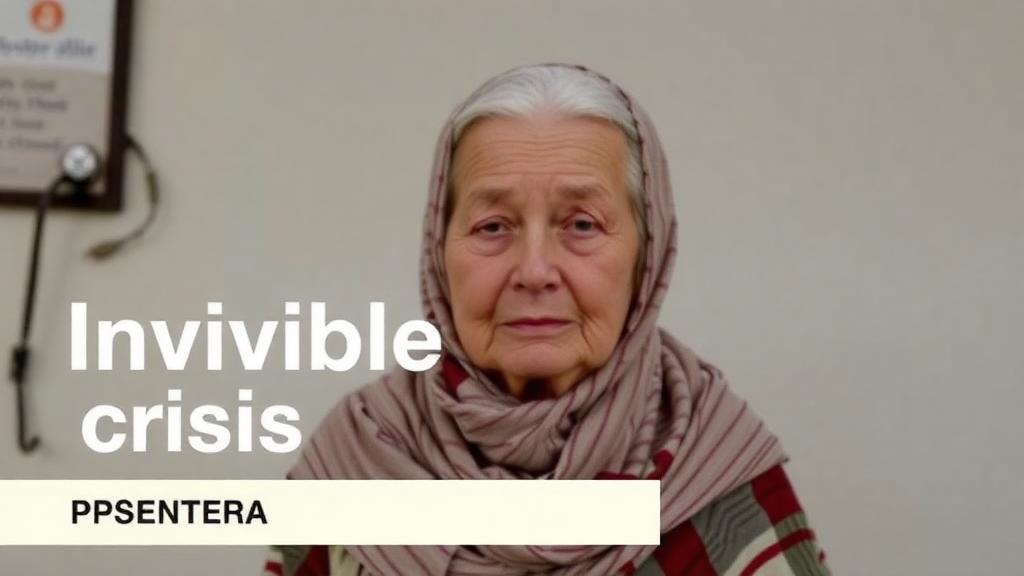
When disasters strike or conflict erupts, the world’s attention turns to the most visible victims: children, mothers, the injured. But a groundbreaking new study reveals a population so thoroughly erased from humanitarian response that one aid worker, arriving in Chad, was told flatly that there were no older women there at all—a claim that is, of course, objectively false, but which captures precisely how invisible this group has become. The research, published in PLOS Aging and Health by a team from the Johns Hopkins Center for Humanitarian Health and HelpAge International, offers the first systematic examination of how humanitarian systems fail older women at the intersection of ageism, sexism, and crisis-driven displacement.
The study comes at a moment when two global trends are colliding with devastating consequences. By 2030, one in six people worldwide will be over the age of 60, a proportion expected to double by 2050. At the same time, humanitarian crises driven by conflict, climate change, and disasters are increasing in both number and duration. The United Nations High Commissioner for Refugees has warned that the biological and social burdens of aging may emerge earlier in life among displaced populations, because chronic undernutrition, trauma, disease, and ageism accelerate physical decline. Yet despite this demographic reality, older people remain largely absent from the design and delivery of humanitarian programming, and older women are the most neglected of all.
To map this landscape of neglect, the research team conducted a global qualitative scoping study, interviewing 19 humanitarian practitioners drawn from 16 organizations working across Europe, the Middle East and North Africa, sub-Saharan Africa, Latin America and the Caribbean, and Asia. Half of the participating organizations operated at the local level and half internationally, spanning older persons’ organizations, disability-serving groups, and sexual and reproductive health and gender-based violence agencies. The researchers used purposive and snowball sampling, guided by a six-member advisory board of experts on older women and women with disabilities in emergencies, and followed COREQ standards for qualitative reporting. Transcripts were double-coded by two analysts, with discrepancies resolved through consensus, and interviews continued until thematic saturation was reached.
The findings paint a picture of layered, mutually reinforcing exclusion. Perhaps the most foundational problem is data: humanitarian needs assessments and monitoring systems routinely fail to disaggregate information by age, sex, and disability, and even when they do, the oldest age brackets are so thinly represented that the full picture cannot be seen. One practitioner described the situation bluntly, noting that data is often not disaggregated at all, and that even when it is, older age groups are not represented well enough to reveal what is actually happening. This statistical erasure has cascading consequences: if older women do not appear in assessments, they do not appear in budgets, program designs, or service delivery plans.
Displacement itself compounds the problem in ways that challenge standard humanitarian assumptions. Practitioners described how older women frequently remain behind during acute emergencies—a choice that is only nominally voluntary. Many feel like a burden and decline to relocate; others want to stay and protect their property, as observed extensively in Ukraine, where massive displacement over years of conflict has left large numbers of older men and women in active combat zones. The study found a striking absence of inclusive evacuation protocols and policies, meaning that those least able to flee are the most likely to be left alone without support, cut off from health services, clean water, adequate food, and safety.
Economic precarity emerged as another central theme, one that both drives and conceals abuse. Aid packages are rarely tailored to older women’s needs, and cash assistance programs often fail them in practice: mobility limitations may prevent travel to distribution points, while digitalized social protection systems create dependency on others to access benefits. That dependency opens the door to exploitation. Practitioners reported cases in which relatives collected money on behalf of older women and then withheld it—a form of financial abuse made possible by the very systems designed to deliver aid. Underlying these structural failures, practitioners identified a corrosive ageist perception that older women, especially those with disabilities, cannot contribute during displacement, leading to the systematic deprioritization of their needs.
The health and protection consequences are severe and, the study argues, deeply interconnected. Older women experience sexual violence, physical assault, denial of resources, and psychological abuse, yet are largely excluded from gender-based violence programming, which is designed primarily for women of reproductive age. Those who live alone are particularly vulnerable, and those who cannot flee are violated in place. Within homes, elder abuse and neglect by caregivers—often daughters-in-law—was reported across settings as diverse as Lebanon, Ukraine, and Indonesia, and remains underreported due to cultural sensitivity and the power families hold over the person being abused. On the health side, practitioners described missed cancer screenings, late-stage cancer diagnoses with no access to treatment or palliative care, elevated rates of HIV and sexually transmitted infections, and unmanaged incontinence, all compounded by weak referral systems and the stigma and shame that keep older women from reporting violence or seeking care.
The researchers frame these barriers through an ecological model, showing how exclusion operates at every level simultaneously. Structurally, the data gap renders older women invisible before any program can be designed. At the institutional and community levels, inaccessible services, mobility limitations, and evacuation failures constrain help-seeking. At the individual level, economic insecurity intensifies dependency on others, which simultaneously increases exposure to abuse and reduces autonomy to escape it. Assumptions that older women are asexual or no longer in need of sexual and reproductive health care silence conversations about menopause, pelvic floor disorders, and conflict-related sexual violence, embedding stigma within the very institutions meant to provide protection.
Crucially, the study does not portray older women solely as victims. Practitioners repeatedly emphasized the vital social roles older women play as caregivers, knowledge holders, and respected community figures. In some settings, an older woman helping a person with disabilities may face fewer questions and receive more community support than an external aid worker. Practitioners described using respected elders as allies to reach younger women and girls, to speak with male leaders, and to guide program design. Older people were identified as effective catalysts for spreading information, teaching skills, and driving income generation—approaches that build sustainable purpose rather than dependency. The study suggests that mixed-age programming, rather than singling out older women, may be particularly promising, and that older women should be included in project leadership, not merely consulted in focus groups.
The authors call for a fundamental reorientation of humanitarian practice: institutionalizing age- and sex-disaggregated data systems with the training and analytic capacity to capture nuanced age bands; designing universally accessible sexual and reproductive health and gender-based violence programs; conducting participatory research directly with older women rather than only about them; and partnering with local older persons’ organizations on community-based and intergenerational programming. They also raise an uncomfortable ethical question about how donor-defined metrics of success may lead age-targeted services to be judged unworthy of investment, and argue that humanitarian protection principles—non-discrimination and accessibility for all—demand renewed commitment. As the world ages and crises multiply, the study makes clear that a humanitarian system that cannot see older women cannot claim to be equitable, effective, or ethical.
Subject of Research: Health and protection needs of older women in humanitarian settings
Article Title: Overlooked health and protection needs of older women in humanitarian settings: A qualitative study of practitioners
Article References: Falb, K. L., Stevenson, M., Hiscock, D., & Lasater, M. (2026). Overlooked health and protection needs of older women in humanitarian settings: A qualitative study of practitioners. PLOS Aging and Health, 1(3), e0000044. https://doi.org/10.1371/journal.page.0000044
Image Credits: AI Generated
DOI: 10.1371/journal.page.0000044
Keywords: older women, humanitarian crises, gender-based violence, sexual and reproductive health, ageism, displacement, elder abuse, humanitarian data, economic precarity, qualitative research, aging population, incontinence
Cite Scienmag News
Ophelia Keating. (October 8, 2026). Invisible in Crisis: Older Women’s Health and Safety Needs Overlooked in Humanitarian Emergencies. Scienmag. https://scienmag.com/invisible-in-crisis-older-womens-health-and-safety-needs-overlooked-in-humanitarian-emergencies/
Ophelia Keating. "Invisible in Crisis: Older Women’s Health and Safety Needs Overlooked in Humanitarian Emergencies." Scienmag, 8 October 2026, https://scienmag.com/invisible-in-crisis-older-womens-health-and-safety-needs-overlooked-in-humanitarian-emergencies/. Accessed 8 October 2026.
Ophelia Keating. "Invisible in Crisis: Older Women’s Health and Safety Needs Overlooked in Humanitarian Emergencies." Scienmag. October 8, 2026. https://scienmag.com/invisible-in-crisis-older-womens-health-and-safety-needs-overlooked-in-humanitarian-emergencies/


