


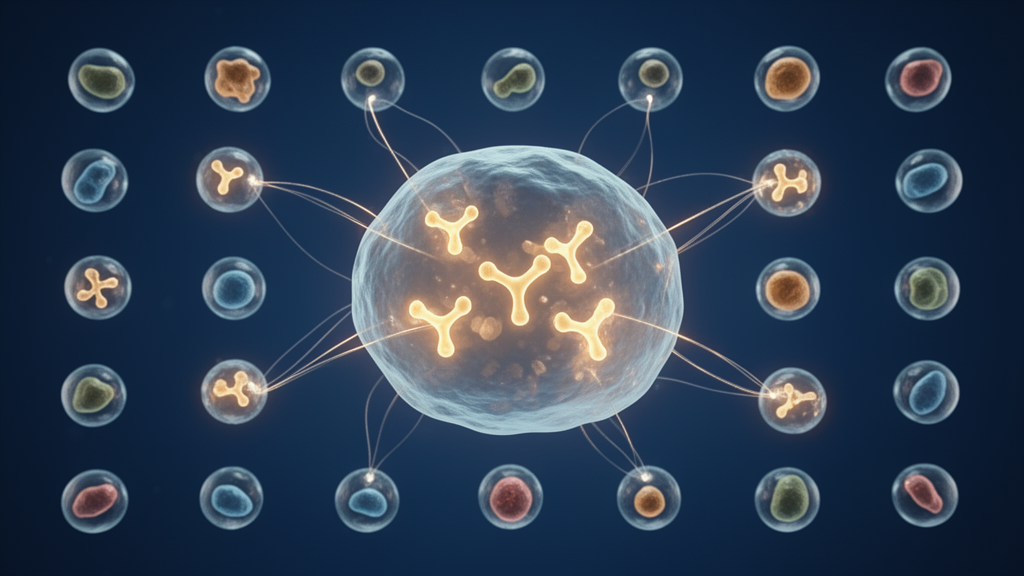
Every second, inside every human cell, thousands of protein kinases are switching one another on and off by attaching phosphate groups to their substrates. This ceaseless molecular choreography, known as protein phosphorylation, governs how cells grow, divide, respond to hormones and stress, and, when it goes wrong, how they turn cancerous. Yet despite decades of study, scientists have never had a single, unified, deeply resolved picture of which phosphorylation events are actually detectable across diverse human cell types. A new study led by Claire Koenig and Jesper V. Olsen at the Novo Nordisk Foundation Center for Protein Research in Copenhagen, published in Nature Structural & Molecular Biology, changes that. The team has assembled a phosphoproteome atlas spanning 33 human cell lines and capturing more than 200,000 distinct phosphorylation sites, a resource they describe as both a reference library and a discovery engine for cell signaling research and precision oncology.
The scale of the undertaking is considerable. The researchers assembled a panel of cell lines representing the major organs, tissues and cancers of the body: epithelial, mesenchymal, endothelial and fibroblast morphologies; cancerous and noncancerous phenotypes; primary and immortalized cells; suspension and adherent cultures; and even embryonal cells and induced pluripotent stem cells to capture early developmental signaling. Each line was profiled under two conditions, serum-starved and serum-stimulated, to sweep in both basal and dynamically regulated phosphorylation events. To boost coverage of the notoriously elusive phosphotyrosine sites, the team also treated colorectal cancer DLD-1 cells with pervanadate, a broad-spectrum inhibitor of tyrosine phosphatases that traps tyrosine phosphorylation at detectable levels. The result is a deliberately broad sampling of the signaling states a human cell can occupy.
Technically, the atlas was built on state-of-the-art mass spectrometry. Both unenriched peptide mixtures, representing each cell’s proteome, and phosphopeptide-enriched samples were analyzed on an Evosep One liquid chromatography system coupled to an Orbitrap Astral mass spectrometer operated in narrow-window data-independent acquisition, or nDIA, mode. Using a 30-samples-per-day gradient with a 200-hertz acquisition method, the team quantified an average of 9,681 protein groups per file. Collectively, the proteome library comprises 543,301 peptide precursors mapping to 16,454 protein groups, roughly 80 percent of the canonical human proteome, with a median protein sequence coverage of 50 percent. Crucially, more than 90 percent of protein kinases, phosphatases, transcription factors, oncogenes and tumor suppressors were identified, and nearly the entire human kinome, around 500 kinases, was covered without detectable bias across kinase families.
The phosphoproteome side of the atlas is even more striking. From the enriched samples, the researchers identified a mean of 30,446 class I phosphosites per file, and the combined phosphopeptide spectral library contains over 500,000 phosphopeptide precursors spanning 225,832 distinct phosphorylation sites. Almost two-thirds of these sites were assigned a localization probability of 0.99 or higher, meaning the exact position of the phosphate on the protein sequence could be pinned down with high confidence. The detected sites comprised 66 percent phosphoserine, 25 percent phosphothreonine and 9 percent phosphotyrosine, the latter proportion inflated by the pervanadate-treated cells; within individual cell lines, tyrosine phosphorylation settled back to the expected few percent. Benchmarking against public databases showed that over 60 percent of the detected sites overlapped with mass-spectrometry-derived resources such as PhosphoSitePlus, and that many sites previously catalogued without direct MS evidence could now be reproduced in a single unified experiment.
One of the most consequential outputs is the empirical spectral library itself, and the team put it through a rigorous stress test. They profiled a heterogeneous pool of differentiating stem cells, deliberately absent from the atlas, across four chromatographic gradients, and searched the data both with the empirical library and with library-free approaches in two widely used software packages, Spectronaut and DIA-NN. The library-based searches increased phosphoproteome depth under every condition tested, delivering a 60 percent gain in quantified phosphosites under high-flow conditions and 40 percent under low-flow conditions in Spectronaut when completeness filtering was applied. The gains came primarily through better-localized sites: library-based searches at a stringent localization cutoff of 0.98 matched the site counts of library-free searches at a much looser 0.75, indicating that high-quality reference spectra resolve the single biggest weakness of library-free phosphoproteomics, confident site localization.
The computational savings were equally dramatic. In DIA-NN, replacing a theoretical in silico phosphopeptide library of nearly 47 million precursors with the empirical library of roughly 540,000 slashed processing time for six files from 9 hours and 55 minutes to just 22 minutes, an average 30-fold speedup across gradients. For a field increasingly drowning in data from automated sample preparation and ultrafast instruments, that difference could reshape how large phosphoproteomics studies are designed. The library also proved its worth in low-input experiments: when the team analyzed EGF-stimulated HeLa cells with peptide inputs ranging from 1 to 20 micrograms, library-based searches yielded an average 18 percent increase in quantified phosphosites and, tellingly, more consistent detection of canonical EGFR activation sites such as the autophosphorylation site Y1110, which appeared in all stimulated replicates and none of the controls when the library was used.
Beyond cataloguing sites, the atlas ventures into one of the hardest quantitative questions in signaling biology: what fraction of a given protein is actually phosphorylated at a given moment, the so-called site stoichiometry. By pairing phosphoproteome measurements with matched proteome data under serum-stimulated and control conditions, the team calculated absolute occupancy for 19,378 phosphosites across 31 cell lines. Occupancies were generally low, below 20 percent, and rose upon serum stimulation. Motif analysis of the sites that gained phosphate revealed basophilic sequences characteristic of AGC-family kinases such as PKA, PKB and S6K, while dephosphorylated sites were enriched for proline-directed motifs targeted by MAPKs and CDKs, indicating phosphatase-mediated shutdown of those pathways. Three independent kinase inference algorithms agreed on the most serum-activated kinases, including ribosomal protein kinases, AKT and MAPK family members, while MARK kinases and cell-cycle CDKs emerged as the most strongly deactivated.
The stoichiometry data also delivered a sobering insight about tyrosine signaling: regulatory phosphotyrosine sites showed the lowest baseline occupancy despite displaying the largest fold changes upon stimulation. Only a small fraction of a tyrosine site needs to be phosphorylated to drive crucial downstream signaling, which explains why global profiling of tyrosine phosphorylation has historically required antibody-based enrichment. The atlas now provides baseline occupancy values for 182 known activation sites and 1,202 regulatory sites, a resource the authors say can help define the occupancy thresholds at which signaling events actually fire.
The culmination of the study is a new metric called the combined kinase activity score, or Cscore, designed to fix a persistent problem in the field: closely related kinases, especially tyrosine kinases, share so many substrates that existing inference tools frequently produce false positives. The team showed that three popular tools assigned EGFR activity to blood cancer cell lines that express no EGFR at all, and failed to flag the constitutively active FLT3 mutant in specific leukemia lines. The Cscore instead integrates five independent lines of evidence: kinase abundance at the proteome and phosphoproteome levels, substrate phosphorylation based on in vitro kinase-reaction relationships, sequence motif enrichment, and quantification of activation-loop sites on the kinase itself, with weights correcting for redundancy among components. Applied across the panel, it produced activity scores for 385 kinases in 31 cell lines and correctly scored directionality, assigning zero activity to EGFR and ERBB2 in suspension cells and high activity to ERBB2 in the BT-474 breast cancer line.
The translational payoff came when the researchers cross-referenced Cscore-predicted vulnerabilities with drug-sensitivity data from the Genomics of Drug Sensitivity in Cancer project. Of 210 kinase-cell line associations identified, several matched known dependencies: the neuroblastoma line NB1 with high ALK activity was sensitive to ALK inhibitors, FLT3-active MOLM-13 and MV-4-11 cells responded to FLT3 inhibitors, and BT-474 cells were sensitive to the ERBB-family inhibitors afatinib and CI-1033. Some predictions, such as NTRK1 activity in OCI-M1 cells, did not validate, a reminder that drug off-target effects and incomplete inhibitor specificity profiles complicate such comparisons. Yet DepMap genetic dependency data independently confirmed vulnerabilities including ALK in NB1, FLT3 in the leukemia lines, ERBB2 in BT-474 and SYK in SU-DHL-4. The authors also flag unvalidated but tantalizing targets, such as the ephrin kinases EPHA3 and EPHA4 in pancreatic cancer cells and ERN1 in HepG2 liver cancer cells. With the full dataset, spectral libraries, stoichiometry tables and Cscore scores deposited in public repositories and browsable through a web interface, the atlas is positioned to become a community standard, one that could turn the noisy landscape of cellular phosphorylation into a navigable map for drug discovery.
Subject of Research: A mass spectrometry-based phosphoproteome atlas of human cell lines mapping kinase activity and signaling vulnerabilities
Article Title: A phosphoproteome atlas of human cell lines reveals the landscape of kinase activity
Article References: Koenig, C., Cho, H., Emdal, K. B., Piga, I., Sabatier, P., Lozano-Juárez, S., Martinez-Val, A., & Olsen, J. V. (2026). A phosphoproteome atlas of human cell lines reveals the landscape of kinase activity. Nature Structural & Molecular Biology. https://doi.org/10.1038/s41594-026-01877-6
Image Credits: AI Generated
DOI: 10.1038/s41594-026-01877-6
Keywords: phosphoproteomics, kinase activity, mass spectrometry, cell signaling, cancer, spectral library, DIA, phosphorylation, precision oncology, proteomics, drug sensitivity, cell lines
Cite Scienmag News
Nathaniel Bowman. (October 8, 2026). Massive phosphoproteome atlas maps kinase activity across 33 human cell lines. Scienmag. https://scienmag.com/massive-phosphoproteome-atlas-maps-kinase-activity-across-33-human-cell-lines/
Nathaniel Bowman. "Massive phosphoproteome atlas maps kinase activity across 33 human cell lines." Scienmag, 8 October 2026, https://scienmag.com/massive-phosphoproteome-atlas-maps-kinase-activity-across-33-human-cell-lines/. Accessed 8 October 2026.
Nathaniel Bowman. "Massive phosphoproteome atlas maps kinase activity across 33 human cell lines." Scienmag. October 8, 2026. https://scienmag.com/massive-phosphoproteome-atlas-maps-kinase-activity-across-33-human-cell-lines/


