


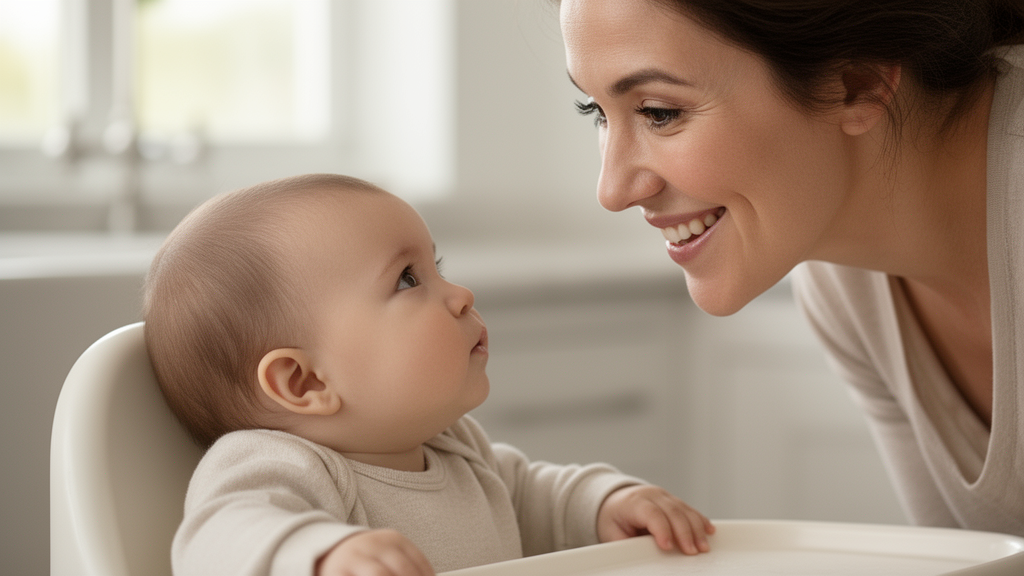
For decades, textbooks and parenting guides have assumed that infants learn to read emotions by seeing clear, stereotyped facial expressions: a broad smile for happiness, a scowl for anger, a grimace for fear. A new study challenges that assumption at its foundation. By systematically analyzing hours of real-world video recordings of babies interacting with their caregivers and family members, researchers found that the hypothesized expressive prototypes for emotion categories are extraordinarily rare in the visual diet of infants between 6 and 17 months of age. The work, published in Communications Psychology, suggests that the everyday environment provides babies with almost no clean examples of the facial configurations that classic theories treat as the building blocks of emotional understanding.
The research team, led by Katie Hoemann of the University of Kansas and including Jeffrey Girard, Marissa Ogren, Lauren Leotti, Lisa Feldman Barrett, Lisa Oakes, and Vanessa LoBue, took advantage of an existing longitudinal corpus of home videos known as the SEEDLingS data set, shared by Elika Bergelson’s research group. Rather than staging laboratory interactions, the study examined naturalistic footage of infants going about ordinary life with the people closest to them. This ecological approach matters because laboratory studies of emotion perception often present infants with posed, prototypical faces, yet those faces may bear little resemblance to what babies actually encounter in daily life.
The technical core of the study involved coding the facial behavior visible in the recordings using facial movement analysis, a method that quantifies the visible contractions of facial muscles rather than relying on subjective labels of what an expression means. The team asked two distinct questions: how much of the face were infants actually exposed to, and how often did the visible configurations match the hypothesized prototypes for emotion categories such as happiness, anger, sadness, and fear. This dual approach allowed the researchers to characterize both the quantity and the emotional quality of infants’ facial input.
The first major finding concerned visibility. Infants were exposed to far more partial faces than full faces across the entire age range studied. In the flow of everyday interaction, caregivers turn away, lean in close, move out of frame, or orient their faces at oblique angles, meaning that a baby’s view of another person’s face is typically fragmentary rather than complete. Exposure to full faces, while low overall, did increase across the observed time periods, hinting that infants’ visual access to complete facial configurations gradually improves as they and their caregivers develop more structured patterns of face-to-face engagement.
The second finding was more striking. Facial configurations hypothesized to serve as expressive prototypes for emotion categories were extremely rare in the input. When babies did glimpse a full face, it almost never displayed the canonical smile, scowl, or grimace that emotion recognition tasks assume they should be learning. This scarcity strikes at a central assumption of classical theories of emotional development, which posit that infants acquire emotional meanings by repeatedly pairing specific facial configurations with specific internal states. If the configurations themselves are seldom visible, that learning mechanism cannot operate as traditionally imagined.
Equally revealing was what happened on the rare occasions when hypothesized prototypes did appear. They often occurred in unexpected contexts, suggesting that the expressions did not necessarily function as cues to their presumed emotional meanings. A smile might accompany frustration rather than joy; a furrowed brow might signal concentration rather than anger. This contextual mismatch reinforces a growing body of evidence that emotions are expressed heterogeneously in daily life, and that the same facial movement can serve many different functions depending on the situation, the person, and the ongoing activity.
Descriptive analyses of the facial movement data added a quantitative layer to the story. Infants’ facial input was dominated by a small number of mostly simple facial configurations, and these frequent configurations did not correspond fully or uniquely to the hypothesized category prototypes. In other words, the statistical structure of the visual environment does not carve itself neatly along the lines of happiness, sadness, anger, and fear. Instead, babies see a recurring set of modest facial movements, many of them partial and many of them ambiguous with respect to any single emotional category.
The implications ripple outward across developmental science. If infants must learn much more than one-to-one mappings between facial configurations and context or behavior in order to acquire expressive vocabularies for emotion, then the learning problem they face is far more complex than previously assumed. Rather than memorizing a small dictionary of expression-to-meaning pairs, babies may need to track how facial movements unfold dynamically, how they combine with voices, gestures, and physical settings, and how particular individuals in their environment use faces in idiosyncratic ways. Emotion understanding, on this view, is constructed from rich, variable, and context-dependent evidence rather than absorbed from a fixed set of signals.
The study also carries methodological weight for the field. Decades of infant emotion perception research have relied on posed, prototypical stimuli precisely because they are easy to control and categorize. The new findings raise the question of whether performance in such tasks reflects learning about real emotional communication or merely sensitivity to artificial faces that infants rarely, if ever, see outside the laboratory. Naturalistic corpora like the one used here, combined with automated facial movement coding, offer a path toward reconciling laboratory findings with the realities of the developing child’s environment.
For parents, the takeaway is quietly reassuring rather than alarming. Babies appear to thrive without being fed a steady diet of textbook expressions, and the messy, partial, and context-bound faces of everyday life seem to be exactly the input from which human emotional understanding is built. The research, funded in part by the National Science Foundation and the Eunice Kennedy Shriver National Institute of Child Health and Human Development, marks a significant step toward grounding theories of emotional development in the world as infants actually experience it, one fleeting and fragmentary glimpse of a caregiver’s face at a time.
Subject of Research: Naturalistic analysis of infants' everyday exposure to facial expressions of emotion from 6 to 17 months
Article Title: Infants’ facial input from 6 to 17 months rarely includes hypothesized expressive emotion prototypes
Article References: Hoemann, K., Girard, J. M., Ogren, M., Leotti, L., Barrett, L. F., Oakes, L. M., & LoBue, V. (2026). Infants’ facial input from 6 to 17 months rarely includes hypothesized expressive emotion prototypes. Communications Psychology. https://doi.org/10.1038/s44271-026-00539-z
Image Credits: AI Generated
DOI: 10.1038/s44271-026-00539-z
Keywords: infant development, emotion perception, facial expressions, facial action coding, longitudinal study, naturalistic observation, caregiver interaction, Communications Psychology, emotional development, SEEDLingS corpus, developmental psychology, social cognition
Cite Scienmag News
Glenn Wilkins. (October 8, 2026). Babies Almost Never See Classic Emotional Expressions on Real Faces, Study Finds. Scienmag. https://scienmag.com/babies-almost-never-see-classic-emotional-expressions-on-real-faces-study-finds/
Glenn Wilkins. "Babies Almost Never See Classic Emotional Expressions on Real Faces, Study Finds." Scienmag, 8 October 2026, https://scienmag.com/babies-almost-never-see-classic-emotional-expressions-on-real-faces-study-finds/. Accessed 8 October 2026.
Glenn Wilkins. "Babies Almost Never See Classic Emotional Expressions on Real Faces, Study Finds." Scienmag. October 8, 2026. https://scienmag.com/babies-almost-never-see-classic-emotional-expressions-on-real-faces-study-finds/


