


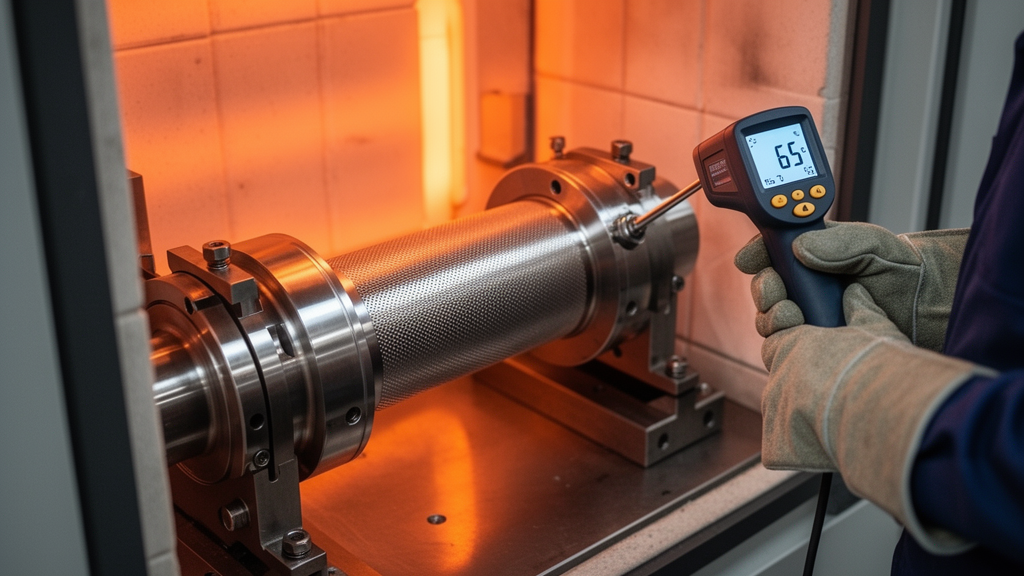
Gear shafts in ships, industrial gearboxes, and heavy machinery live hard lives. They transmit enormous torques, endure millions of load cycles, and, crucially, they get warm. Every meshing tooth and spinning bearing generates frictional heat, and over hours of continuous operation the surface of a steel shaft can sit at temperatures well above ambient. For engineers who strengthen these components by hammering their surfaces with ultrasonic pulses, that warmth has long been a quiet worry: heat is the natural enemy of the compressive stresses that make the treatment worthwhile. A new study from researchers at Xiamen University of Technology and Huaqiao University in China now offers the most detailed answer yet to a deceptively simple question — what happens to those protective stresses when the metal warms up in service?
The technique in question, ultrasonic impact treatment (UIT), belongs to a family of surface engineering methods that work by plastic deformation rather than by adding material. In UIT, a piezoelectric or magnetostrictive transducer drives a small impact pin against the component surface thousands of times per second. Each strike locally exceeds the yield strength of the steel, squashing the outermost grains and leaving behind a layer of residual compressive stress. That compressed layer is a powerful ally against fatigue: it must be overcome by any tensile stress before cracks can open and propagate, so a shaft treated this way can survive far more load cycles than an untreated one. The same hammering also work-hardens the surface and smooths away machining marks, compounding the benefit.
The catch is thermodynamics. Residual stresses are, by definition, locked into the material without any external load holding them in place, and elevated temperature gives the metal a route to let them go. Atoms become more mobile, dislocations climb and annihilate, and localized creep allows the strained lattice to relax toward a lower-energy state. Engineers call this stress relaxation, and it has been documented in shot-peened and cold-rolled components operating in warm environments. If UIT-induced stresses relax too quickly, the fatigue life advantage could quietly evaporate mid-service — a failure mode that would be invisible until a shaft cracked. Quantifying that risk for realistic service temperatures has, until now, been largely unaddressed.
Xinbo Zhang, Zongrong Sun, and Xigui Wang tackled the problem with a two-pronged strategy combining physical experiments with finite element simulation. Their subject was a gear shaft machined from 30CrMoA, a chromium-molybdenum alloy steel widely used in transmission components where strength and toughness must coexist. After applying ultrasonic impact treatment to the shaft, the team characterized the resulting surface layer in detail: they measured residual stresses as a function of depth, mapped microhardness profiles, recorded surface roughness, and examined the deformed microstructure. They then held treated samples at 65 degrees Celsius — a realistic in-service temperature for warm-running gearboxes — and tracked how the stress field evolved over time.
The baseline results confirm just how dramatic UIT’s effect can be. The treatment drove the surface into compression at roughly −321 megapascals, and the compressive field did not stop at the surface: it extended about 1.25 millimeters into the material, peaking at approximately −724 MPa at depth before gradually decaying toward the neutral bulk. In parallel, the surface microhardness jumped from 231 HV to 318 HV, with the hardened layer reaching a depth of about 1.14 millimeters. Surface roughness, a critical parameter because machining grooves act as fatigue crack initiation sites, fell from a Ra value of 0.8 micrometers to just 0.18 micrometers — a better than fourfold smoothing of the surface.
Then came the heat test. During thermal exposure at 65 degrees Celsius, the surface compressive stress relaxed in a distinctive two-stage pattern: a rapid initial drop followed by a progressively slower decay, with the stress field essentially stabilizing after eight hours of holding time. The total relaxation amounted to approximately 23.94 percent of the original surface stress. That figure deserves careful reading. A quarter of the compressive stress is a meaningful loss, and the study does not pretend otherwise. But the relaxation is bounded and self-limiting — it decelerates and plateaus rather than continuing indefinitely — which means engineers can, in principle, predict and account for the final stabilized stress state at design time.
More striking still is what did not change. While the stresses were easing, the work-hardening effect remained essentially intact: surface microhardness, hardened layer depth, and the deformed microstructure showed no significant degradation after the thermal exposure. This decoupling — stress relaxing while hardening persists — is the study’s central novelty. Previous UIT research has focused overwhelmingly on room-temperature strengthening, leaving the in-service thermal behavior unexplored. The finding implies that even after partial stress relaxation, the treated surface retains its strengthened microstructure and much of its compressive protection, so the fatigue benefit is diminished but far from destroyed.
The computational half of the study is what turns these observations into an engineering tool. The team built a finite element model of the treated shaft and simulated the coupled mechanical and thermal evolution of the residual stress field, using a Lagrangian formulation in which the coordinate system is attached to the deformable material and the motion of individual material points is tracked through time — a framework the authors refined during peer review to align with standard continuum mechanics terminology. When the simulated stress evolution was compared against the experimental measurements at 65 degrees Celsius, the agreement was excellent, validating the model’s ability to predict how residual stresses evolve under thermal loading without requiring a physical test for every new geometry or temperature.
That predictive capability matters because gear shafts come in many sizes, alloys, and operating conditions, and testing each combination experimentally is slow and expensive. A validated numerical model lets designers simulate the treatment and the subsequent thermal history together, obtaining the stabilized residual stress profile before a component is ever manufactured. For marine transmissions, wind turbine gearboxes, and industrial drives that run warm for months at a time, this provides a quantitative basis for specifying UIT with confidence that the strengthening will survive the service environment — something the field has lacked until now.
The broader lesson of the study is a reminder that surface treatments are not static properties but evolving states of the material. A compressive stress stamped into steel by ultrasonic impacts is a metastable condition, and service temperature is one of the forces that can erode it. By measuring exactly how fast and how far that erosion proceeds at a realistic operating temperature — and by showing that the hardened microstructure stands firm while the stresses settle — Zhang, Sun, and Wang have converted an open question into a design parameter. For the gear shafts quietly spinning inside ships and machines around the world, the ultrasonically hammered surface now has a documented warranty against the heat.
Subject of Research: Thermal stability of ultrasonic impact treatment-induced residual stresses in 30CrMoA gear shafts studied by finite element simulation and experiment
Article Title: Thermal stability of surface residual stresses in gear shaft subjected to ultrasonic impact treatment: A finite element simulation study
Article References: Thermal stability of surface residual stresses in gear shaft subjected to ultrasonic impact treatment: A finite element simulation study. (n.d.). https://doi.org/10.5194/ms-2026-176
Image Credits: AI Generated
DOI: 10.5194/ms-2026-176
Keywords: ultrasonic impact treatment, residual stress, gear shaft, 30CrMoA steel, finite element simulation, stress relaxation, work hardening, surface roughness, microhardness, thermal exposure, fatigue life, surface engineering
Cite Scienmag News
Denise Maddox. (October 8, 2026). Ultrasonic Impact Treatment Survives the Heat: Gear Shaft Stresses Hold Firm at 65 °C. Scienmag. https://scienmag.com/ultrasonic-impact-treatment-survives-the-heat-gear-shaft-stresses-hold-firm-at-65-c/
Denise Maddox. "Ultrasonic Impact Treatment Survives the Heat: Gear Shaft Stresses Hold Firm at 65 °C." Scienmag, 8 October 2026, https://scienmag.com/ultrasonic-impact-treatment-survives-the-heat-gear-shaft-stresses-hold-firm-at-65-c/. Accessed 8 October 2026.
Denise Maddox. "Ultrasonic Impact Treatment Survives the Heat: Gear Shaft Stresses Hold Firm at 65 °C." Scienmag. October 8, 2026. https://scienmag.com/ultrasonic-impact-treatment-survives-the-heat-gear-shaft-stresses-hold-firm-at-65-c/


