


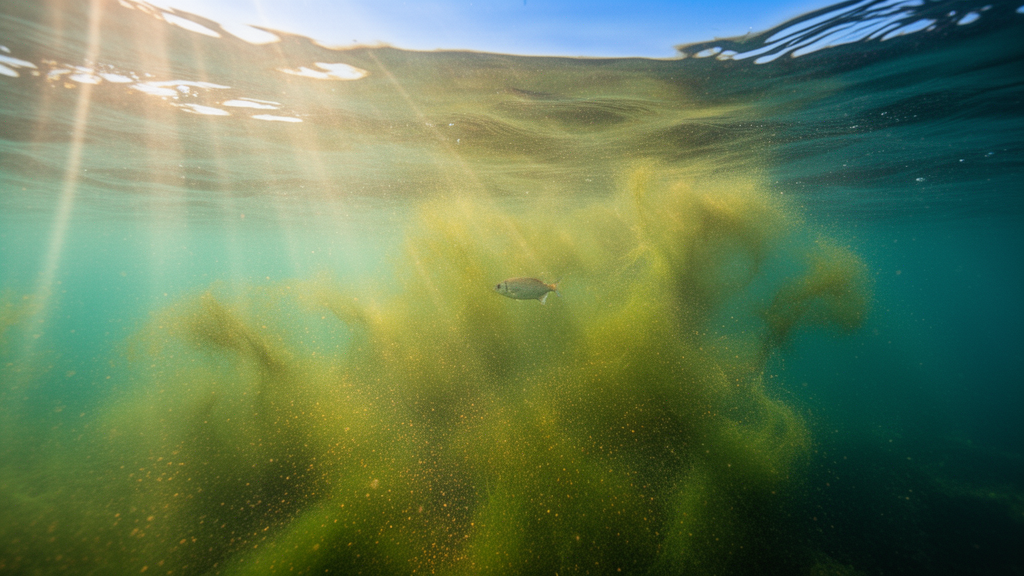
When a brutal marine heatwave swept across a temperate shelf sea in June 2023, scientists were watching with an autonomous underwater glider that could see what satellites could not. What they found was startling: while the surface of the sea told a brief and dramatic story of blooming algae, the real action was unfolding dozens of meters below, where chlorophyll concentrations climbed to extraordinary levels and stayed there. The discovery, published in Communications Earth & Environment, reveals that our satellite-based view of how ocean life responds to climate extremes may be missing half the picture, and the half we are missing could be the more consequential one.
Marine heatwaves, defined as periods when sea temperatures exceed a seasonally variable threshold for at least five consecutive days, have been growing in both frequency and intensity around the world as the climate warms. The most severe events, categorized on a scale that runs from I to IV, represent temperature extremes so far outside the historical norm that they have virtually no precedent in the local record. The June 2023 event studied by the team reached Category IV status, the most extreme classification, making it a natural laboratory for understanding what happens to the base of the marine food web when the ocean overheats.
The setting was a seasonally stratified shelf sea, an environment common across the temperate latitudes where warming surface waters sit atop colder, denser deep water, separated by a sharp transition known as the thermocline. This layered structure fundamentally changes how nutrients, light, and plankton interact. In spring, strong mixing delivers nutrients to the sunlit surface, fueling the famous spring bloom. By early summer, stratification locks those nutrients away from the surface, and phytoplankton become concentrated in a subsurface chlorophyll maximum, a hidden layer of elevated algal biomass that thrives near the thermocline where light still penetrates and nutrients remain accessible. Satellite ocean color sensors, which measure the light scattered by chlorophyll at the very surface, are effectively blind to this layer.
The research team, led by Charlotte A. J. Williams of the National Oceanography Centre in Liverpool, deployed an autonomous ocean glider to profile the water column repeatedly through the heatwave. Gliders are torpedo-shaped robots that alter their buoyancy to dive and rise in sawtooth patterns, collecting high-resolution measurements of temperature, salinity, and chlorophyll fluorescence as they go. This vertical dimension of observation proved essential. Surface chlorophyll, the quantity that satellites would detect, rose rapidly from less than 1 milligram per cubic meter to more than 5 milligrams per cubic meter, briefly pushing concentrations beyond the climatological range defined by two standard deviations above and below the long-term mean by as much as 40 percent. Yet this dramatic surface excursion was short-lived, a fleeting pulse rather than a lasting shift.
The subsurface story was entirely different. Within the subsurface chlorophyll maximum, concentrations that would normally sit at typical post-bloom values of 1 to 2 milligrams per cubic meter climbed to more than 3 milligrams per cubic meter, and during episodic peaks they exceeded 9 milligrams per cubic meter, a several-fold intensification of the hidden algal layer. Unlike the surface spike, this subsurface enhancement persisted, sustaining elevated biomass over the course of the event. When integrated over the entire water column, the total chlorophyll inventory reached 140 milligrams per square meter, a depth-integrated measure that captures the full standing stock of phytoplankton and revealed that the heatwave had substantially increased the total amount of algal life the sea could support, not merely shuffled it around vertically.
Understanding why the heatwave produced these extremes requires grappling with the interplay of physical and biological processes. The authors found that the bottom mixed layer, the cold water hugging the seafloor, warmed at an accelerated rate during the event, and that horizontal temperature gradients across the region strengthened. These signals are consistent with a possible influence of horizontal transport processes, meaning that the heatwave may have been associated with lateral movement of water masses, potentially advecting warm water and possibly associated nutrient or biomass signatures into the region. Elevated surface irradiance, the greater light availability that can accompany the calm, clear conditions often linked to heatwave weather patterns, may also have contributed to the enhanced phytoplankton growth. The observations cannot definitively separate these mechanisms, but both point to a plausible explanation in which physical forcing during extreme warming amplifies biological productivity in ways that standard theory might not predict.
The implications ripple outward through the marine ecosystem. Phytoplankton are the foundation of nearly all marine food webs, converting sunlight and dissolved nutrients into the organic matter that sustains everything from copepods to fish to seabirds. A sustained, several-fold increase in subsurface chlorophyll during a heatwave means that the vertical distribution of food available to grazing zooplankton, fish larvae, and other organisms could shift substantially. In stratified seas, many animals forage at or near the thermocline precisely because that is where the food is. Altering the intensity and extent of the subsurface chlorophyll maximum could therefore restructure foraging behavior, growth rates, and ultimately the productivity of commercially important species. The research was conducted as part of the PELAgIO project within the Ecological Consequences of Offshore Wind programme, reflecting growing interest in how climate extremes and human infrastructure interact in shelf sea ecosystems.
There is also a sobering message here for how we monitor the ocean. Much of what we know about global phytoplankton trends comes from satellite ocean color imagery, which samples only the uppermost meters of the sea. If heatwave-driven changes concentrate in the subsurface, as this study shows they can, then satellite-based assessments would record a brief surface anomaly and miss the sustained ecological response below. The depth-integrated chlorophyll increase to 140 milligrams per square meter would be largely invisible to a satellite pass. Only platforms capable of repeated vertical profiling, such as gliders, Argo floats equipped with biological sensors, or dedicated shipboard sampling, can capture these subsurface dynamics. As marine heatwaves become more common, the case for investing in vertically resolved observing systems grows correspondingly stronger.
The findings also complicate our understanding of what marine heatwaves do to marine productivity. A common assumption holds that warm stratified waters should depress phytoplankton growth by tightening stratification and cutting off nutrient supply to the sunlit zone. The observations from this Category IV event run counter to that expectation in important ways, showing rapid surface enhancement and, more significantly, sustained subsurface intensification. The researchers suggest that horizontal transport processes, capable of moving water properties laterally across the shelf, may be part of the explanation, and they caution that the combined influence of enhanced irradiance and advective effects cannot be cleanly disentangled from the available data. This honesty about mechanism is itself valuable: it flags precisely which processes future studies, and future models, must resolve if we are to forecast how shelf sea ecosystems will fare under continued warming.
Shelf seas punch far above their weight in the global carbon cycle and in the fisheries that hundreds of millions of people depend upon, so understanding their response to climate extremes is far from an academic exercise. The 2023 heatwave observations demonstrate that the most dramatic ecological responses to ocean warming in these seas may occur out of sight, below the surface, sustained over timescales long enough to matter for the food web. As temperatures continue to climb and events of this severity grow more frequent, the hidden layers of the ocean are emerging as a critical frontier for climate science, and the gliders that probe them may prove to be among the most important instruments in the modern oceanographer’s toolkit. The study, published open access in Communications Earth & Environment, stands as a reminder that in a warming ocean, what we see at the surface is only the beginning of the story.
Subject of Research: Subsurface chlorophyll response of a seasonally stratified shelf sea to a Category IV marine heatwave observed by an autonomous ocean glider
Article Title: Chlorophyll extremes during a surface marine heatwave in a seasonally stratified shelf sea
Article References: Williams, C. A. J., Scott, B. E., Rippeth, T. P., Jacobs, Z. L., Wihsgott, J. U., Palmer, M. R., O’Hara Murray, R., & Hopkins, J. E. (2026). Chlorophyll extremes during a surface marine heatwave in a seasonally stratified shelf sea. Communications Earth & Environment. https://doi.org/10.1038/s43247-026-04118-2
Image Credits: AI Generated
DOI: 10.1038/s43247-026-04118-2
Keywords: marine heatwave, chlorophyll, phytoplankton, shelf sea, ocean glider, seasonal stratification, subsurface chlorophyll maximum, thermocline, ocean warming, satellite ocean color, marine ecosystem, Communications Earth & Environment
Cite Scienmag News
Violet Maxwell. (October 8, 2026). Hidden Algal Blooms Surge Beneath the Surface During Ocean Heatwaves. Scienmag. https://scienmag.com/hidden-algal-blooms-surge-beneath-the-surface-during-ocean-heatwaves/
Violet Maxwell. "Hidden Algal Blooms Surge Beneath the Surface During Ocean Heatwaves." Scienmag, 8 October 2026, https://scienmag.com/hidden-algal-blooms-surge-beneath-the-surface-during-ocean-heatwaves/. Accessed 8 October 2026.
Violet Maxwell. "Hidden Algal Blooms Surge Beneath the Surface During Ocean Heatwaves." Scienmag. October 8, 2026. https://scienmag.com/hidden-algal-blooms-surge-beneath-the-surface-during-ocean-heatwaves/


