


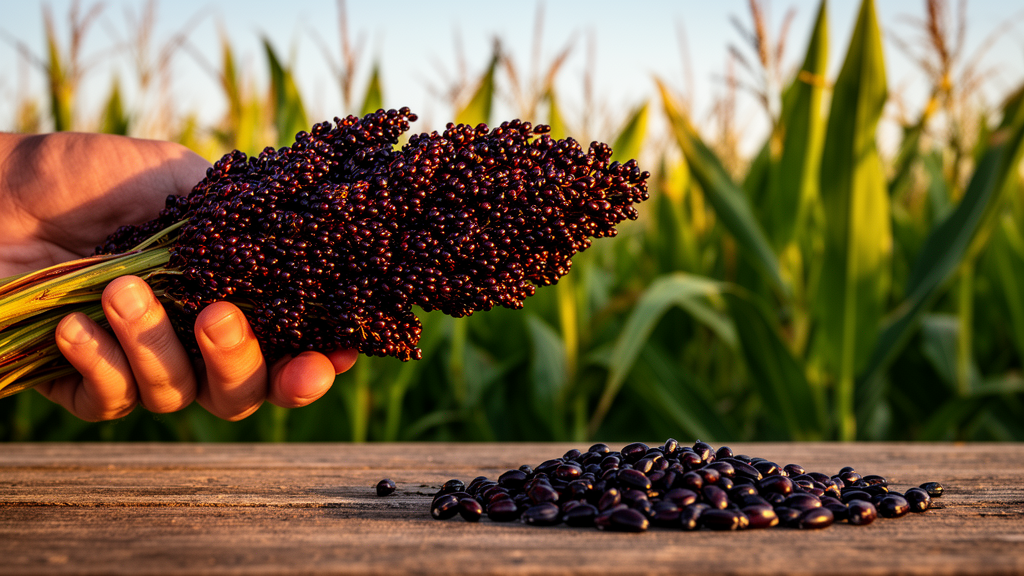
Deep in the grain belt of Texas, a rare line of sorghum called Tx3362 produces seeds with an almost obsidian-black outer layer, a trait found in almost no other cereal on Earth. Those dark pericarps are loaded with 3-deoxyanthocyanidins, or 3-DOAs, a family of flavonoid pigments with potent antioxidant activity that black sorghum alone delivers as a human food source. Now a team led by researchers at Texas A&M University, Cold Spring Harbor Laboratory, and the USDA Agricultural Research Service has assembled the first high-quality reference genome for this remarkable genotype, and used it to trace the genetic circuitry that switches on the black pigment trait. The work, published in BMC Genomics, offers plant breeders a molecular roadmap for a crop that could deliver natural food colorants and health-promoting compounds at scale.
Sorghum is no obscure laboratory curiosity. It is a staple C4 cereal grown across the world for food, animal feed, and biofuel, and it serves as a key model for functional genomics among the grasses. Yet despite decades of breeding, the genetic architecture behind the black pericarp phenotype remained stubbornly opaque. The reason was simple but consequential: no reference genome existed for a black sorghum genotype. Researchers had to rely on assemblies from red or white pericarp lines, which meant that genes unique to the black trait, or rearranged versions of them, could be invisible to standard analyses. Without a proper map, the complex network of structural genes and transcription factors governing 3-DOA biosynthesis in pericarp tissue could not be fully characterized.
To close that gap, the team generated a hybrid genome assembly of Tx3362, combining long-read and short-read sequencing technologies to resolve the repetitive and rearranged regions that trip up simpler approaches. The resulting assembly and annotation yielded 46,941 gene models, of which 5,217 were entirely absent from existing sorghum pan-genome references. That figure is striking: more than one in ten of the genes in this black sorghum line had simply never been catalogued, because the references used until now came from genotypes with different pericarp chemistry. Among those newly captured gene models are members of the flavonoid structural gene families that sit at the heart of the 3-DOA pathway.
Comparative genomics against two well-studied references, the red pericarp cultivar Wray and the standard laboratory line BTx623, revealed extensive structural variation across the Tx3362 genome. The researchers documented inversions, translocations, and duplications, along with lineage-specific expansions and contractions of flavonoid structural gene families. In other words, the black sorghum genome is not merely the standard sorghum genome with a few point mutations; it carries wholesale rearrangements and copy-number changes in exactly the gene families that build antioxidant pigments. This kind of structural variation is precisely what a single reference genome hides, and it underscores why pan-genome resources that capture multiple genotypes are transforming crop genetics.
With the new reference in hand, the team turned to the question of when and how the 3-DOA pathway fires up during grain development. They performed weighted gene co-expression network analysis, or WGCNA, on RNA-sequencing data from pericarp tissue sampled across maturation, using Tx3362 itself as the mapping reference. That choice mattered: mapping reads to the correct genome allowed the network to include the Tx3362-specific gene models that would have been lost or misassigned against other references. The analysis refined a module of 292 genes whose expression is highly correlated with 3-DOA accumulation, a dramatic narrowing of the search space from tens of thousands of genes to a focused candidate list.
The next layer of the investigation addressed regulation. Flavonoid biosynthesis is controlled by transcription factors, the DNA-binding proteins that switch biosynthetic genes on and off. The team profiled nine sorghum transcription factors spanning the MYB, NAC, WRKY, bHLH, and C2H2 families using DAP-Seq, or DNA affinity purification sequencing, a technique that maps where each protein binds across the genome. The results showed coordinated regulation of 3-DOA pathway genes during black pericarp maturation, with a clear temporal program: activation begins early, between two and five days post-anthesis, and continues through late stages of grain development, ten to seventeen days after anthesis. Binding events were detected in the promoters of genes within the co-expression module, connecting the regulators directly to their targets and revealing interactions among the transcription factors themselves.
One of the most intriguing findings concerns the environmental trigger. Black sorghum does not accumulate 3-DOAs constitutively; the pigments appear in the pericarp in response to UV-B light, a tissue-specific and environmentally induced response that is vanishingly rare among cereals. When the researchers examined developing floral meristem tissues, the structures that give rise to the grain itself, they found early transcriptional correlations for the environmentally induced 3-DOA response. That suggests the developmental groundwork for the black pericarp trait is laid well before the grain matures, hinting that the capacity to respond to UV-B with massive pigment production is wired into the earliest stages of reproductive development in this lineage.
The biological significance of 3-DOAs extends beyond color. These compounds function as antioxidants, neutralizing reactive oxygen species, and black grain sorghum is currently the only food source of these particular molecules for human nutrition. They also serve as natural food colorants, an increasingly valuable commodity as food manufacturers seek alternatives to synthetic dyes. By identifying the structural genes, the transcription factors, and the regulatory network that drive 3-DOA accumulation, the study provides breeders with concrete molecular targets. Marker-assisted selection or gene editing could, in principle, transfer or enhance the black pericarp trait in elite sorghum backgrounds, or potentially tune the pathway to boost pigment yields without waiting for the right field conditions.
The Tx3362 reference genome also delivers a broader resource for sorghum biology. The newly annotated gene models, the comparative maps of structural variation against Wray and BTx623, and the co-expression and transcription-factor binding datasets together form a framework for exploring flavonoid metabolism, stress responses, and developmental pathways throughout the crop. Because flavonoids also participate in plant defense and environmental stress tolerance, the resource may illuminate traits far removed from grain color, including how sorghum copes with the intense solar radiation of its native growing environments.
What began as an effort to explain why one unusual sorghum line turns black in the sun has ended with a genome, a gene network, and a regulatory map for one of the cereal world’s rarest biochemical feats. The integration of genome assembly, co-expression analysis, and DNA-binding profiling demonstrates a template for dissecting complex traits in any crop where a single reference genome is not enough. For a grain that could color our foods naturally and protect human health with every serving, the black pericarp of Tx3362 has finally given up its genetic secrets, and breeders now hold the keys to the vault.
Subject of Research: Genome assembly and integrated omics analysis of 3-deoxyanthocyanidin biosynthesis genes in black pericarp sorghum
Article Title: Unlocking the black pericarp sorghum (Sorghum bicolor (L.) Moench) trait through genome assembly and integrated omics analysis of key genes in 3-deoxyanthocyanidin biosynthesis
Article References: Schumaker, B., Chougule, K., Lu, Z., Regulski, M., Rooney, W. L., Klein, R. R., Klein, P. E., & Gladman, N. (2026). Unlocking the black pericarp sorghum (Sorghum bicolor (L.) Moench) trait through genome assembly and integrated omics analysis of key genes in 3-deoxyanthocyanidin biosynthesis. BMC Genomics. https://doi.org/10.1186/s12864-026-13398-z
Image Credits: AI Generated
DOI: 10.1186/s12864-026-13398-z
Keywords: sorghum, Tx3362, genome assembly, 3-deoxyanthocyanidins, flavonoid biosynthesis, black pericarp, WGCNA, DAP-Seq, transcription factors, pan-genome, antioxidants, plant breeding
Cite Scienmag News
Juliet Wilcox. (October 8, 2026). Black Sorghum Genome Cracked: New Reference Reveals Secrets of Rare Antioxidant-Rich Grain. Scienmag. https://scienmag.com/black-sorghum-genome-cracked-new-reference-reveals-secrets-of-rare-antioxidant-rich-grain/
Juliet Wilcox. "Black Sorghum Genome Cracked: New Reference Reveals Secrets of Rare Antioxidant-Rich Grain." Scienmag, 8 October 2026, https://scienmag.com/black-sorghum-genome-cracked-new-reference-reveals-secrets-of-rare-antioxidant-rich-grain/. Accessed 8 October 2026.
Juliet Wilcox. "Black Sorghum Genome Cracked: New Reference Reveals Secrets of Rare Antioxidant-Rich Grain." Scienmag. October 8, 2026. https://scienmag.com/black-sorghum-genome-cracked-new-reference-reveals-secrets-of-rare-antioxidant-rich-grain/


