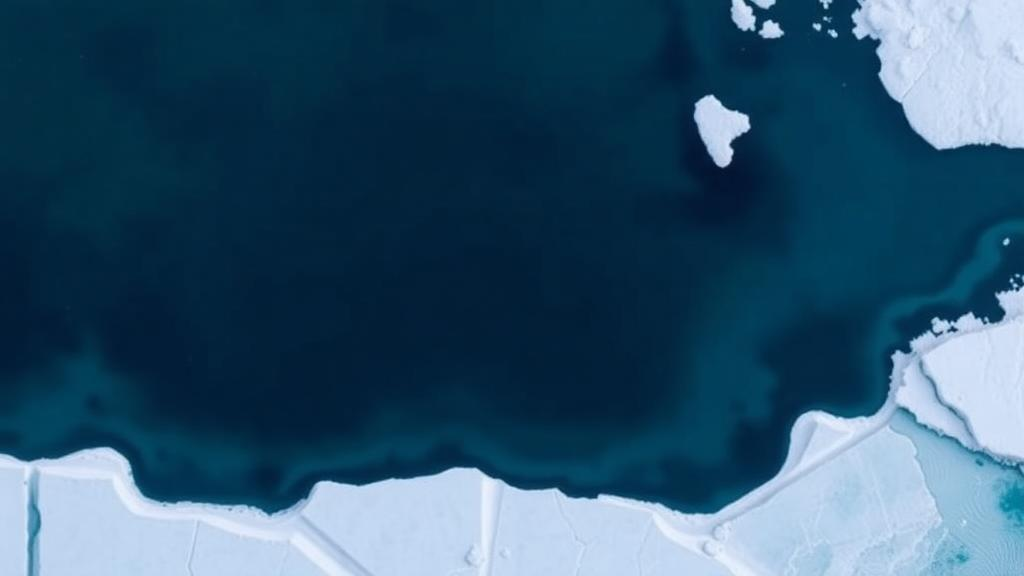
One of East Antarctica’s fastest-moving glaciers lost a chunk of its floating ice tongue in the autumn of 2017, and a new decade-long satellite analysis suggests the break-up coincided with unusually favorable conditions for calving: thin sea-ice cover, relatively warm sea surface temperatures, and a weakened atmospheric cooling signal. The study, published in the journal Ocean Dynamics, reconstructs the annual behavior of the Shirase Glacier from 2014 to 2024 and offers one of the most detailed year-by-year pictures yet of how oceanic and atmospheric variability shape the dynamics of a major East Antarctic outlet.
The research team, led by Dvija Dave of Gujarat University in collaboration with scientists at the Space Applications Centre of the Indian Space Research Organisation, focused on a glacier that has long fascinated glaciologists. Shirase Glacier drains a substantial portion of the East Antarctic Ice Sheet into Lützow-Holm Bay, and its floating ice tongue extends far out to sea, making it a natural laboratory for studying how ice, ocean, and atmosphere interact at the margin of a continent often considered more stable than its western counterpart. Previous work had already revealed that the glacier’s flow speed fluctuates noticeably from year to year, but the mechanisms driving those swings remained only partially understood.
To track the glacier’s motion, the team turned to a technique that has revolutionized cryospheric science: feature tracking of optical satellite imagery. Using data from the Landsat-8 satellite, the researchers processed pairs of images with an image cross-correlation approach, implemented with the ImGRAFT toolbox, a widely used open-source package for georectifying and tracking features in glacier imagery. The method works by identifying distinctive surface features, such as crevasses and flowlines, in one image and then searching for those same features in a later image. The displacement between the two positions, divided by the time elapsed between acquisitions, yields the surface ice velocity. This allowed the team to build annual velocity maps of the glacier and its tongue across the full decade.
The technique’s precision matters enormously for studies like this one, because small errors can masquerade as real changes in ice flow. The researchers quantified their uncertainty carefully, reporting velocity root-mean-square errors ranging from 3.72 to 21.80 meters per year, depending on the year and image quality. When they measured the area of ice lost during calving events, they estimated uncertainties of plus or minus 4.33 to 5.88 square kilometers, equivalent to roughly 0.80 to 0.88 percent of the measured areas. Such error bars are small enough that the major signals in the record stand out clearly against the noise.
Beyond velocity, the team computed the effective strain rate across the glacier, a measure of how rapidly the ice is deforming as it flows. Strain rates reveal where the ice is being stretched or compressed, and high strain near the glacier front often marks zones of mechanical weakness where calving is more likely. By analyzing annual surface ice velocity, effective strain rate, and ice detachment together, the researchers could connect the glacier’s internal dynamics to its frontal evolution over time, identifying periods of advance, stability, and abrupt loss.
The headline event of the decade came in the Southern Hemisphere autumn of 2017. Between April 29 and May 5 of that year, approximately 80 square kilometers of ice detached from the glacier front, a substantial calving event that reshaped the glacier’s floating tongue. The detachment followed a period of frontal advance between 2014 and 2016, during which the glacier tongue had pushed further out into the bay. That sequence, advance followed by abrupt retreat, is a classic calving cycle, but the timing of the 2017 break-up offered a clue about what might have tipped the ice over the edge.
To search for that clue, the researchers examined three environmental variables from the ERA-5 reanalysis dataset produced by the European Centre for Medium-Range Weather Forecasts: sea ice concentration, sea surface temperature, and the difference between skin temperature and near-surface air temperature. Sea ice acts as a mechanical buttress against glacier fronts, dampening waves and reducing the stress on the ice tongue, so low sea-ice concentration can leave a glacier front exposed and vulnerable. Sea surface temperature, meanwhile, influences the rate at which warm water can reach and melt the ice from below, a process that earlier research has shown to be remarkably intense beneath the Shirase Glacier tongue.
The temporal associations the team found were striking. Relatively low sea ice concentration in April and May 2017 coincided directly with the calving window, while comparatively high sea surface temperatures and the least negative skin-to-air temperature difference of the study period were also observed during those months. In other words, the glacier front lost its sea-ice buffer precisely when the ocean was warmest and the atmospheric temperature contrast was weakest. The pattern is suggestive: weakened buttressing combined with enhanced oceanic heat could have primed the front for detachment. The authors are careful, however, to note the limits of the inference. These temporal associations suggest that glacier flow and frontal evolution were related to calving and environmental variability, but they do not establish the individual causal contributions of sea ice, sea surface temperature, or atmospheric conditions. Correlation in time, even compelling correlation, is not proof of mechanism.
That caution is scientifically appropriate, and it situates the new study within a broader and sometimes contentious debate about East Antarctic stability. Earlier investigations documented strong ice-ocean interaction beneath the Shirase Glacier tongue, and other work attributed a slowdown of the glacier to strengthening alongshore winds, highlighting that atmospheric circulation can modulate the glacier’s speed independently of ocean temperature. The new decade-long record adds annual resolution to this picture, showing how the glacier’s velocity, strain, and frontal position evolve together through cycles of advance and detachment, and providing a benchmark against which future changes can be measured.
What makes the study broadly significant is its demonstration that even in East Antarctica, long portrayed as the quiet sibling of the rapidly changing Antarctic Peninsula and Amundsen Sea sector, outlet glaciers respond sensitively to their environment on short timescales. With roughly 80 square kilometers of ice vanishing in a single week, and with the environmental conditions preceding that loss now documented in detail, the Shirase Glacier offers a case study in how sea-ice loss, ocean warming, and atmospheric variability can converge on a single glacier front. Continued satellite monitoring, the authors suggest, will be essential to determine whether the associations they observed recur with future calving events, and whether the glacier’s decade of documented variability is a prelude to more sustained retreat.
Subject of Research: Oceanic and atmospheric influences on the annual ice dynamics and calving of Shirase Glacier, East Antarctica, from 2014 to 2024
Article Title: Impact of oceanic and atmospheric variability on the annual ice dynamics of the Shirase Glacier (2014–2024), East Antarctica
Article References: Impact of oceanic and atmospheric variability on the annual ice dynamics of the Shirase Glacier (2014–2024), East Antarctica. (n.d.). https://doi.org/10.1007/s10236-026-01864-x
Image Credits: AI Generated
DOI: 10.1007/s10236-026-01864-x
Keywords: Shirase Glacier, East Antarctica, calving, sea ice concentration, sea surface temperature, surface ice velocity, Landsat-8, feature tracking, ERA-5 reanalysis, effective strain rate, ice tongue, Lützow-Holm Bay
Cite Scienmag News
Violet Maxwell. (October 8, 2026). Shirase Glacier’s 2017 Calving Linked to Warm Ocean and Thin Sea Ice. Scienmag. https://scienmag.com/shirase-glaciers-2017-calving-linked-to-warm-ocean-and-thin-sea-ice/
Violet Maxwell. "Shirase Glacier’s 2017 Calving Linked to Warm Ocean and Thin Sea Ice." Scienmag, 8 October 2026, https://scienmag.com/shirase-glaciers-2017-calving-linked-to-warm-ocean-and-thin-sea-ice/. Accessed 8 October 2026.
Violet Maxwell. "Shirase Glacier’s 2017 Calving Linked to Warm Ocean and Thin Sea Ice." Scienmag. October 8, 2026. https://scienmag.com/shirase-glaciers-2017-calving-linked-to-warm-ocean-and-thin-sea-ice/