


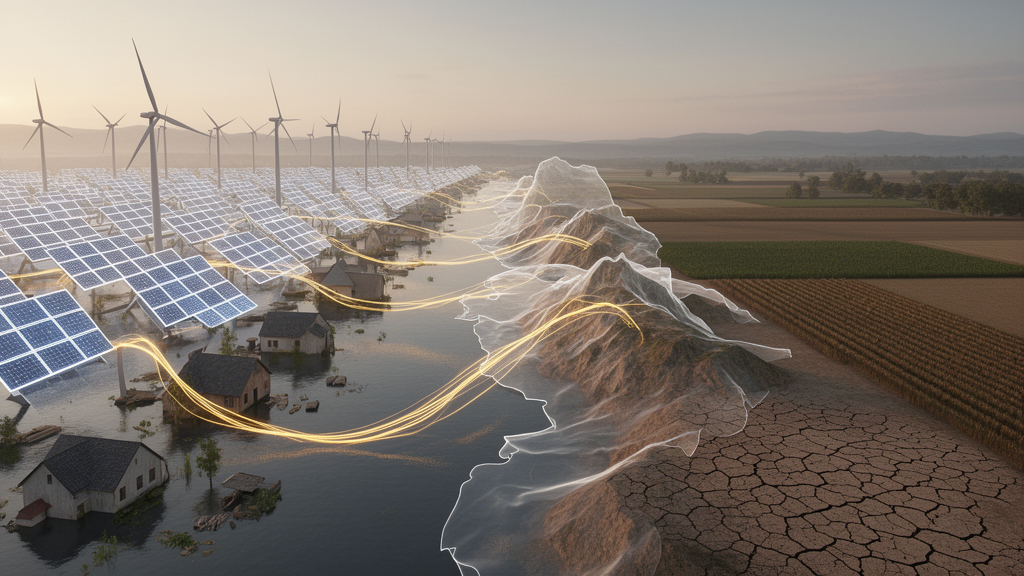
The world’s shift away from fossil fuels is often described as a purely technological challenge, a matter of installing enough solar panels, wind turbines, and batteries to replace coal, oil, and gas. But a new systematic review published in Discover Sustainability argues that this framing misses a crucial dimension of the problem: climate vulnerability. Anuj Agrawal, Pushp Kumar, and Rouni Sharma of Manipal University Jaipur conducted a comprehensive analysis of 76 peer-reviewed studies drawn from the Scopus database, using the PRISMA framework, the internationally recognized protocol for systematic reviews, combined with bibliometric methods that map how research themes connect and evolve. Their conclusion is striking. Although the literature on energy transition and the literature on climate vulnerability have each grown enormously over the past decade, the two fields remain largely separate, with only a small and fragmented body of work attempting to analyze how these systems interact and influence one another.
The stakes of this gap are far from academic. Energy transition is simultaneously a central component of the climate system and a key driver of economic development, which means that decisions about how societies decarbonize are inseparable from questions about who is exposed to climate hazards, how sensitive those populations are, and how capable they are of adapting. Yet the review found that when researchers try to measure environmental performance in the context of the energy transition, they overwhelmingly rely on a single indicator: carbon emission reduction. This narrow metric, while important, says little about the multidimensional nature of climate vulnerability, which climate scientists typically decompose into three components: exposure to climate hazards, sensitivity of human and economic systems to those hazards, and adaptive capacity, the resources and institutions available to cope with them.
The methodological rigor of the new study is what gives this critique its force. By applying the PRISMA framework, the authors screened and selected studies according to transparent, reproducible criteria, and their bibliometric analysis of the resulting 76 papers allowed them to identify the intellectual structure of the field rather than simply summarizing individual findings. The corpus spans work published between 2019 and 2026 and covers an unusually wide geographic and disciplinary range, from econometric assessments of the energy mix in G7 countries to grassroots climate resilience studies in the Ranbir Singh Pura region of Jammu and Kashmir, from central bank risk management in the United States and Europe to energy planning under climate pressure in Ecuador using LEAP modeling tools.
From this body of evidence, the review identifies four major thematic areas that dominate the existing literature. The largest proportion of studies focuses on policy, economic, and institutional dimensions of the energy transition and climate vulnerability relationship. This cluster includes research on how central banks manage climate and energy transition risks, how green finance influences energy transition decisions, and how climate policy uncertainty shapes corporate behavior and investment flows. A second cluster centers on climate risk and vulnerability itself, including studies of extreme weather impacts, nonlinear effects of climate risks on climate-sensitive sectors, and Delphi-based expert assessments of climate change risks in southern Africa. The third theme covers energy transition and environmental outcomes, while the fourth captures emerging research areas that do not yet fit neatly into the established categories.
One of the most provocative findings to emerge from the reviewed literature is the recognition that the renewable energy transition itself carries climate risks, a point emphasized in several Norwegian and Danish studies included in the corpus. Researchers at the Western Norway Research Institute and partner institutions have argued that overlooked climate risks are embedded in ongoing renewable energy transitions, and that the research agenda must be extended to capture them. Renewable infrastructure is not immune to the changing climate it is meant to mitigate: hydropower depends on precipitation patterns that are shifting, wind and solar installations face extreme weather exposure, and the critical mineral supply chains that underpin batteries and turbines are themselves vulnerable to climate disruption. A World Meteorological Organization initiative to build a Global Energy Resilience Atlas with climate risk indices for hydropower illustrates how seriously this concern is now being taken at the institutional level.
The financial dimension of the energy transition and climate vulnerability nexus has become a particularly active research frontier, especially since 2022. Several studies in the review examine how physical climate risks and transition risks drive volatility and dynamic correlations between fossil energy markets and clean energy stocks, and how climate risk factors affect the hedging properties of green and brown portfolios. Others investigate whether climate risk affects the carbon footprint of bank loans, how investors react to climate policies and decarbonization pathways, and how financial development moderates the relationship between climate vulnerability and renewable energy consumption. This surge of financially oriented research reflects a broader shift in which climate risk is increasingly priced into capital markets, but the review suggests that this focus has come at the expense of attention to the human dimensions of vulnerability.
Indeed, some of the most socially consequential work in the corpus concerns energy poverty, the condition in which households cannot access adequate, affordable, and reliable energy services. Studies of energy poverty in high-mountain rural areas of China document a high-carbon trap in which the poorest households remain locked into polluting fuels precisely because they lack the resources to transition. Comparative research on Hungary and Jordan reveals divergent national pathways through which climate change deepens energy poverty, while analyses of renewable and non-renewable energy aid in developing Asian countries examine whether international assistance actually reduces energy deprivation. A related strand of work explores how energy poverty and climate risk jointly threaten human development at global and regional scales, underscoring that the energy transition is not merely an environmental project but a distributional one with profound implications for equity.
The geographic patterns in the literature reveal their own form of bias. A substantial share of the 76 studies concentrates on China, with additional clusters in Europe, the United States, and parts of South Asia and Africa, while many climate-vulnerable regions remain understudied. The review also highlights that most analyses are conducted at the national level, leaving sub-national dynamics, where vulnerability often varies dramatically within countries, largely invisible. This is a significant limitation because exposure, sensitivity, and adaptive capacity are inherently local phenomena: a coastal fishing community, an inland farming district, and an urban industrial center within the same country can face radically different climate risks and possess very different capacities to respond. Without sub-national analysis, policymakers cannot target adaptation and transition resources where they are most needed.
The timing of the field’s evolution is itself revealing. The authors note that especially after 2022, some studies began to adopt multidimensional measures of climate vulnerability or climate risk, including composite indices that incorporate exposure, sensitivity, and adaptive capacity rather than relying on emissions alone. This shift coincides with the intensification of extreme weather events worldwide and with growing recognition that mitigation and adaptation cannot be treated as separate policy silos. Research on extreme events and climate adaptation-mitigation linkages in the era of global urbanization, and assessments of climate and transition risks to agriculture under 1.5 and 2.0 degree Celsius warming scenarios, exemplify this more integrated approach. Yet the review finds that such integration remains the exception rather than the rule, and that the literature as a whole still lacks a unified analytical framework capable of capturing the two-way interactions between energy systems and climate vulnerability.
What would such a framework look like, and why does it matter? The review’s central message is that energy transition and climate vulnerability are not independent variables that can be studied in isolation; they form a coupled system in which decarbonization choices alter vulnerability profiles, and vulnerability conditions shape which transition pathways are feasible and just. A country rich in renewable resources but poor in adaptive capacity faces different trade-offs than one with strong institutions but heavy fossil fuel dependence, and treating carbon emissions as the sole measure of progress obscures these differences entirely. By cataloguing the inconsistencies in existing approaches, identifying the four dominant research themes, and pinpointing the gaps in sub-national analysis and multidimensional vulnerability measurement, Agrawal, Kumar, and Sharma have provided the research community with a map of where the science stands and where it must go. As governments accelerate decarbonization commitments under mounting climate pressure, the review makes a compelling case that the success of the energy transition will ultimately be judged not only by how much carbon it removes from the atmosphere, but by how effectively it reduces the vulnerability of the people most exposed to a changing climate.
Subject of Research: The relationship between energy transition and climate vulnerability examined through a systematic review of 76 studies
Article Title: Global evidence on energy transition and climate vulnerability through systematic review
Article References: Agrawal, A., Kumar, P., & Sharma, R. (2026). Global evidence on energy transition and climate vulnerability through systematic review. Discover Sustainability. https://doi.org/10.1007/s43621-026-04765-7
Image Credits: AI Generated
DOI: 10.1007/s43621-026-04765-7
Keywords: energy transition, climate vulnerability, systematic review, PRISMA, bibliometric analysis, renewable energy, climate risk, adaptive capacity, carbon emissions, energy poverty, green finance, sustainable development
Cite Scienmag News
Sloane Callahan. (October 8, 2026). Systematic Review Maps the Fragmented Science Linking Energy Transition and Climate Vulnerability. Scienmag. https://scienmag.com/systematic-review-maps-the-fragmented-science-linking-energy-transition-and-climate-vulnerability/
Sloane Callahan. "Systematic Review Maps the Fragmented Science Linking Energy Transition and Climate Vulnerability." Scienmag, 8 October 2026, https://scienmag.com/systematic-review-maps-the-fragmented-science-linking-energy-transition-and-climate-vulnerability/. Accessed 8 October 2026.
Sloane Callahan. "Systematic Review Maps the Fragmented Science Linking Energy Transition and Climate Vulnerability." Scienmag. October 8, 2026. https://scienmag.com/systematic-review-maps-the-fragmented-science-linking-energy-transition-and-climate-vulnerability/


