


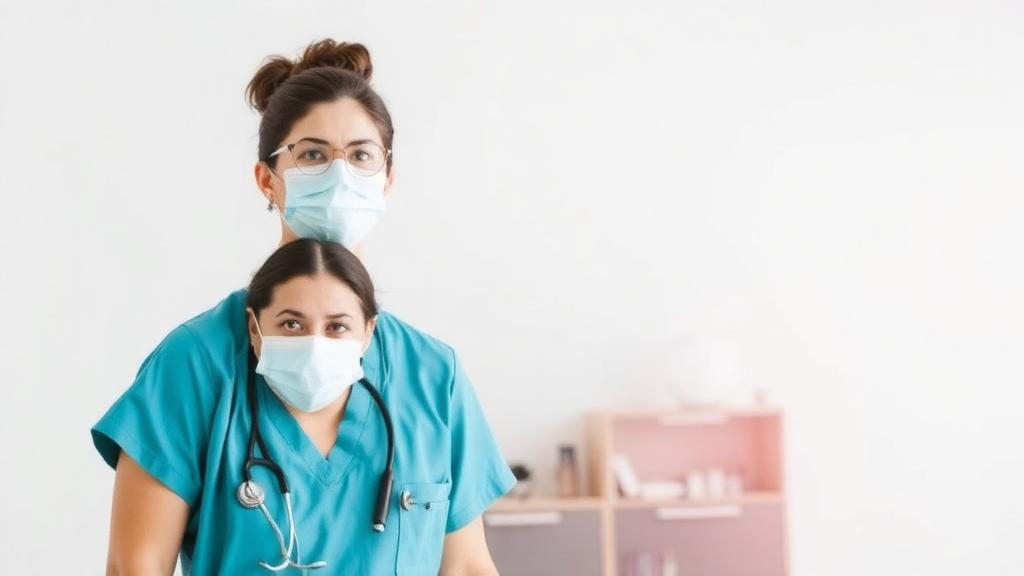
When the COVID-19 pandemic swept through hospitals in 2020, nurses became the most visible and most exposed members of the health workforce. A new qualitative study published in BMC Nursing offers one of the most intimate portraits yet of what that exposure actually felt like from the inside. Researchers Hümeyra Hançer Tok of Cumhuriyet University and Makbule Tokur Kesgin of Bolu Abant Izzet Baysal University interviewed eight nurses who had provided direct care to COVID-19 patients, using a phenomenological design that aims to capture lived experience rather than simply count symptoms or outcomes. Their analysis, published under open access, distills those interviews into four major themes: professional identity and changes in the work environment, embodied consequences, moral distress and existential dilemmas, and resilience in adversity. Together, the themes trace an arc from disruption to damage to meaning-making, and they carry practical implications for how health systems prepare for the next global crisis.
The methodological choice matters for how the findings should be read. Phenomenology is a qualitative tradition that asks a deceptively simple question: what is it like to live through this experience? Rather than administering standardized questionnaires, the researchers used a demographic information form and a semi-structured interview guide, allowing participants to describe their pandemic reality in their own words. The eight participants were all women, aged between 26 and 43 years, two of them single, and all had actively cared for COVID-19 patients. Written and verbal informed consent was obtained, the study was conducted in accordance with the Declaration of Helsinki, and it received ethics approval from the Clinical Research Ethics Committee of Bolu Abant İzzet Baysal University in July 2020, at the height of the first wave. Institutional permissions from the Ministry of Health were also secured. The small, purposive sample means the study cannot quantify prevalence, but it excels at depth, surfacing the textures of experience that large surveys routinely miss.
The first theme, professional identity and changes in the work environment, describes how the pandemic transformed not only what nurses did but who they understood themselves to be. Workloads expanded dramatically as infection control procedures, donning and doffing of personal protective equipment, and the sheer volume of critically ill patients compressed the time available for the relational core of nursing. The participants described a work environment that had become almost unrecognizable: wards converted to COVID units, colleagues redeployed, routines rebuilt around contagion risk. In phenomenological terms, the pandemic destabilized the professional self. Nursing identity is typically anchored in hands-on, holistic patient care, and when that care had to be delivered through layers of plastic and behind closed doors, nurses reported a sense of estrangement from the very activities that gave their work meaning. At the same time, the crisis reinforced a collective recognition of nurses as indispensable, a duality that the authors identify as central to the pandemic experience.
The second theme, embodied consequences, documents the physical and psychological toll recorded in the nurses’ own accounts. The study found that the pandemic increased workload and negatively affected physical and psychological health, with social isolation adding a further layer of strain. Long shifts in protective equipment produced fatigue and discomfort; the persistent risk of infection generated chronic anxiety, not only for the nurses themselves but for the families they might unknowingly carry the virus home to. Many participants distanced themselves from loved ones to protect them, a sacrifice that compounded the psychological burden with loneliness. The researchers frame these as embodied consequences because the stress was not an abstract occupational hazard but something written on the body: exhaustion, sleep disruption, and the somatic signature of sustained fear. In the study’s framing, the body became the site where the pandemic’s pressures were most directly registered.
Perhaps the most philosophically charged theme is moral distress and existential dilemmas. Moral distress is a well-established concept in nursing ethics, describing the anguish that arises when a clinician knows the ethically right course of action but is prevented from pursuing it by institutional, resource, or situational constraints. During COVID-19, those constraints were everywhere: too few hands, too little equipment, visiting restrictions that forced patients to die without family at the bedside, and triage decisions that no nurse was trained to make at pandemic scale. The interviews reveal nurses wrestling with questions that reached beyond clinical technique into the existential: what do I owe my patients, what do I owe my family, and can I survive being caught between the two? The authors present these dilemmas not as individual weaknesses but as structural products of a system pushed past its limits, which is precisely why they demand systemic rather than purely personal remedies.
Against this backdrop of strain, the fourth theme, resilience in adversity, documents how the nurses coped. The study identifies three principal resources: peer support, psychological assistance, and personal coping strategies. Peer support emerged as the backbone, with colleagues who shared the same risks and the same moral weight providing a form of understanding that no one outside the ward could offer. Psychological assistance, whether through formal counseling or informal debriefing, helped some participants process what they were witnessing. Personal strategies ranged from reframing the crisis as a professional duty and a source of pride to practical routines for protecting mental health. The researchers emphasize that resilience here is not a fixed trait but a dynamic process, assembled from relationships, institutional support, and individual meaning-making, and therefore something that health systems can actively cultivate or carelessly erode.
The study’s conclusions translate these themes into a concrete agenda. To safeguard the physical, psychological, and social well-being of nurses during crises, the authors call for the promotion of effective coping strategies, guaranteed access to ergonomic equipment, and stronger professional support mechanisms. Each recommendation maps onto a finding: coping strategies address the resilience theme, ergonomic equipment addresses the embodied consequences of physically punishing work conditions, and support mechanisms address the isolation and moral distress that flourished when nurses felt structurally alone. The authors also position the study as a contribution to pandemic preparedness, arguing that understanding nurses’ lived experiences is a prerequisite for designing interventions that will actually be used when the next crisis arrives.
The broader significance of the work lies in what it adds to a rapidly growing literature on health worker well-being. Surveys conducted during the pandemic consistently documented elevated rates of burnout, anxiety, and depression among nurses worldwide, but numbers alone cannot explain why nurses stayed at their posts, what sustained them, or which forms of support felt meaningful rather than performative. Qualitative studies like this one supply the missing interpretive layer. They show that professional identity is not a luxury but a load-bearing structure: when the work environment attacks it, psychological injury follows, and when it is reinforced, resilience becomes possible. They also demonstrate that moral distress is a distinct injury, separate from workload fatigue, requiring ethical infrastructure, such as clear triage frameworks and moral debriefing, rather than resilience training alone.
There are, of course, limits to what eight interviews can establish. The participants were all female nurses in a single national context, and the authors themselves present the work as exploratory rather than generalizable. The findings are best understood as hypotheses for larger mixed-methods research: does peer support measurably buffer burnout across larger cohorts, do ergonomic interventions reduce the embodied toll of crisis nursing, and can moral distress be prevented through institutional design? The researchers received no external funding for the study, and they declare no competing interests, facts that speak to the independent, curiosity-driven character of the work. What the study loses in statistical power it gains in fidelity to experience, and its publication in an open-access journal ensures that nurses, managers, and policymakers alike can read the primary account rather than a summary of it.
As the acute phase of COVID-19 recedes, the temptation is to file the nursing experience of the pandemic under history. This study argues against that filing. The pressures it documents, crushing workloads, isolation from family, moral injury, and the erosion of professional identity, did not end with the emergency; they persist in attenuated form in health systems worldwide that are still short-staffed and still asking nurses to do more with less. The lesson the authors draw is that the well-being of nurses is not a soft issue but a hard operational one, because no health system functions without them. Investing in coping support, ergonomic protection, and professional solidarity is, on this evidence, not merely humane but strategically essential, the difference between a workforce that bends in the next crisis and one that breaks.
Subject of Research: Nurses' lived experiences, coping strategies and occupational challenges during the COVID-19 pandemic
Article Title: Nursing under pressure: identity, challenges and coping during pandemic a qualitative study
Article References: Tok, H. H., & Kesgin, M. T. (2026). Nursing under pressure: identity, challenges and coping during pandemic a qualitative study. BMC Nursing. https://doi.org/10.1186/s12912-025-03998-7
Image Credits: AI Generated
DOI: 10.1186/s12912-025-03998-7
Keywords: COVID-19, nursing, qualitative research, phenomenology, moral distress, professional identity, burnout, peer support, resilience, occupational health, pandemic preparedness, BMC Nursing
Cite Scienmag News
Ophelia Keating. (October 8, 2026). Nurses on the Front Line: How COVID-19 Reshaped Identity, Health and Coping. Scienmag. https://scienmag.com/nurses-on-the-front-line-how-covid-19-reshaped-identity-health-and-coping/
Ophelia Keating. "Nurses on the Front Line: How COVID-19 Reshaped Identity, Health and Coping." Scienmag, 8 October 2026, https://scienmag.com/nurses-on-the-front-line-how-covid-19-reshaped-identity-health-and-coping/. Accessed 8 October 2026.
Ophelia Keating. "Nurses on the Front Line: How COVID-19 Reshaped Identity, Health and Coping." Scienmag. October 8, 2026. https://scienmag.com/nurses-on-the-front-line-how-covid-19-reshaped-identity-health-and-coping/


