


When the COVID-19 pandemic upended daily life in early 2020, no two people experienced the crisis in exactly the same way. Some responded with pragmatic caution, others with denial, and many with a corrosive mix of anxiety and helplessness. A new study published in PLOS One suggests that a large part of that variation can be traced to something established long before the virus ever emerged: personality. The research, conducted by authors in the United States and Italy, examined how the Big Five personality traits shaped susceptibility to mental distress during the pandemic, and it found that neuroticism stood out as the most consequential of them all.
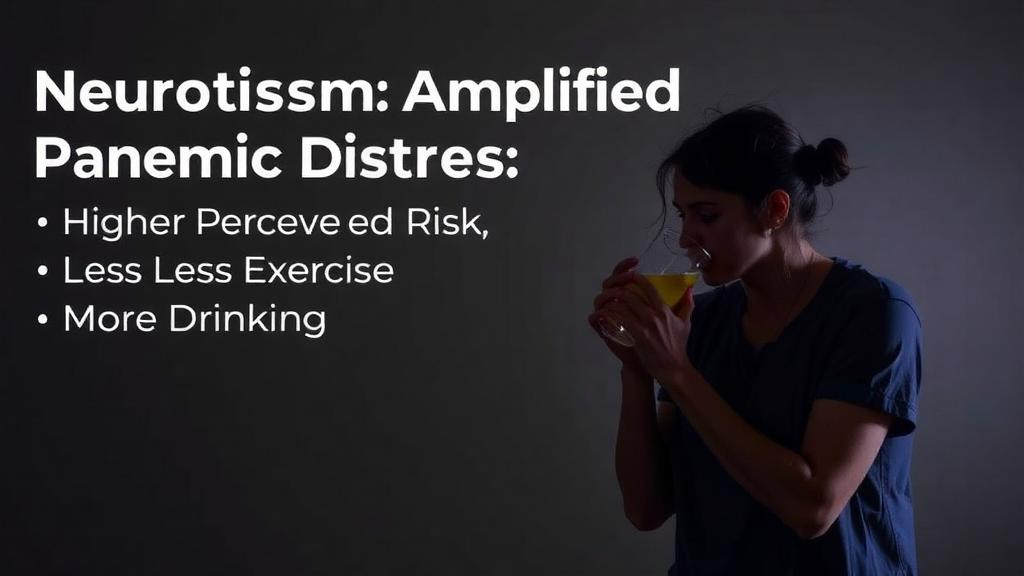
Neuroticism, one of the five broad dimensions measured by virtually every modern personality inventory, describes the tendency to experience negative emotions such as worry, fear, irritability, and sadness more frequently and more intensely. People high in neuroticism are not simply pessimistic; decades of research show that their nervous systems react more strongly to perceived threats and take longer to return to baseline after a stressor. In the context of a global health emergency, that disposition proved to be a meaningful vulnerability. According to the study, individuals with higher neuroticism scores perceived the risk of COVID-19 as greater, engaged in less physical exercise, and reported drinking more alcohol than their more emotionally stable peers.
Each of those three findings matters on its own, but together they sketch a coherent psychological pathway through which a crisis becomes a compounding health problem. The first element, heightened risk perception, is not inherently maladaptive. Accurately judging danger is essential to protective behavior, and during a pandemic, some degree of vigilance saves lives. Yet the study indicates that for highly neurotic individuals, risk perception operated less as a calibrated alarm and more as a persistent state of dread. When threat appraisal remains chronically elevated, the physiological stress response does not switch off, and the psychological toll accumulates in the form of anxiety, rumination, and disturbed sleep.
The second element, reduced physical exercise, illustrates how a personality trait can cascade into behavioral change that then feeds back into mental health. Exercise is one of the most reliable non-pharmacological buffers against anxiety and depressive symptoms, and lockdowns had already stripped away many routine opportunities for movement, from gym visits to casual walking commutes. For people high in neuroticism, who tend to experience stress as more overwhelming and may have fewer psychological resources to initiate effortful coping behaviors, the pandemic environment appears to have pushed activity levels down further. The result is a familiar and unfortunate loop: stress reduces the motivation to exercise, and the absence of exercise removes one of the most effective tools for managing stress.
The third element, increased alcohol consumption, raises the stakes considerably. Alcohol is a widely used self-medication strategy, offering short-term relief from anxiety at the cost of long-term vulnerability. Elevated drinking during the pandemic was documented across many populations, but the new findings suggest the increase was not evenly distributed. Those highest in neuroticism, precisely the people most prone to pandemic-related distress, were also those most likely to reach for alcohol as a coping mechanism. Public health researchers have long warned that crises can leave a residue of problematic substance use that outlasts the crisis itself, and this study helps identify which segments of the population carried the greatest risk of that residue.
Methodologically, the study belongs to a growing body of work that treats personality not as a static curiosity but as a measurable risk factor for health outcomes. The Big Five framework, encompassing openness, conscientiousness, extraversion, agreeableness, and neuroticism, provides a standardized vocabulary for describing stable individual differences, and its predictive power has been demonstrated across domains ranging from occupational success to longevity. What the pandemic offered researchers was an unprecedented, shared stressor: nearly everyone on the planet faced the same threat at the same time, filtered only through their own dispositions and circumstances. That natural experiment made it possible to isolate the contribution of personality with unusual clarity.
The findings on neuroticism align with a broader theoretical picture in which the trait functions as a general amplifier of vulnerability. Previous research had already linked neuroticism to poorer outcomes across the pandemic, including higher rates of depression, anxiety, and loneliness, as well as lower adherence to some protective behaviors. The new study extends that picture by tracing specific behavioral mediators: the perception of greater risk, the reduction in exercise, and the increase in alcohol use. In statistical terms, these behaviors help explain how a personality trait translates into mental distress, offering researchers concrete intervention targets rather than an abstract disposition to worry about.
It is worth emphasizing what the study does not claim. Neuroticism is not a diagnosis, and high scores do not doom anyone to poor mental health. The trait exists on a continuum, and its expression depends heavily on context, resources, and coping strategies. Moreover, conscientiousness and other traits likely played protective roles during the pandemic, with more conscientious individuals tending to maintain routines and adhere to health guidelines. The authors, funded in part by the National Institute on Aging, note that the funders had no role in study design, data collection, analysis, or publication, and the researchers declared no competing interests. The work appears in PLOS One under the title How personality traits shape susceptibility to mental distress in times of crisis: Evidence from the COVID-19 pandemic.
The practical implications reach well beyond the pandemic. Health systems increasingly recognize that psychological risk is not distributed evenly, and personality screening, already used in some clinical and occupational settings, could help identify people who need additional support when disasters strike. Simple, scalable interventions, such as promoting structured home exercise, providing accessible mental health resources, and offering evidence-based alternatives to alcohol for stress relief, could be targeted toward individuals known to be high in neuroticism before or during a crisis. The study suggests that such targeting would address not just the distress itself but the behavioral pathways, inactivity and drinking, through which distress becomes physical harm.
As the world moves past the acute phase of COVID-19, researchers are still tallying the psychological costs, and studies like this one sharpen the accounting. The pandemic did not create neuroticism, but it revealed how deeply a stable feature of temperament can shape the way a person weathers an unstable world. For the millions of people whose threat-detection systems run hot, the crisis was experienced not as an episode to be managed but as a prolonged siege on their well-being, compounded by less exercise and more alcohol. Understanding that pattern is the first step toward designing public health responses that protect the most vulnerable minds, not just the most vulnerable bodies, the next time a global crisis arrives.
Subject of Research: The influence of Big Five personality traits, particularly neuroticism, on mental distress and health behaviors during the COVID-19 pandemic
Article Title: How neurotic people struggled more in the COVID-19 pandemic: they perceived the risk as higher, exercised less, and drank more alcohol
Article References: How neurotic people struggled more in the COVID-19 pandemic: they perceived the risk as higher, exercised less, and drank more alcohol. (n.d.). Original publication
Image Credits: AI Generated
DOI: Not provided
Keywords: neuroticism, personality, COVID-19, mental distress, risk perception, physical exercise, alcohol consumption, Big Five, PLOS One, pandemic psychology, coping behavior, public health
Cite Scienmag News
Kristina Jarvis. (October 8, 2026). Neuroticism Amplified Pandemic Distress: Higher Perceived Risk, Less Exercise, More Drinking. Scienmag. https://scienmag.com/neuroticism-amplified-pandemic-distress-higher-perceived-risk-less-exercise-more-drinking/
Kristina Jarvis. "Neuroticism Amplified Pandemic Distress: Higher Perceived Risk, Less Exercise, More Drinking." Scienmag, 8 October 2026, https://scienmag.com/neuroticism-amplified-pandemic-distress-higher-perceived-risk-less-exercise-more-drinking/. Accessed 8 October 2026.
Kristina Jarvis. "Neuroticism Amplified Pandemic Distress: Higher Perceived Risk, Less Exercise, More Drinking." Scienmag. October 8, 2026. https://scienmag.com/neuroticism-amplified-pandemic-distress-higher-perceived-risk-less-exercise-more-drinking/


