


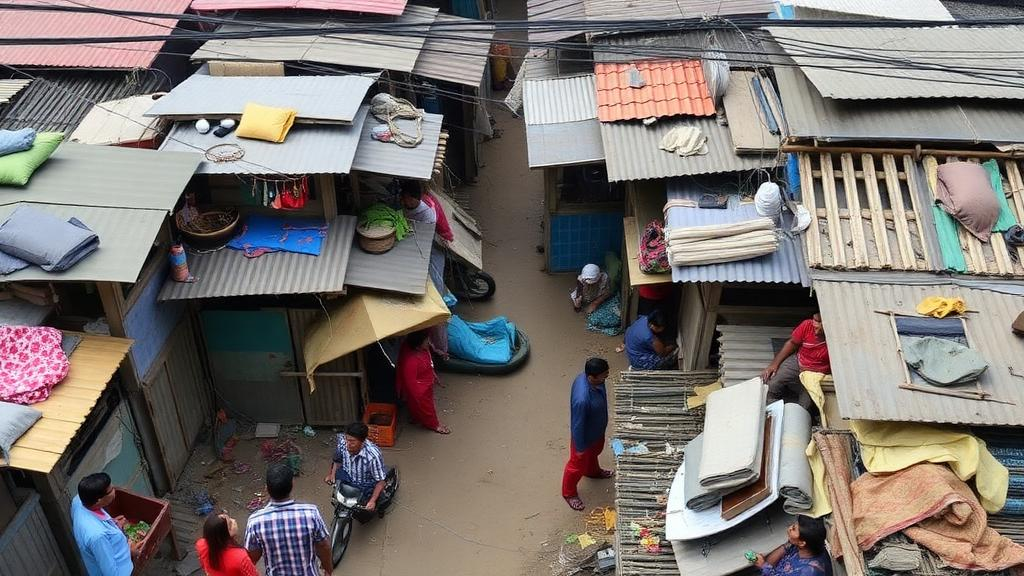
When the COVID-19 pandemic swept through Bangladesh, its economic shockwaves did not fall evenly across society. For the residents of urban slums, many of whom survive on daily wages earned in the informal economy, the loss of a single day of work could mean going hungry. A new study from Khulna, the country’s third-largest city, now provides one of the most detailed statistical portraits yet of how the pandemic triggered a cascading spiral of deprivation among slum households — a spiral that began with lost jobs and ended, for many families, with the loss of their savings and even their physical assets. The research, published in SN Social Sciences, offers evidence that could reshape how governments and aid agencies design relief for the world’s most vulnerable urban populations.
The study, led by Md Ayatullah Khan and Farhana Hoque of Khulna University together with colleagues at the University of Chittagong, surveyed 450 slum household heads using a cluster-based household survey across three purposively selected wards — 12, 21 and 31 — of the Khulna City Corporation, an area home to a significant share of Bangladesh’s slum dwellers. Rather than treating pandemic hardship as a single outcome, the researchers modelled it as a chain of linked events: employment loss leading to income loss, income loss driving shortages of daily necessities, and those shortages in turn forcing families to deplete savings and, ultimately, sell off assets. Each link in that chain was analysed separately, allowing the team to trace precisely how one form of deprivation raised the odds of the next.
The statistical toolkit combined descriptive measures — means, standard deviations and percentages — with inferential techniques including t-tests, chi-square tests and a binary logit model. The binary logit approach, a standard method for modelling outcomes with two possible states, allowed the researchers to estimate how demographic and socio-economic characteristics changed the probability that a household experienced each stage of the loss spiral. This design matters because it moves the analysis beyond simple description: it identifies which characteristics of households statistically predicted each downstream loss, controlling for the other variables in the model.
The demographic profile that emerged from the survey is strikingly consistent with the structure of urban informal labour in South Asia. The majority of household heads were male, had little formal education, and worked in daily-wage or informal occupations — day labourers, market vendors, rickshaw pullers, auto drivers and housemaids. These are precisely the jobs that vanished overnight when lockdowns were imposed. A rickshaw puller cannot work from home; a market vendor cannot sell vegetables to customers who are ordered to stay indoors. Unlike salaried workers in the formal economy, informal workers in Bangladesh typically have no contracts, no severance pay and no unemployment insurance, so the loss of work translated immediately and completely into the loss of income.
And that translation was the engine of the spiral. The analysis found that employment loss strongly predicted income loss, which in turn significantly increased the odds that a household would face shortages of daily needs — food, medicine and other essentials. Once a family’s income stream was severed, its thin financial buffers eroded rapidly. Savings loss followed, and beyond savings came asset loss: the sale of livestock, utensils, mobile phones or building materials that represented years of accumulated economic security. In the vocabulary of development economics, these households were not merely made temporarily poorer; they were pushed backward along the asset ladder that normally protects poor families from falling into chronic poverty.
The binary logit results also isolated the risk factors that made some households more likely to suffer than others. Older age of the household head, low levels of schooling, pre-existing indebtedness and living in rented accommodation all emerged as key predictors of pandemic-induced losses. Each of these factors has a clear mechanistic interpretation. Older household heads face both reduced earning capacity and greater health risks in a pandemic, making them less able to seek alternative work. Low schooling restricts the range of jobs a person can take, trapping workers in the most pandemic-exposed occupations. Indebtedness means that any income interruption immediately triggers pressure from lenders, forcing distress sales. And renters, unlike owners, must continue paying for shelter even when their income has stopped, converting every week of unemployment into a mounting liability.
The authors interpret these findings through the lens of the livelihood-vulnerability framework and the concept of the poverty trap. In this view, poverty is not simply a low level of income but a dynamic process in which shocks interact with a household’s limited assets, weak institutions and precarious employment to produce self-reinforcing decline. A pandemic lockdown is exactly the kind of shock that such households are least equipped to absorb: they hold few liquid assets, they lack access to formal credit, and their labour — their principal asset — is the very thing the lockdown suspends. The result is a vicious circle in which each loss makes the household more vulnerable to the next, and recovery becomes progressively harder without external intervention.
The Khulna findings echo a broader pattern documented across the Global South during the pandemic. Studies of informal settlements in Bangkok, Kampala, Rio de Janeiro, Nairobi and Santiago de Chile all recorded steep employment and income losses among slum residents, along with food insecurity and disrupted access to healthcare. Research in Dhaka and elsewhere in Bangladesh reported income drops of as much as 80 percent among the urban poor during the early lockdowns. What the new study adds is the explicit modelling of the loss cascade itself — demonstrating statistically that the stages of deprivation are not parallel symptoms of the pandemic but sequential consequences, with employment loss as the upstream driver and asset loss as the terminal stage.
From this causal structure, the authors derive a set of policy recommendations that are notable for their sequencing. Because employment loss sits at the head of the spiral, interventions that prevent job loss or rapidly restore earning capacity deliver the greatest downstream benefit. The study recommends a targeted skills development programme and the creation of formal employment linkages for informal workers, alongside legal and institutional protections for informal work — a sector that employs the vast majority of urban workers in Bangladesh but operates largely outside the reach of labour regulation. Such measures address the structural fragility that made slum dwellers so exposed in the first place.
For households already caught in the spiral, the authors recommend immediate cash transfers, debt relief and rental support. Cash transfers replenish the income stream directly, allowing families to buy food without selling assets; debt relief halts the distress-sale dynamic that converts temporary hardship into permanent impoverishment; and rental support keeps families housed while they rebuild. The logic is to interrupt the cascade at its weakest link before the losses compound. As the world confronts future pandemics, climate shocks and economic crises — all of which hit informal urban settlements hardest — the Khulna study offers a sobering lesson: protecting the poor requires not just aid, but aid delivered early enough, and targeted precisely enough, to stop the spiral before it starts.
Subject of Research: Socio-economic drivers of pandemic-induced employment, income, savings and asset losses among urban slum dwellers in Khulna, Bangladesh
Article Title: Drivers of pandemic-induced losses and shortages among urban slum dwellers: a case from Bangladesh
Article References: Khan, M. A., Hoque, F., Islam, K. R., & Yeasmin, K. M. (2026). Drivers of pandemic-induced losses and shortages among urban slum dwellers: a case from Bangladesh. SN Social Sciences, 6(10), Article 444. https://doi.org/10.1007/s43545-026-01729-6
Image Credits: AI Generated
DOI: 10.1007/s43545-026-01729-6
Keywords: COVID-19, urban slums, Bangladesh, informal employment, income loss, poverty trap, livelihood vulnerability, binary logit model, cash transfers, Khulna, food insecurity, debt relief
Cite Scienmag News
Courtney Benton. (October 7, 2026). How COVID-19 Pushed Bangladesh’s Slum Dwellers Into a Spiral of Loss. Scienmag. https://scienmag.com/how-covid-19-pushed-bangladeshs-slum-dwellers-into-a-spiral-of-loss/
Courtney Benton. "How COVID-19 Pushed Bangladesh’s Slum Dwellers Into a Spiral of Loss." Scienmag, 7 October 2026, https://scienmag.com/how-covid-19-pushed-bangladeshs-slum-dwellers-into-a-spiral-of-loss/. Accessed 7 October 2026.
Courtney Benton. "How COVID-19 Pushed Bangladesh’s Slum Dwellers Into a Spiral of Loss." Scienmag. October 7, 2026. https://scienmag.com/how-covid-19-pushed-bangladeshs-slum-dwellers-into-a-spiral-of-loss/


