


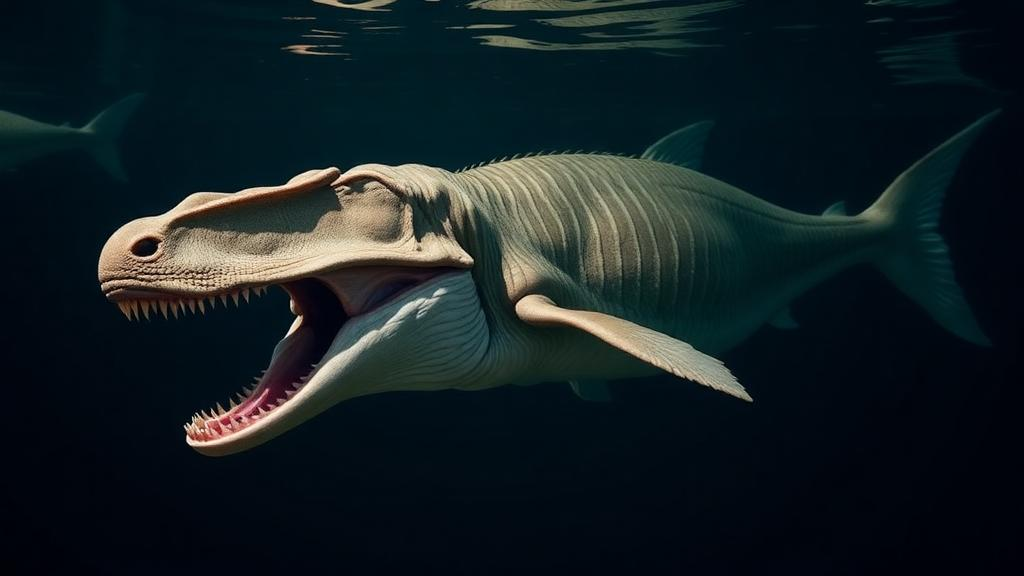
A fossil that spent years in the collections of a Chinese museum has turned out to be one of the most consequential early mammal relatives ever described. Megacauda sungei, a furry, half-meter-long swimmer that prowled the waters of what is now Inner Mongolia around 165 million years ago, is being hailed by researchers from the Universities of Shenyang, Chicago, and Bonn as the largest Jurassic mammaliaform known to science and, more importantly, as the earliest evidence yet found that the defining machinery of the mammalian throat was already in place long before modern mammals appeared. The specimen, described in the journal Nature, preserves not only a remarkably complete skeleton but also traces of soft tissue, allowing the team to reconstruct how this animal moved, hunted, and swallowed with a sophistication that no crocodile can match even today.
At first glance, the animal hardly seems like a revolutionary. Measuring just fifty centimeters from nose to tail tip and weighing roughly two kilograms, Megacauda sungei would look modest next to any of the mammals alive now, from rhinoceroses to whales and elephants. Yet in the Mesozoic Era, spanning roughly 230 to 66 million years ago, size meant something entirely different. This was the age of the dinosaurs, and the early ancestors of mammals lived in the shadows of these giants, often weighing only a few grams. Against that backdrop, a half-meter aquatic predator was a genuine heavyweight, which is why the researchers describe it with a certain irony as a top predator of its day. Its very name, combining the Latin for large tail with an homage to Professor Sun Ge, Honorary Director of the Paleontological Museum of Liaoning, signals the animal’s most striking external feature.
That feature is also a window into its lifestyle. With its short coat and flattened tail, Megacauda sungei resembles an otter, a beaver, or a platypus, and like those modern animals it was clearly at home in the water. Three-dimensional reconstructions built from computed tomography images of the fossil suggest a swimming style that was both coordinated and efficient: the animal paddled with its front legs, propelled itself with wave-like undulations of its tail, and steered with its hind legs. According to paleontologist Professor Thomas Martin of the University of Bonn, this is the earliest evidence of an aquatic lifestyle in mammals, pushing back the timeline for when mammal relatives first committed to life in rivers and lakes. The finding adds a swimming specialist to a docodont family tree that already included tree-dwellers and burrowers comparable to moles, underscoring how experimentally diverse these early mammaliaforms were.
The teeth tell their own story of adaptation. The specialized canines of Megacauda sungei are distinctive in having three roots, an unusual anatomical arrangement, and the cusps of its teeth curved backwards. That backward curvature is a classic adaptation for gripping slippery, struggling prey, and it fits neatly with the picture of an aquatic hunter chasing fish or other slick animals through the water. Combined with the streamlined tail and paddling limbs, the dentition paints a coherent portrait of a predator fully integrated into its aquatic ecosystem, not merely an occasional visitor to the water’s edge. For an animal living in the shadow of dinosaurs, such specialization likely meant the difference between ecological success and obscurity.
But the true evolutionary revolution revealed by this fossil lies deeper than teeth or tails, hidden in the anatomy of the throat. Many animal groups lack a soft palate entirely and possess only a simple hyoid bone apparatus without any true swallowing mechanism. Crocodiles illustrate the alternative strategy vividly: to get unchewed prey down their throats, they raise their heads and use jerky movements, relying on gravity to do the work. As Professor Martin explains, this is achieved with the aid of gravity alone. Mammals, by contrast, evolved a complex hyoid structure in the pharynx that allows them to swallow against gravity. It is the reason a human being can drink upside down through a straw while continuing to breathe, an ability that seems trivial until one appreciates how few animals on Earth can manage it.
The soft palate is the keystone of this system. By separating the oral cavity from the pharynx, it permits swallowing and breathing to proceed without interference, and it keeps food and liquid from entering the nasal passages. This anatomical arrangement is a critical prerequisite for suckling, allowing newborn mammals to feed on nutrient-rich milk safely and efficiently. In the words of Professor Martin, it was this adaptation that made brain development, eventually leading to humans, possible. The soft palate and the shaping of the oral cavity and pharynx are directly linked to the evolution of mammals as a lineage. What the new fossil demonstrates is that this transformation was already underway, and apparently well advanced, in Megacauda sungei tens of millions of years before the emergence of modern mammals.
Classifying the animal required extensive comparisons with other fossils and with living species. The team, led by Professor Chang-Fu Zhou of Shandong University, Professor Zhe-Xi Luo of the University of Chicago, and Professor Thomas Martin of the University of Bonn, determined that the specimen, discovered at Xiayingzi in Inner Mongolia, belongs to the docodonts, an extinct group of early mammaliaforms that flourished primarily during the Jurassic period. Docodonts are not on the direct line to today’s placental mammals, marsupials, and monotremes, but they are close relatives whose anatomy offers a rare glimpse of the evolutionary experiments that accompanied the origin of the mammalian body plan. Within this group, Megacauda sungei stands out as the largest Jurassic mammaliaform yet known, a fact that reshapes assumptions about how big these animals could grow while dinosaurs dominated the land.
The path from discovery to publication was long and, as is so often the case in paleontology, began with chance. The Paleontological Museum of Liaoning in Shenyang acquired the specimen years ago together with other finds, and its significance only became apparent during a joint examination by the three senior researchers. Once the unique nature of the fossil was recognized, it took years of painstaking work before all examinations were complete and the new species could be securely classified, described, and documented. Martin describes the outcome as the result of a long period of teamwork, and the effort paid off handsomely: the description of the new species has unlocked countless secrets relating to the origin of mammals, from the mechanics of aquatic locomotion to the deep history of the throat anatomy that makes suckling, and ultimately large mammalian brains, possible.
Beyond its individual significance, Megacauda sungei changes the broader picture of early mammaliaform evolution. Together with other finds, it shows that docodonts occupied an astonishing range of ecological niches across the Northern Hemisphere during the Jurassic: some lived in trees, others underground like moles, and others, like the new species, in water. As Martin summarizes, this demonstrates how widespread docodonts were and that this diverse group of animals developed very different lifestyles at an incredibly early stage. A creature barely half a meter long, once dismissed as just another small fossil, thus carries an outsized message: the fundamental innovations that define mammals, from swimming bodies to swallowing throats, were assembled piecemeal and remarkably early, in the shadows of the dinosaurs, by animals small enough to hold in two hands.
Subject of Research: The anatomy and evolutionary significance of the Jurassic aquatic mammaliaform Megacauda sungei
Article Title: “Top predator” from the Jurassic measures just half a meter
Article References: “Top predator” from the Jurassic measures just half a meter. (n.d.). Original publication
Image Credits: AI Generated
DOI: Not provided
Keywords: Megacauda sungei, docodont, Jurassic, mammaliaforms, soft palate, paleontology, Inner Mongolia, aquatic adaptation, hyoid apparatus, mammalian evolution, Nature, fossil
Cite Scienmag News
Gavin Prescott. (October 8, 2026). Jurassic swimmer with a soft palate rewrites the story of how mammals learned to swallow. Scienmag. https://scienmag.com/jurassic-swimmer-with-a-soft-palate-rewrites-the-story-of-how-mammals-learned-to-swallow/
Gavin Prescott. "Jurassic swimmer with a soft palate rewrites the story of how mammals learned to swallow." Scienmag, 8 October 2026, https://scienmag.com/jurassic-swimmer-with-a-soft-palate-rewrites-the-story-of-how-mammals-learned-to-swallow/. Accessed 8 October 2026.
Gavin Prescott. "Jurassic swimmer with a soft palate rewrites the story of how mammals learned to swallow." Scienmag. October 8, 2026. https://scienmag.com/jurassic-swimmer-with-a-soft-palate-rewrites-the-story-of-how-mammals-learned-to-swallow/


