


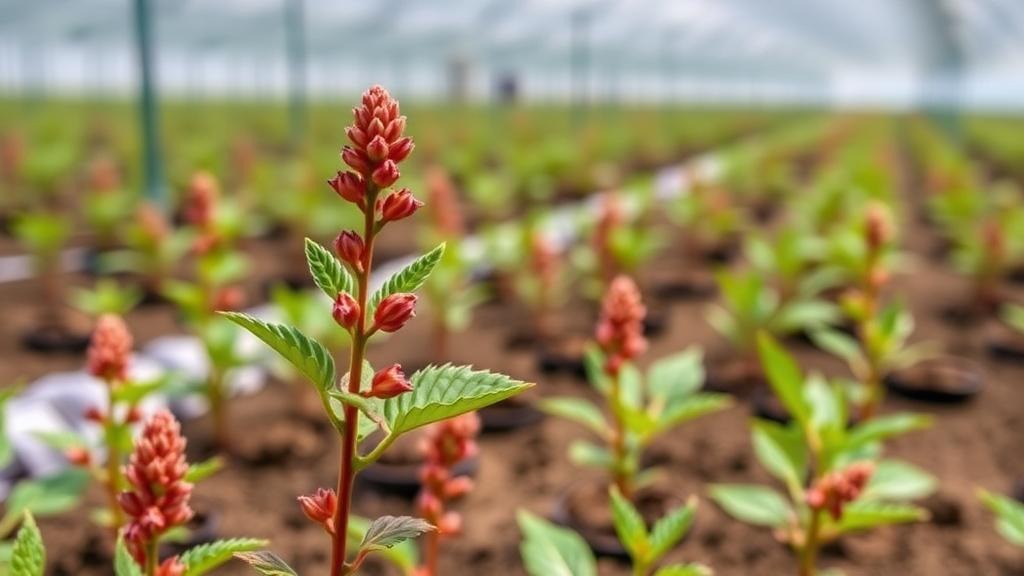
One of the most stubborn problems in agriculture is the phenomenon known as the continuous-cropping obstacle: when the same crop is planted year after year on the same soil, yields decline, soil-borne diseases intensify, and the delicate community of microbes surrounding the plant’s roots falls out of balance. For most crops, this is a slow-motion disaster that constrains sustainable production. But a traditional Chinese medicinal plant called Achyranthes bidentata, whose roots are prized for their pharmacological properties, has long puzzled researchers because it seems to shrug off the very conditions that cripple other species. A new study published in BMC Plant Biology now offers a molecular explanation for this anomaly, and in doing so reveals an unexpected mechanism by which a plant can actively recruit beneficial bacteria while suppressing a notorious fungal pathogen, all through the chemistry of a single hormone-like compound.
The research, led by Chenjing Zhang and colleagues at Fujian Agriculture and Forestry University, focused on 20-hydroxyecdysone, or 20E, the major bioactive ecdysteroid produced by A. bidentata. Ecdysteroids are best known as the molting hormones of insects, but plants in the Amaranthaceae family synthesize them in remarkable quantities, and their ecological roles have remained only partially understood. What made 20E a compelling suspect in the continuous-cropping mystery was its documented capacity to influence microbial growth: it can stimulate beneficial bacteria and, intriguingly, affect the potentially pathogenic fungus Fusarium oxysporum, a soil dweller responsible for devastating wilt diseases in countless crops worldwide. The team hypothesized that the plant’s ability to thrive under repeated cultivation might hinge on how much 20E it pumps into its root zone.
To trace the pathway from gene to ecosystem, the investigators combined three complementary approaches: field association analysis across plots with different durations of continuous cropping, functional manipulation of a candidate biosynthetic gene, and controlled experiments with purified 20E and root exudates. The field surveys delivered the first crucial pattern. As continuous cropping stretched over multiple years, 20E accumulation in the plant rose in tandem with increasing abundances of two bacterial genera, Bacillus and Pseudomonas, both widely recognized as plant-beneficial groups capable of suppressing disease and promoting growth. Strikingly, Fusarium oxysporum showed no sustained accumulation in these long-term plots, defying the expectation that a pathogenic fungus would flourish as monoculture continues.
Correlation analysis sharpened this picture considerably. Traits related to 20E were positively associated with the abundances of the beneficial bacteria and negatively associated with F. oxysporum. In other words, the more 20E the system contained, the more the rhizosphere tilted toward a protective microbial assembly and away from a disease-prone one. This statistical signature suggested, but did not prove, a causal chain running from the plant’s sterol metabolism through 20E production to the composition of its microbial entourage. Establishing that chain required identifying and manipulating the enzyme at the top of the pathway.
That enzyme is sterol Δ7-reductase, known as DHCR7, a key player in sterol biosynthesis that shapes the sterol composition of cells. Because sterols provide the precursor backbone from which ecdysteroids like 20E are built, DHCR7 sits at a critical regulatory junction. The team identified, for the first time in A. bidentata, two paralogous copies of the gene, which they named AbDHCR7-1 and AbDHCR7-2. Both copies were significantly induced by long-term continuous cropping, hinting that the plant ramps up its sterol-processing machinery precisely when the soil environment becomes most challenging, a response consistent with metabolic adaptation rather than decline.
The functional experiments then delivered the study’s most dramatic numbers. When the researchers overexpressed AbDHCR7-1 in hairy root cultures, 20E contents surged by 222 percent compared with controls; overexpression of AbDHCR7-2 produced a 111 percent increase. The root exudates, the chemical cocktail that roots release into the surrounding soil, also showed a tendency toward higher 20E levels in the overexpression lines, meaning the hormone was not merely accumulating inside the tissue but was being exported into the rhizosphere where microbes would encounter it. Conversely, when the team used virus-induced gene silencing to knock down AbDHCR7 expression, 20E accumulation dropped. The dose-response relationship between the gene and the metabolite was now firmly established in both directions.
The decisive test came in soil. In a controlled pot experiment using substrate taken from the one-year continuous-cropping field treatment, the researchers applied hairy-root exudates harvested from the overexpression lines. The result was a measurable shift in the soil community: rhizosphere abundances of Bacillus and Pseudomonas increased significantly, while the abundance of F. oxysporum decreased. This experiment connected the molecular manipulation directly to ecological outcomes, demonstrating that a plant’s engineered metabolic output, delivered through its natural exudation channels, could restructure the microbial neighborhood in a direction favorable to the plant. It is the kind of host-driven microbiome management that microbiologists have theorized about but rarely documented with such a complete chain of evidence.
Complementary assays filled in the mechanistic details of how individual microbes respond to 20E itself. Exogenous 20E treatment and in vitro culture experiments showed differential responses among the targeted organisms: the beneficial bacteria responded positively to the compound, growing and enriching in its presence, whereas F. oxysporum exhibited an inhibitory response. This selectivity is what makes the system so elegant from the plant’s perspective. A single exported metabolite acts simultaneously as a lure for allies and a deterrent for an enemy, achieving through chemistry what many crops cannot achieve even with intensive agricultural intervention. The differential sensitivity also suggests that the microbial community structure under long-term cropping is not a random byproduct of soil fatigue but an actively sculpted outcome of host metabolism.
The broader implications of the work extend in two directions. For the study of medicinal plants, it provides the first functional link between a DHCR7 enzyme and 20E accumulation in A. bidentata, opening the possibility of breeding or engineering varieties with optimized ecdysteroid profiles, both for pharmacological yield and for soil resilience. For agriculture at large, it offers a template for rhizosphere microbiome management based on host-specific metabolites rather than external inputs such as pesticides or microbial inoculants. If crops could be tuned to exude the right compounds at the right times, the soil itself might be enlisted as a partner in disease suppression. The authors note that their findings provide a basis for further understanding the mechanisms underlying continuous-cropping adaptation in medicinal plants, and the field system they describe, spanning multiple years of repeated cultivation, offers a rare natural experiment in how a plant and its microbial partners co-evolve under sustained monoculture pressure.
There is also a conceptual lesson in the study’s reversal of expectations. Continuous cropping is conventionally framed as a story of degradation: nutrients deplete, pathogens accumulate, and microbial diversity collapses. A. bidentata demonstrates that the trajectory can run differently when the host possesses the right metabolic machinery. By upregulating sterol metabolism under stress, the plant converts an increasingly hostile soil environment into an increasingly selective one, filtering its microbial associates through the lens of 20E. Whether similar mechanisms operate in other ecdysteroid-producing species, or whether the principle can be transferred to crops that lack such chemistry, remains an open question. But the demonstration that a single biosynthetic gene can ripple outward from sterol composition to hormone export to bacterial enrichment and fungal suppression marks a significant step toward understanding plants not as passive victims of their soil, but as active architects of the living world that surrounds their roots.
Subject of Research: Regulation of 20-hydroxyecdysone biosynthesis by AbDHCR7 and its effects on rhizosphere microbial communities in Achyranthes bidentata under continuous cropping
Article Title: AbDHCR7 regulates 20-hydroxyecdysone accumulation in Achyranthes bidentata and contributes to differential responses of targeted rhizosphere microorganisms
Article References: Zhang, C., Zhang, B., Zhang, S., Chen, Y., Zhang, M., Li, J., Zeng, C., Fang, Z., Zhong, S., Jiao, Y., Xu, H., Qin, B., Chen, T., Lin, S., Liu, Y., Fang, C., & Lin, W. (2026). AbDHCR7 regulates 20-hydroxyecdysone accumulation in Achyranthes bidentata and contributes to differential responses of targeted rhizosphere microorganisms. BMC Plant Biology. https://doi.org/10.1186/s12870-026-10100-z
Image Credits: AI Generated
DOI: 10.1186/s12870-026-10100-z
Keywords: Achyranthes bidentata, AbDHCR7, 20-hydroxyecdysone, rhizosphere microbiome, continuous cropping, root exudates, Bacillus, Pseudomonas, Fusarium oxysporum, sterol biosynthesis, medicinal plants, plant-microbe interactions
Cite Scienmag News
Alan Morgan. (October 7, 2026). Medicinal Plant Rewrites the Rules of Continuous Cropping Through a Single Sterol Enzyme. Scienmag. https://scienmag.com/medicinal-plant-rewrites-the-rules-of-continuous-cropping-through-a-single-sterol-enzyme/
Alan Morgan. "Medicinal Plant Rewrites the Rules of Continuous Cropping Through a Single Sterol Enzyme." Scienmag, 7 October 2026, https://scienmag.com/medicinal-plant-rewrites-the-rules-of-continuous-cropping-through-a-single-sterol-enzyme/. Accessed 7 October 2026.
Alan Morgan. "Medicinal Plant Rewrites the Rules of Continuous Cropping Through a Single Sterol Enzyme." Scienmag. October 7, 2026. https://scienmag.com/medicinal-plant-rewrites-the-rules-of-continuous-cropping-through-a-single-sterol-enzyme/


