


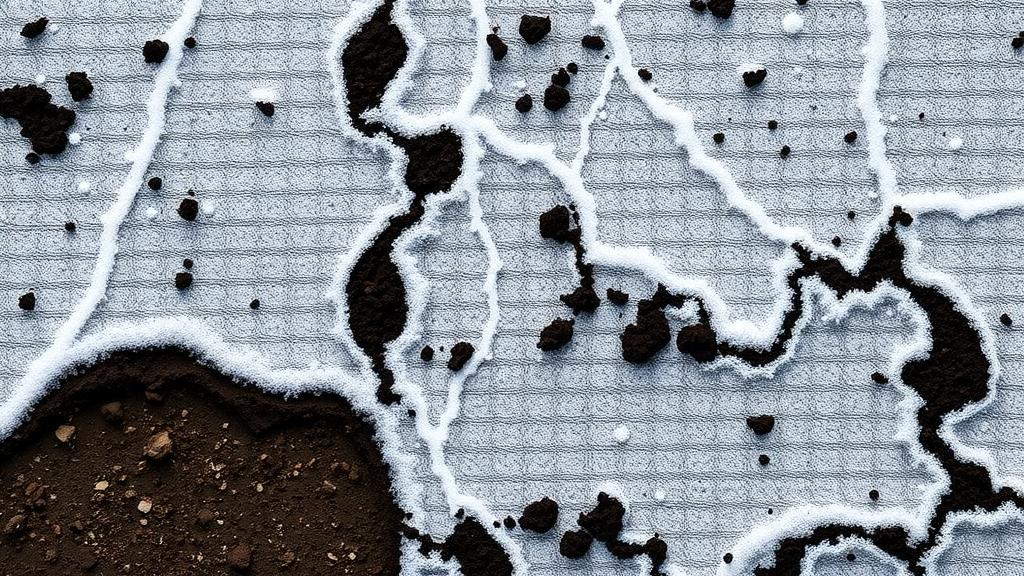
Every winter, across the industrial belts and neighboring farmlands of the Northern Hemisphere, soils repeatedly freeze at night and thaw by day. That familiar cycle of ice forming and melting has long been treated as a physical nuisance for engineers and farmers, one that heaves roadbeds, fractures aggregates, and loosens the structure of the ground. A new study published in Nature Water suggests it is also a powerful chemical reactor. A team of researchers led by Chen Miao and Jiang Xu of Zhejiang University reports that the interfaces where ice meets liquid water can rapidly transform freshly deposited arsenic particles in soil, converting them into far more stable mineral forms and slashing their potential to leach into water or enter the food chain. The finding reframes freeze–thaw cycling as a previously overlooked gatekeeper in the early geochemical fate of one of the world’s most notorious poisons.
The urgency behind the work is easy to appreciate. Industrial activities such as copper smelting, coal combustion, and metal refining emit arsenic-laden dust that settles onto surrounding soils, and recent global assessments have documented escalating arsenic contamination across Chinese soils in particular. What happens to those freshly deposited particles in the days and weeks after they land has profound consequences: mobile, soluble arsenic species can migrate into groundwater, be taken up by crops, or become bioavailable to humans and wildlife, while arsenic locked into refractory minerals poses far less immediate risk. Yet most risk models treat the post-deposition fate of arsenic as a slow aging process measured in months or years, driven by microbial activity, redox shifts, and mineral weathering. The new study argues that in cold climates, the clock starts ticking much faster, and the mechanism is frozen water.
To probe that mechanism, the researchers assembled an unusually broad evidence base: fifty diverse soil samples collected from across China, spanning the range of textures, pH values, and mineralogies where industrial arsenic deposition is a realistic concern. They spiked these soils with freshly deposited arsenic particles representative of industrial emissions and subjected them to controlled wetting followed by repeated freeze–thaw cycles, mimicking the sequence that occurs when precipitation coincides with or precedes subzero temperatures, a pattern common in many industrialized regions. The headline result was striking. Across the fifty soils, the relative leachability ratio of arsenic, measured against otherwise identical soils that never froze, dropped by an average of 71 percent. In practical terms, arsenic that had recently settled from the air became dramatically less likely to be washed out by percolating water once the soil had cycled through freezing and thawing.
Just as important as the magnitude of the effect was its timing. The suppression of bioavailability potential was concentrated overwhelmingly in the first three freeze–thaw cycles, after which the transformation largely plateaued. This rapid onset matters because it means the critical window of vulnerability, when freshly deposited arsenic is at its most mobile, may be closed off within days of the first hard frost. For environmental risk assessors, that suggests seasonal timing should be built into models of industrial contamination: arsenic deposited in autumn or winter in cold regions may follow a fundamentally different trajectory than arsenic deposited in spring, even if the total mass of contamination is identical.
The team did not stop at bulk leaching measurements. Using quasi-in situ techniques and single-particle analysis, including synchrotron-based spectroscopy at the Shanghai Synchrotron Radiation Facility with partial standard support from the Stanford Synchrotron Radiation Lightsource, they tracked what actually happened to arsenic at the level of individual particles and nanoscale phases. The answer was a story of mineralogical locking. During freeze–thaw cycling, arsenic shifted into comparatively stable forms, most notably ferric arsenate and arsenic associated with haematite, an iron oxide renowned for its strong binding of arsenate. Both of these phases are well known from the broader geochemical literature as sinks that sequester arsenic over long timescales. The freeze–thaw process, in effect, accelerated an immobilization pathway that might otherwise take far longer under ambient conditions.
The mechanistic explanation centers on the peculiar chemistry of the ice–water interface. When soil water freezes, solutes are progressively excluded from the growing ice lattice and concentrated into thin films of unfrozen liquid coating ice crystals and soil particles. Within these microenvironments, concentrations of dissolved species can spike, pH can shift, and reaction rates can be transformed. The researchers found that these concentration-driven fluctuations in the boundary chemistry steered the speciation changes, promoting the precipitation and association of arsenic with iron-bearing phases. This is consistent with a growing body of work on so-called freeze concentration effects, which have been shown to accelerate oxidation reactions and enhance the dissolution of iron oxides in frozen solutions. In the soil context, the ice boundary acts as a nanoscale chemical reactor, cycling solutes through extreme conditions each time the ground freezes and releases them again on thaw.
Chemistry, however, was only half of the story. The physical side of freeze–thaw cycling also proved consequential. The expansion of water as it freezes exerts pressure on soil aggregates and particles, and repeated cycles are known to fragment and rework the soil matrix. The study showed that this physical fragmentation redistributed arsenic mass across particle-size fractions, changing which size classes carried the contaminant and how it was hosted within the soil fabric. Because particle size governs surface area, transport behavior, and biological accessibility, this redistribution feeds directly into estimates of bioavailability potential. The interplay between the chemical transformation at ice boundaries and the physical sorting of particles by frost action thus operates as a coupled system, with each process reinforcing the overall shift toward less reactive arsenic.
The implications extend well beyond China’s industrial parks. Many of the world’s smelters, power plants, and heavy industry clusters sit in regions where subzero temperatures regularly follow precipitation, meaning that freeze–thaw processing of freshly deposited metals and metalloids is likely a global phenomenon that has simply gone unmeasured. The findings also intersect with climate change in a nuanced way. As the Northern Hemisphere’s frozen soil season shortens and permafrost warms, the frequency and distribution of freeze–thaw events are shifting. In some regions, fewer freeze–thaw cycles could mean less natural immobilization of industrial arsenic and a longer window of mobility; in others, more erratic winter thawing could produce additional cycles that lock contaminants in place. The study’s authors explicitly frame their work as a step toward understanding how climate dynamics modulate the initial geochemical fate of industrially emitted particles, and they provide climate-change analysis code available from the corresponding author on reasonable request.
There are also practical consequences for soil management and remediation. Stabilization strategies for arsenic-contaminated soils often rely on promoting exactly the kinds of mineral associations, arsenate bound to iron oxides and ferric arsenate phases, that the freeze–thaw process generates naturally. Understanding that winter conditions can accomplish part of this stabilization on their own could inform when and how remediation is scheduled, how site risk is assessed seasonally, and how the bioavailability of arsenic in agricultural soils near industry is estimated for food safety purposes. The results may also generalize beyond arsenic: the same ice–water interface chemistry and frost-driven fragmentation should influence the speciation and reactivity of other freshly deposited heavy metal particles, a possibility the researchers highlight as a frontier for future work.
What makes the study compelling is its demonstration that a process as ordinary as the ground freezing overnight can reorganize the chemistry of a toxic contaminant within a handful of cycles, at a scale visible only through synchrotron light and single-particle analysis. It is a reminder that some of the most consequential geochemistry on Earth happens in the thin, fleeting films of water where ice meets soil, far from laboratories and long before conventional monitoring programs think to look. For the millions of people living downwind of industrial emissions in cold climates, the winter freeze may be quietly working in their favor, converting airborne arsenic into forms the soil can hold. Capturing that effect in risk models, and tracking how a warming world alters it, is now an urgent task for environmental scientists.
Subject of Research: Transformation of freshly deposited arsenic speciation and bioavailability in soils during freeze–thaw cycles
Article Title: Ice–water interfaces drive speciation transformation and suppress bioavailability potential of freshly deposited arsenic during soil freeze–thaw cycles
Article References: Miao, C., Zeng, Y., Wu, N., Zhou, Q., Chen, C., Yao, C., Jiang, X., Sheng, Y., Yang, K., Lin, D., Zhu, L., & Xu, J. (2026). Ice–water interfaces drive speciation transformation and suppress bioavailability potential of freshly deposited arsenic during soil freeze–thaw cycles. Nature Water. https://doi.org/10.1038/s44221-026-00730-w
Image Credits: AI Generated
DOI: 10.1038/s44221-026-00730-w
Keywords: arsenic, freeze–thaw cycles, ice–water interface, soil contamination, speciation, bioavailability, heavy metals, industrial emissions, geochemistry, iron oxides, ferric arsenate, climate change
Cite Scienmag News
Violet Maxwell. (October 7, 2026). Freezing Soil May Lock Away Industrial Arsenic, Study Finds. Scienmag. https://scienmag.com/freezing-soil-may-lock-away-industrial-arsenic-study-finds/
Violet Maxwell. "Freezing Soil May Lock Away Industrial Arsenic, Study Finds." Scienmag, 7 October 2026, https://scienmag.com/freezing-soil-may-lock-away-industrial-arsenic-study-finds/. Accessed 7 October 2026.
Violet Maxwell. "Freezing Soil May Lock Away Industrial Arsenic, Study Finds." Scienmag. October 7, 2026. https://scienmag.com/freezing-soil-may-lock-away-industrial-arsenic-study-finds/

