


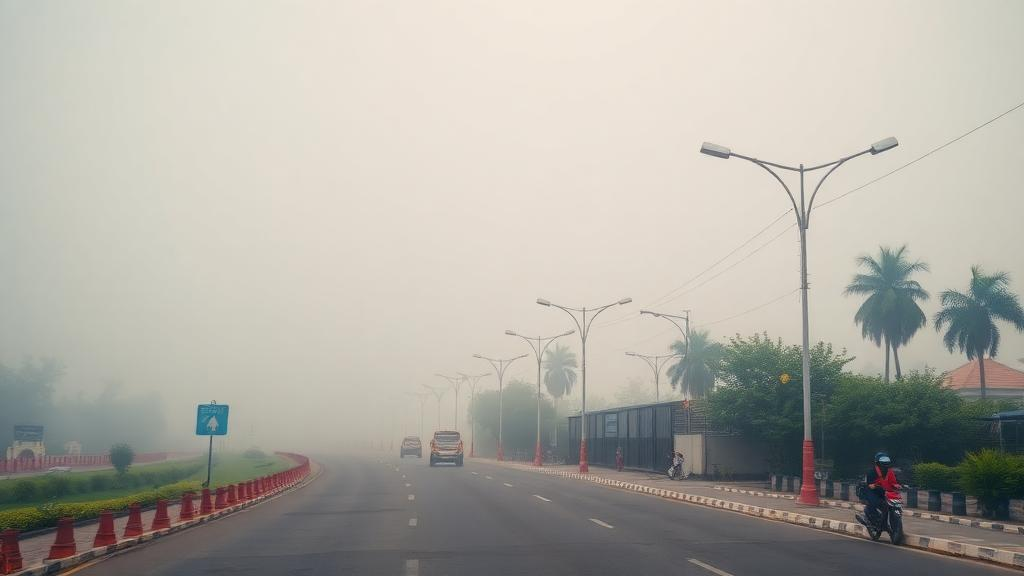
Air pollution in India has become one of the defining public health emergencies of the modern era, with several cities consistently ranking among the most polluted on Earth according to the World Health Organization and IQAir’s global reports. For hospitals bracing for surges in respiratory admissions, for school administrators deciding whether to cancel outdoor activities, and for regulators weighing emergency interventions, an accurate forecast of the Air Quality Index can mean the difference between preparation and crisis. Yet the data on which such forecasts depend are notoriously unreliable: monitoring sensors fail, communication links drop, and in some pollutant records up to 54 percent of measurements are simply missing. A new study published in Discover Artificial Intelligence tackles this problem head-on, presenting a four-stage explainable hybrid deep learning framework that achieves remarkable predictive accuracy while remaining transparent about why it makes each prediction.
The research team, led by Priyal Singhal and Upendra Singh of Manipal University Jaipur together with colleagues at VIT Bhopal University, trained and validated their framework on 435,742 daily air quality records collected by India’s Central Pollution Control Board between 1990 and 2015. The dataset spans monitoring stations across major states including Maharashtra, Uttar Pradesh, Andhra Pradesh, Punjab, and Rajasthan, recording concentrations of sulphur dioxide, nitrogen dioxide, respirable suspended particulate matter, and suspended particulate matter. Because the historical records predate routine measurement of PM2.5, carbon monoxide, ozone, ammonia, and lead at most stations, the researchers computed a CPCB-derived AQI proxy based on the three pollutants reliably available throughout the period, with particulate matter serving as the historical Indian monitoring proxy for PM10.
The first stage of the pipeline addresses the missing data problem, which is far from random in this dataset. Gaps correlate with station age and with the monsoon months of June through September, when outages are most frequent. Rather than deploying computationally expensive generative adversarial networks such as TimeGAN, the team developed a lightweight noise-augmented linear interpolation scheme. The method fills gaps by interpolating between observed neighbours, then injects calibrated Gaussian noise with a standard deviation set to two percent of each column’s observed dispersion, preventing the artificially smooth segments that plague simple interpolation. A final clipping step enforces physical non-negativity. The approach comes with a formal variance-preservation guarantee: the ratio of imputed to observed variance stayed within 0.04 percent of unity across pollutants, and sensitivity analysis confirmed that performance is stable for noise scales between 0.01 and 0.05. Compared against mean-fill, forward-fill, KNN, MICE, Kalman smoothing, and MissForest under an identical downstream pipeline, the scheme delivered the lowest error at fifteen to twenty times lower computational cost than the heaviest alternatives.
At the heart of the framework sits a hybrid ensemble combining two fundamentally different modelling philosophies. A long short-term memory network with a fourteen-day input window learns sequential dependencies, capturing fortnight-scale dynamics such as multi-day pollution accumulation and monsoon wash-out episodes that discrete lag features cannot fully encode. In parallel, an XGBoost gradient-boosted tree model exploits nonlinear feature interactions across twenty-six engineered predictors, including lagged values, rolling means, calendar variables, and inter-pollutant ratios. The two sub-models are fused through a dynamic R-squared-weighted averaging scheme derived from a variance-minimising convex combination argument. The measured residual correlation between the two learners was just 0.31, indicating genuine complementarity, and covariance-optimal weights estimated independently fell within 0.04 of the R-squared-derived weights, confirming the fusion rule operates near the theoretical optimum.
The most distinctive contribution, however, is the closed-loop use of explainability. Rather than computing SHAP values merely for human inspection, as previous LSTM-SHAP frameworks have done, the team used SHAP attributions from the XGBoost sub-model as an active feature-selection signal. SHAP, grounded in cooperative game theory, assigns each feature an exact marginal contribution to every prediction, and for tree models the TreeExplainer algorithm computes these values in polynomial time. The researchers independently verified feature importance for the LSTM using gradient sensitivity analysis, finding strong agreement between the two methods: Spearman rank correlation of 0.87, with the top three features identical across both approaches. The top ten features by SHAP importance were then used to retrain both sub-models, cutting input dimensionality by 62 percent.
The results are striking. The final XAI-enhanced ensemble achieved a root mean squared error of 0.3817, a mean absolute error of 0.2773, and an R-squared of 0.9994 on the held-out test set, representing a 54.7 percent RMSE reduction and a 58.7 percent MAE reduction over the standalone LSTM baseline. Translated to original AQI units, the error corresponds to roughly 1.91 AQI points, well below the 50-point width of the narrowest CPCB AQI category and at or below the noise floor of the underlying measurement instruments, whose typical uncertainty propagates to roughly three to four AQI units. SHAP-guided selection alone yielded an additional 38 percent RMSE improvement over the standard ensemble, and the across-trial variance of test error fell by 56 percent, an effect the authors interpret through bias-variance theory: removing low-signal features suppresses estimator variance without materially increasing bias.
The team subjected these gains to unusually rigorous statistical scrutiny. All models were retrained across thirty independent random seeds, with paired t-tests and Wilcoxon signed-rank tests applied under Bonferroni correction. Every improvement remained significant by several orders of magnitude, with Cohen’s d effect sizes exceeding 2.8, far above the conventional threshold of 0.8 for a large effect. A five-fold rolling-origin time-series cross-validation, in which each fold advances the train-test boundary forward in time, reproduced the model ranking with RMSE of 0.3928 versus 0.6382 for the standard ensemble, and bootstrap confidence intervals for the two models did not overlap. The framework also outperformed a Temporal Fusion Transformer, which the authors attribute to the limited training scale under-utilising the transformer’s capacity while the ensemble’s explicit feature engineering exploits the available signal more efficiently.
The authors are candid about the caveats. The near-deterministic correlation of 0.99 between RSPM and the AQI target means that part of the headline R-squared reflects a definitional relationship, though control experiments demonstrate genuine learning: a deterministic baseline computing AQI directly from RSPM achieves substantially higher error, and removing RSPM from the feature set entirely still yields an R-squared of 0.9851. Winter pollution peaks are systematically under-predicted by four to eight AQI units, a bias traced to the absence of meteorological covariates such as temperature, wind speed, and boundary layer height in the historical records, with stubble-burning episodes in the Indo-Gangetic Plain contributing an episodic component that a seasonal correction only partially recovers. The test set also contains few samples in the Poor, Very Poor, and Severe AQI categories, precisely those most relevant for public health intervention, and the framework’s calibration to Indian RSPM-dominated profiles would require adaptation in PM2.5-dominated or ozone-dominated regions.
On the deployment front, the numbers are compelling. Per-sample inference takes just 7.9 milliseconds on a commodity CPU, roughly five orders of magnitude faster than the CPCB’s reporting cadence, and the reduced ten-feature input lowers memory and input-output demands. The explainability stage adds about twenty-one minutes at training time only. Because the pipeline is agnostic to pollutant count, porting it to post-2015 CPCB data with the full eight-pollutant suite requires only substituting the sub-index inputs and re-running SHAP selection. The study’s central lesson may prove its most enduring contribution: interpretability and accuracy are not competing objectives in environmental forecasting but complementary ones, and the feedback loop that turns explanations into better models offers a template that extends well beyond air quality, from rainfall prediction to any domain where high-stakes decisions demand both precision and justification.
Subject of Research: Explainable hybrid deep learning for air quality index prediction using Indian CPCB monitoring data
Article Title: Explainable hybrid deep learning framework for air quality index prediction in Indian cities
Article References: Singhal, P., Saurabh, P., Sharma, M., Badge, J., & Singh, U. (2026). Explainable hybrid deep learning framework for air quality index prediction in Indian cities. Discover Artificial Intelligence, 6(1), Article 1395. https://doi.org/10.1007/s44163-026-02131-0
Image Credits: AI Generated
DOI: 10.1007/s44163-026-02131-0
Keywords: air quality index, explainable AI, SHAP, LSTM, XGBoost, ensemble learning, deep learning, missing data imputation, CPCB India, air pollution, environmental forecasting, machine learning
Cite Scienmag News
Russell Cooper. (October 7, 2026). Explainable AI Model Predicts India’s Air Quality With Near-Perfect Accuracy. Scienmag. https://scienmag.com/explainable-ai-model-predicts-indias-air-quality-with-near-perfect-accuracy/
Russell Cooper. "Explainable AI Model Predicts India’s Air Quality With Near-Perfect Accuracy." Scienmag, 7 October 2026, https://scienmag.com/explainable-ai-model-predicts-indias-air-quality-with-near-perfect-accuracy/. Accessed 7 October 2026.
Russell Cooper. "Explainable AI Model Predicts India’s Air Quality With Near-Perfect Accuracy." Scienmag. October 7, 2026. https://scienmag.com/explainable-ai-model-predicts-indias-air-quality-with-near-perfect-accuracy/


