


High in the Sierra Nevada, one of America’s most beloved landscapes is quietly losing the battle against a damage done more than a century ago. Yosemite National Park’s Tuolumne Meadows, a sweeping alpine wetland celebrated by generations of hikers and photographers, has never recovered from the intensive sheep grazing that stripped its native vegetation in the nineteenth century. Now, researchers at Colorado State University are leading a determined effort to bring the meadows back, and their new findings reveal both a promising path forward and a sobering truth: ecological restoration at this scale will unfold over decades, not seasons.
The problem began in the mid-1800s, when large flocks of sheep were driven into the high country to graze. The animals targeted the deep-rooted sedges that formed the backbone of the wet meadow ecosystem, plants that anchor the soil, regulate moisture, and pull carbon dioxide from the atmosphere into the ground. Grazing continued for years after the park was established in 1890, and the pressure proved too severe for the native vegetation to rebound. More than a hundred years after the sheep were removed, the sedges have still not returned on their own, a striking example of what ecologists call an alternative stable state, in which an ecosystem becomes locked into a degraded configuration rather than drifting back to its original condition.
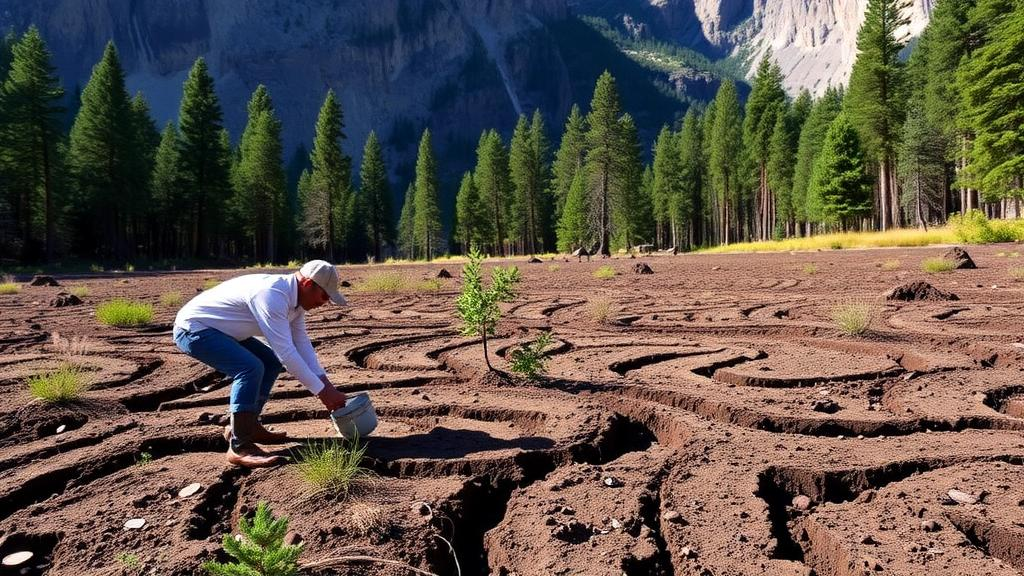
In the place of the sedges, shallow-rooted plants moved in. Without the deep root networks that once threaded through the soil, the ground lost structure and biomass, and exposed patches dried out under the intense mountain sun. Today, more than twenty percent of the meadows’ topsoil remains bare, a figure that underscores how far the system sits from its historical condition. The consequences ripple outward: wet meadows are critical habitat for Yosemite’s wildlife, they filter and store water that feeds downstream systems, and they preserve the open mountain vistas that draw millions of visitors to the park each year.
Perhaps the most consequential loss is invisible to the casual observer. Healthy wet meadow soils are enormous carbon reservoirs, built up over centuries as plant material decomposes slowly in waterlogged, oxygen-poor conditions. When the vegetation that sustains those conditions disappears, the balance tips. Without deep-rooted plants to maintain soil moisture and organic inputs, the soil dries, decomposition accelerates, and stored carbon escapes back into the atmosphere. The meadow shifts from a carbon sink to a carbon source, and as the soil loses its water-holding capacity, the odds of natural recovery shrink with every passing season.
To interrupt that spiral, the Colorado State University team took a direct approach: they planted the dominant native species back into the landscape. Working in Tuolumne Meadows, the researchers put 40,000 native sedge seedlings into the ground and then monitored how the plantings affected the ecosystem over the following years. The strategy rests on a simple ecological logic. Rather than waiting passively for a system that shows no capacity for self-repair, restoration practitioners reintroduce the engineer species, the plant that historically built and maintained the habitat, and allow its biology to rebuild the soil conditions everything else depends on.
After three years of monitoring, the results offered grounds for cautious optimism alongside a realistic assessment of the timeline. The planted sedges were slowly improving soil health, increasing the amount of soil organic matter in the ground around them. That matters because soil organic matter is the currency of meadow recovery: it stores nutrients, holds water, and gives the soil the structure it needs to support a functioning plant community. Every increment of organic matter the sedges add nudges the system back toward the wet, carbon-rich state that defined the meadows before grazing.
Yet the full accounting showed the meadow was still losing carbon overall. Continued decomposition of soil organic matter outweighed the new carbon the young sedges were capturing and storing. In other words, the restoration is working, but the plants are rebuilding a bank account that was drained over 150 years, and deposits are currently smaller than withdrawals. The findings, published in the Journal of Geophysical Research: Biogeosciences under the title Can the Carbon Storage Function of a Degraded Mountain Wet Meadow Be Restored?, make clear that three years of growth cannot undo a century and a half of degradation.
Lead author David Cooper, a senior research scientist emeritus in CSU’s Department of Forest and Rangeland Stewardship, framed the work as a necessary intervention in systems that cannot heal themselves. Many ecosystems do not naturally recover from severe disturbance, he noted, and while a place may look green, it may be severely degraded and in need of restoration. The team’s approach, he said, of planting the species that was and should be the dominant vegetation is the path forward. His estimate for the full repair is measured in generations of restoration effort rather than a few field seasons: it might take 25 to 50 years to fix damage that accumulated over roughly 150 years. I think the meadow can be restored, but these things take time, he said.
The Tuolumne Meadows project carries lessons well beyond Yosemite’s boundaries. Mountain wet meadows around the world have been degraded by grazing, water diversion, and climate-driven drying, and many occupy the same precarious position: green enough to appear healthy, but functionally impaired and bleeding carbon. The CSU study demonstrates that active replanting of dominant native species can begin to reverse soil degradation even in a system that has failed to recover naturally for over a century. It also demonstrates the limits of patience as a strategy. In ecosystems pushed past a threshold, simply removing the original stressor, in this case the sheep, is not enough; the vegetation that maintained the soil must be deliberately restored.
For now, the 40,000 seedlings in Tuolumne Meadows represent a long-term bet on the resilience of a landscape given proper care. If the sedges continue to build soil organic matter year after year, the meadow’s carbon balance will eventually tip back, moisture will return, and the habitat and views that define Yosemite’s high country will be secured for the future. The science says it is possible. The science also says it will demand decades of sustained commitment, monitoring, and continued planting, a reminder that restoring an ecosystem is far easier to damage than to rebuild, and that some of the most important conservation work happens slowly, one seedling at a time.
Subject of Research: Ecological restoration of carbon-storing wet meadows in Yosemite National Park
Article Title: Yosemite’s meadows can be restored, but it will take time and effort
Article References: Yosemite’s meadows can be restored, but it will take time and effort. (n.d.). Original publication
Image Credits: AI Generated
DOI: Not provided
Keywords: Yosemite, Tuolumne Meadows, ecological restoration, wet meadows, sedges, soil organic matter, carbon storage, overgrazing, Colorado State University, biogeosciences, alpine ecosystems, native plants
Cite Scienmag News
Denise Maddox. (October 7, 2026). Scientists replant Yosemite’s Tuolumne Meadows in race to revive degraded soil. Scienmag. https://scienmag.com/scientists-replant-yosemites-tuolumne-meadows-in-race-to-revive-degraded-soil/
Denise Maddox. "Scientists replant Yosemite’s Tuolumne Meadows in race to revive degraded soil." Scienmag, 7 October 2026, https://scienmag.com/scientists-replant-yosemites-tuolumne-meadows-in-race-to-revive-degraded-soil/. Accessed 7 October 2026.
Denise Maddox. "Scientists replant Yosemite’s Tuolumne Meadows in race to revive degraded soil." Scienmag. October 7, 2026. https://scienmag.com/scientists-replant-yosemites-tuolumne-meadows-in-race-to-revive-degraded-soil/


