


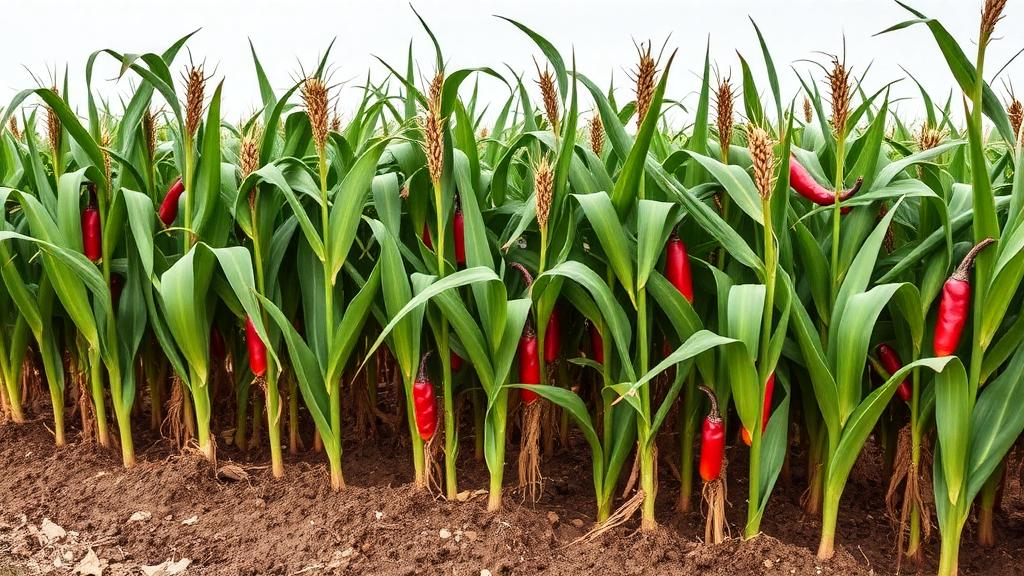
For thousands of years, farmers have planted different crops side by side, betting that neighbors can sometimes help each other more than they compete. That ancient bet, known as intercropping, is enjoying a modern revival as agriculture searches for ways to squeeze more food from less land while coping with increasingly erratic rainfall. But a new study published in Plant and Soil suggests that the very process of domestication may have quietly eroded one of the keys to successful crop partnerships: the ability of a plant to flexibly adjust its traits when a neighbor moves in. The research, led by Junlong Ye, Yinghan Liu, Liangliang Hu and Xin Chen of Zhejiang University together with colleagues, compared wild pepper ancestors with modern elite varieties grown alongside maize, and found that thousands of years of artificial selection appear to have reshaped how peppers respond to both competition and drought.
The team designed an elegant experiment around five varieties of pepper, Capsicum annuum: two wild ancestors and three modern elite cultivars. Each variety was grown either alone in monoculture or intercropped with maize, Zea mays, one of the world’s most dominant cereal crops. Crucially, the researchers ran the whole experiment twice over, once under normal moisture conditions and once under drought, creating a full factorial design that allowed them to separate the effects of domestication history, cropping system, and water availability. This mattered because the outcome of any plant interaction is not fixed; the stress-gradient hypothesis in ecology holds that neighbors that harm each other under benign conditions can switch to helping each other when the environment turns harsh, as shade from one plant conserves soil moisture for another.
The results confirmed that moisture dramatically rewires the pepper-maize relationship. Under normal watering, intercropping actually suppressed pepper growth, with maize presumably winning the contest for light and resources. Under drought, however, the picture flipped: pepper responses became predominantly neutral or even facilitative, and every wild and modern pepper-maize combination achieved overyielding, meaning the relative yield total exceeded one. In practical terms, the mixed stands produced more combined biomass per unit area than the two species grown separately would have. For a world facing growing water scarcity, especially in major agricultural regions of China where this work was conducted, the finding that drought can transform a competitive interaction into a productive partnership is genuinely striking.
Yet the study’s most provocative insight concerns domestication. Wild pepper varieties showed higher log response ratios, a standard metric of how a plant’s performance changes between monoculture and mixture, and intercrops involving wild varieties achieved higher relative yield totals than those with modern cultivars. In other words, the wild plants were better at turning a neighbor’s presence into an advantage. Interestingly, this relative superiority of wild peppers did not vary significantly with moisture, suggesting that the domestication penalty is baked into the plants themselves rather than being an artifact of any particular watering regime. Modern breeding, optimized for high yields in monoculture fields with ample inputs, may have inadvertently selected against traits that make crops good teammates.
To understand the mechanism, the researchers measured seventeen functional traits spanning leaves and roots, the biological machinery that determines how a plant acquires light, water, and nutrients. Under normal moisture, modern pepper varieties displayed a distinctive combination in monoculture: acquisitive leaf traits, the fast-growth leaf economics typical of bred crops, paired with conservative root traits. More tellingly, modern varieties showed greater intercropping-induced variability in root traits than wild ancestors when water was plentiful. The team quantified this plasticity using multidimensional hypervolumes, a modern ecological technique that treats a plant’s suite of traits as a cloud of points in multi-dimensional space and measures how that cloud expands or shifts when conditions change.
Drought told a different story. When water became scarce, intercropped modern peppers showed reduced variation in root chemical and morphological traits compared with their well-watered counterparts. This contraction of the root trait space suggests that modern cultivars lose part of their capacity to reconfigure their underground foraging strategy precisely when reconfiguration matters most. Roots are the hidden half of intercropping success; complementary root depths, architectures, and nutrient-acquisition strategies are among the main drivers of overyielding in cereal-legume and cereal-vegetable mixtures worldwide. If domestication has narrowed the plasticity of root-acquisition traits, modern peppers may simply be less able to negotiate a division of labor with maize below ground.
The study fits into a growing body of evidence that crop domestication disrupts biodiversity effects. Previous work has shown that domestication erodes beneficial interactions in barley-faba bean mixtures, shifts competitive ability in durum wheat, and alters root trait syndromes across many crop types. What makes the new pepper-maize study distinctive is its explicit focus on how moisture modulates these domestication effects through the lens of functional trait plasticity. Plasticity, the ability of a single genotype to express different phenotypes in different environments, is a double-edged trait: it is advantageous when environments vary predictably and costly when they do not. The authors argue that domestication was associated with trait-specific changes in moisture-dependent plasticity, particularly in root-acquisition traits, and that this may constrain how modern varieties respond to the simultaneous pressures of competition and facilitation.
The implications for breeding are tantalizing. If the wild ancestors of pepper carry alleles that promote beneficial root plasticity and facilitative interactions, those traits could theoretically be reintroduced into elite germplasm, either through conventional crossing with wild relatives or through genomic selection. The authors explicitly suggest that reintroducing beneficial wild traits may improve crop performance in intercropping systems under variable environments. This is part of a broader conversation in agroecology about back-crossing to the wild, a strategy that has been proposed for restoring lost genetic diversity in everything from disease resistance to drought tolerance. The pepper study adds a new dimension to that debate: what is being lost may not only be stress tolerance itself, but the behavioral flexibility that allows crops to cooperate with their neighbors.
There are, of course, caveats. The experiment involved a single partner crop, maize, and a handful of pepper varieties, and biomass responses in a controlled setting do not always translate directly to grain or fruit yield in farmers’ fields. The relative advantages of wild varieties also did not shift with moisture in the statistical tests, hinting that the domestication effect is robust but perhaps not moisture-specific in the way the trait data alone might suggest. Still, the combination of trait measurements, hypervolume analysis, and yield metrics makes this one of the most mechanistically complete examinations of domestication’s cost to intercropping to date, and it arrives at a moment when intercropping is being promoted as a pillar of sustainable intensification from smallholder farms in Asia and Africa to experimental systems in Europe and North America.
For now, the message for growers and breeders alike is nuanced but clear. Intercropping pepper with maize remains a promising strategy, especially under water-limited conditions where every combination tested achieved overyielding. But the full potential of these ancient partnerships may be locked behind traits that modern breeding left behind in the wild. As climate change makes rainfall less predictable and water scarcity more common, the plants best suited to the fields of the future may be those that have not forgotten how to share. Reconnecting modern crops with their wild heritage, the study suggests, could be the key to unlocking it.
Subject of Research: Effects of crop domestication on functional trait plasticity and intercropping performance of pepper with maize under varying moisture conditions
Article Title: Impaired intercropping effect of domesticated pepper with maize under variable moisture conditions: a functional trait perspective
Article References: Ye, J., Liu, Y., Yi, W., Zhao, L., Liu, Y., Guo, L., Tang, J., Hu, L., & Chen, X. (2026). Impaired intercropping effect of domesticated pepper with maize under variable moisture conditions: a functional trait perspective. Plant and Soil. https://doi.org/10.1007/s11104-026-09086-2
Image Credits: AI Generated
DOI: 10.1007/s11104-026-09086-2
Keywords: crop domestication, intercropping, pepper, maize, drought stress, functional traits, phenotypic plasticity, root traits, overyielding, relative yield total, agroecology, plant breeding
Cite Scienmag News
Alan Morgan. (October 7, 2026). Domestication May Have Blunted Pepper’s Intercropping Edge With Maize. Scienmag. https://scienmag.com/domestication-may-have-blunted-peppers-intercropping-edge-with-maize/
Alan Morgan. "Domestication May Have Blunted Pepper’s Intercropping Edge With Maize." Scienmag, 7 October 2026, https://scienmag.com/domestication-may-have-blunted-peppers-intercropping-edge-with-maize/. Accessed 7 October 2026.
Alan Morgan. "Domestication May Have Blunted Pepper’s Intercropping Edge With Maize." Scienmag. October 7, 2026. https://scienmag.com/domestication-may-have-blunted-peppers-intercropping-edge-with-maize/


