


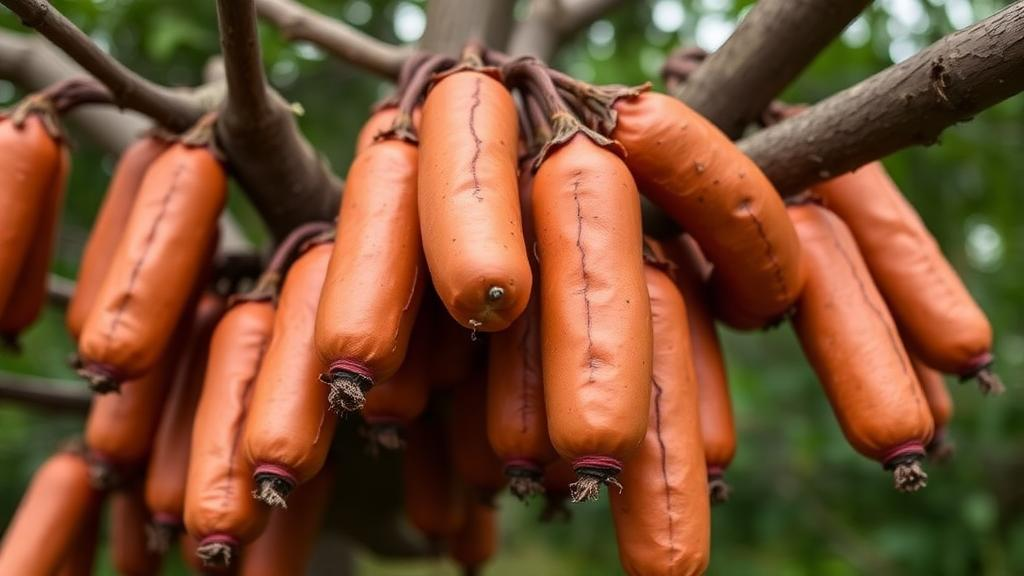
The sausage tree, Kigelia africana, is one of Africa’s most recognizable botanical icons, a towering species that can reach twenty meters in height and produces enormous berry fruits measuring up to one hundred centimeters long and weighing as much as ten kilograms. Across West Africa, the tree is deeply woven into daily life: its bark, fruits, and leaves sustain local economies, with more than twenty traders selling its organs for traditional medicine at the Abomey-Calavi market in Benin alone, and a single liter of fruit oil extract fetching thirty euros in Cotonou. Yet despite this cultural and economic prominence, the species is listed as threatened on the Benin Red List, and its natural regeneration is faltering. A new open-access study published in Discover Plants by Charlotte Yamontché and colleagues at the University of Parakou now offers a strikingly practical explanation for part of that decline, and a clear warning for anyone hoping to propagate the species in nurseries: the seeds simply do not survive long in storage.
The research team set out to answer two intertwined questions that have long frustrated foresters and conservationists working with the species. First, does the climatic origin of seeds, what biologists call the provenance, shape how well they germinate and how vigorously their seedlings grow? Second, how long can seeds be kept before they lose the ability to sprout? Both questions matter enormously for restoration programs, because producing seedlings at scale requires reliable seed supplies, and seed quality is known to depend heavily on both genetics and storage conditions. Previous studies had hinted that seeds from more humid zones germinate better than those from drier regions, and there was genuine scientific disagreement about whether Kigelia africana seeds behave as orthodox seeds, which tolerate drying and can be stored for years, or as more delicate material that deteriorates rapidly.
To resolve these uncertainties, the researchers collected mature fruits from populations spanning all three of Benin’s climatic zones: the Sudanian zone, represented by Tanguiéta and Kandi; the Sudano-Guinean zone, represented by Glazoué and Parakou; and the Guinean zone, represented by Kétou and Lalo. The fruits were transported to Parakou, cut into pieces, and covered with straw for seven to ten days to accelerate pulp decomposition before the seeds were extracted by hand, air-dried on absorbent paper, and stored in paper envelopes at room temperature. The team measured seed moisture content with a moisture meter and recorded an average of thirteen percent, which falls within the eleven to fifteen percent range recommended in earlier work for storing this species. Seeds were then divided into three storage categories: freshly collected, stored for one year, and stored for two years.
The experimental design was rigorous. The team applied nine treatments combining storage duration with soaking in room-temperature water for zero, twenty-four, or forty-eight hours, reflecting the common nursery practice of soaking hard-coated seeds to speed germination. Seeds were sown in plastic containers filled with forest soil at an open-air nursery at the Faculty of Agronomy of the University of Parakou, arranged in a randomized complete block design with three blocks. Germination was recorded daily, along with the time to first germination and the average germination duration. Once seedlings produced at least two leaves, they were transplanted into polyethylene bags, and their height, stem diameter, and leaf number were measured weekly for twelve weeks. The germination data were analyzed as time-to-event data using log-logistic models, and the effects of provenance and storage were tested with generalized linear mixed-effects models in the R statistical environment.
The headline result was unambiguous and, for nursery growers, sobering. Not a single seed stored for two years germinated, regardless of provenance or soaking treatment. Seeds stored for one year fared better but still lagged behind fresh material: mean germination was 65.22 percent for freshly collected seeds and 57.22 percent for one-year-stored seeds. Soaking helped the stored seeds somewhat, with one-year-stored seeds soaked for twenty-four hours reaching the highest mean germination rate of 65.00 percent, compared with 53.33 percent for unsoaked stored seeds and 52.00 percent for those soaked for forty-eight hours. The message is that every additional month in storage erodes viability, and beyond a single year the seed bank is effectively dead.
Provenance proved equally decisive. Seeds from the humid Guinean zone consistently outperformed the rest, germinating at 91 percent after twenty-four hours of soaking, 84 percent after forty-eight hours, and 85 percent without any soaking at all. By contrast, overall germination averaged 57 percent in the Sudano-Guinean zone and only 47 percent in the Sudanian zone. All treatments differed significantly, with non-overlapping confidence intervals at p below 0.001. The authors identify the Guinean zone as the most suitable seed source for propagating the species, a finding with immediate practical value for restoration planners who must decide where to source seed for outplanting across Benin’s varied landscapes.
Seedling growth told a more nuanced story. Seedlings from freshly collected seeds grew taller than those from stored seeds, and freshly collected seeds soaked for twenty-four hours produced the tallest plants, with statistically significant effects on height (estimate = 0.12, p < 0.001) and stem diameter (estimate = 0.06, p < 0.001). Yet the interaction between provenance and treatment was complex. In the Sudano-Guinean zone, soaking freshly collected seeds for twenty-four or forty-eight hours significantly reduced height growth, while soaking one-year-stored seeds significantly increased it. For diameter, unsoaked freshly collected seeds outperformed their soaked counterparts, and intriguingly, seedlings from unsoaked and soaked one-year-stored seeds grew better in diameter than those from unsoaked fresh seeds, suggesting that a year of storage can even have a positive effect on stem thickening under certain conditions.
Why do the seeds deteriorate so quickly? The authors point to the storage environment itself. The seeds in this study were kept at an average temperature of 26.8 degrees Celsius with relative humidity of 80 to 85 percent during the rainy season, both well above the conditions generally recommended for seed storage, since temperatures above 20 degrees and humidity above 70 percent compromise physiological quality and invite attack by microorganisms and insects. Uncontrolled fluctuations in temperature and humidity can progressively destroy seeds, destroying membrane integrity and compromising cellular synthesis. The finding also echoes work on Handroanthus spongiosus, a fellow member of the Bignoniaceae family, whose seeds deteriorated greatly after twenty-four months in permeable packaging at room temperature, hinting that rapid viability loss under ambient conditions may be a family-wide trait. The study contradicts earlier reports that soaking two-year-stored Kigelia seeds for twenty-four hours could raise germination to 80 percent, underscoring how much remains uncertain about this species’ storage physiology.
The provenance effects on growth are consistent with a broader pattern in tropical forestry. Genetic characteristics of tree populations are known to drive variation in seedling vigor, and comparable provenance effects have been documented in Cordia africana in Ethiopia and Pavetta crassipes in West Africa. Benin’s Kigelia populations span a diversity of soil and climatic conditions, which likely shaped local adaptation and reserve accumulation in seeds, influencing both dormancy and seedling performance. Interestingly, while Guinean-zone seeds germinated best, seedlings from the drier Sudanian zone grew taller on average, a reminder that germination success and seedling vigor are not the same thing and that matching seed source to planting environment requires care.
The practical conclusions are clear. Kigelia africana seeds should be sown fresh whenever possible, and never stored for more than one year if germination is the goal. A twenty-four-hour soak in room-temperature water is a reasonable pre-treatment, particularly for stored seeds, but its effects depend on where the seed came from and how long it has been kept. For conservationists racing to reverse the species’ decline, the study recommends climate-zone-specific seed management strategies, further research to pin down the exact storage limit, determination of seed physiological maturity at harvest, and genetic characterization of populations to understand seed longevity. As overexploitation continues to pressure wild populations across the species’ range, these findings turn a seemingly simple question, how long can a seed wait, into a decisive factor in whether one of Africa’s most iconic trees survives the century.
Subject of Research: Effects of seed provenance and storage duration on germination and seedling growth of the threatened African tree Kigelia africana in Benin
Article Title: Seed viability, germination, and seedling growth of Kigelia africana (Lam.) Benth. to provenance and storage duration
Article References: Yamontché, C., Wédjangnon, A. A., Akin, Y. Y., Kuiga Sourou, B. N., Houètchégnon, T., & Ouinsavi, C. (2026). Seed viability, germination, and seedling growth of Kigelia africana (Lam.) Benth. to provenance and storage duration. Discover Plants, 3(1), Article 377. https://doi.org/10.1007/s44372-026-00846-z
Image Credits: AI Generated
DOI: 10.1007/s44372-026-00846-z
Keywords: Kigelia africana, sausage tree, seed germination, seed storage, provenance, seedling growth, Benin, West Africa, forest restoration, seed viability, Bignoniaceae, plant conservation
Cite Scienmag News
Alan Morgan. (October 7, 2026). Sausage Tree Seeds Lose Their Power After Just One Year in Storage, Benin Study Finds. Scienmag. https://scienmag.com/sausage-tree-seeds-lose-their-power-after-just-one-year-in-storage-benin-study-finds/
Alan Morgan. "Sausage Tree Seeds Lose Their Power After Just One Year in Storage, Benin Study Finds." Scienmag, 7 October 2026, https://scienmag.com/sausage-tree-seeds-lose-their-power-after-just-one-year-in-storage-benin-study-finds/. Accessed 7 October 2026.
Alan Morgan. "Sausage Tree Seeds Lose Their Power After Just One Year in Storage, Benin Study Finds." Scienmag. October 7, 2026. https://scienmag.com/sausage-tree-seeds-lose-their-power-after-just-one-year-in-storage-benin-study-finds/


