


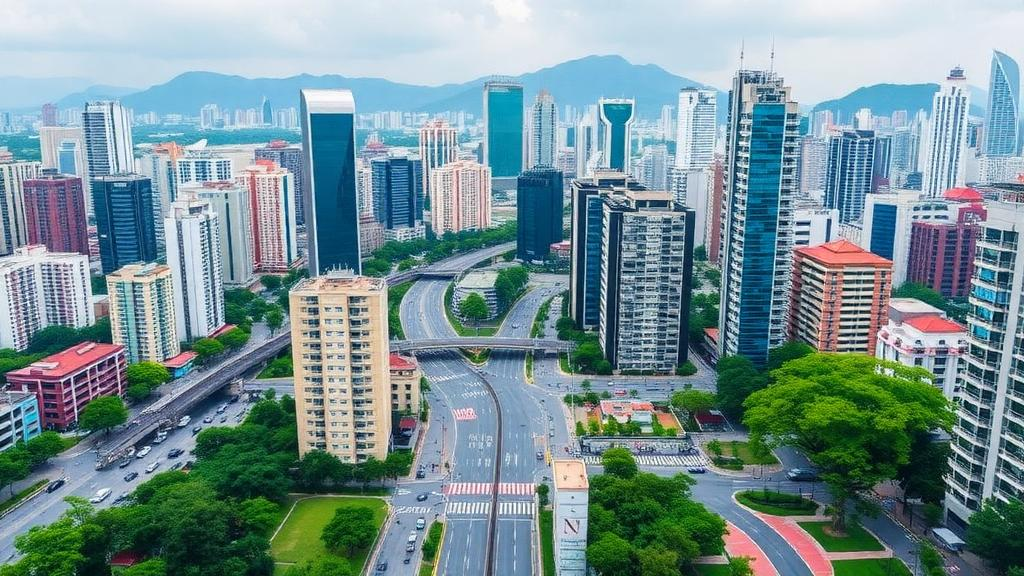
When it comes to cutting carbon emissions, few cities on Earth have moved as fast, or as deliberately, as Shenzhen. The southern Chinese metropolis, once a fishing town of a few thousand people, has become a global showcase for electric buses, a booming new-energy-vehicle industry, and one of the country’s pioneering carbon markets. But behind the glossy headlines about zero-emission fleets and green skyscrapers lies a far more complicated story: nearly three decades of policy-making in which goals were invented, discarded, replaced and layered on top of one another, often in ways that defied the tidy textbook ideals of coherent policy design. A new study published in Global Public Policy and Governance by Wenting Ma of Harbin Institute of Technology (Shenzhen), Thomas Hoppe of the University of Twente, and Tao Sun of Shenzhen University now offers the most detailed longitudinal account yet of how Shenzhen’s low-carbon policy mix actually evolved between 1994 and 2022, and the findings challenge some of the most cherished assumptions in policy science.
The research tackles a deceptively simple question that has long frustrated scholars of public policy: what makes a policy mix work? In an ideal world, the authors explain, policies would display three qualities at once. Goals would be coherent, meaning they reinforce rather than contradict each other. Instruments, the concrete tools governments use, such as subsidies, regulations, taxes and information campaigns, would be consistent, so that one tool does not undermine another. And goals and instruments would be aligned, with each tool actually serving the objective it was designed for. In practice, however, governments rarely design policy mixes from scratch. Instead, as the study puts it, policy mixes are typically patched up to solve problems as they arise, a process that generates ever-greater complexity over time. Whether that complexity helps or hinders the long-term evolution of climate policy has remained stubbornly unclear.
To answer the question, the team adopted a quantitative longitudinal research design, a methodological approach that tracks phenomena across extended time periods rather than taking a single snapshot. They assembled and coded the full corpus of low-carbon policies issued in Shenzhen across 28 years, mapping how the number of policies grew, which policy subdomains emerged, and how individual goals and instruments changed over time. The coding allowed the researchers to classify changes in the policy mix into recognizable patterns familiar from the international policy-design literature: replacement, in which a new policy displaces an old one; conversion, in which an existing instrument is repurposed toward a new goal; and layering, in which new policies are simply stacked on top of existing ones without removing anything. Each pattern carries different implications for how well the overall mix fits together.
The headline finding is that Shenzhen’s low-carbon policy evolution followed a trajectory of gradual accumulation punctuated by two dramatic surges, with the number of policies peaking in 2012 and again in 2021. Those two dates are not accidental. The first surge coincided with Shenzhen’s designation as a national low-carbon pilot zone, part of China’s broader strategy of testing climate policies in selected cities before scaling them nationwide. The second surge aligned with the run-up to and aftermath of China’s national commitments on carbon peaking and carbon neutrality. In both cases, the study finds, the local government was responding directly to national government programs, translating central directives into municipal policy at remarkable speed. Shenzhen’s status as a laboratory for national experimentation thus acted as a powerful engine of policy production, driving the city to accumulate an ever-larger stock of policies across an expanding set of subdomains.
Beneath the aggregate growth, the researchers uncovered a striking asymmetry in how goals and instruments behaved. Policy goals, the study found, evolved rather flexibly, with new goals frequently replacing old ones as political priorities shifted. When Shenzhen’s leadership redefined what the city should achieve, whether industrial upgrading, air quality, or carbon intensity targets, the goal architecture of the policy mix was rewritten accordingly. Policy instruments, by contrast, developed far more incrementally. Rather than being swept away when priorities changed, existing tools tended to persist, undergoing replacement, conversion, or layering. This means that Shenzhen’s policy mix carries the sediment of its own history: instruments introduced decades ago for entirely different purposes have been bent toward low-carbon ends, while newer instruments sit atop older ones, sometimes reinforcing them and sometimes working at cross-purposes.
The distribution of these policy dynamics turned out to be roughly balanced between good fits and poor fits. Replacement, the pattern in which a new policy cleanly supersedes an outdated one, represented a good fit between new policies and the existing mix, keeping the toolkit relatively coherent. Conversion and layering, on the other hand, represented poor fits, adding complexity without necessarily resolving contradictions. Crucially, the study shows that these dynamics varied not only across different policy subdomains but also within them, meaning that even a single domain such as transport or buildings could contain a patchwork of well-integrated and poorly integrated instruments. This granularity matters, because it suggests that assessments of policy quality cannot rely on aggregate indicators alone; the internal texture of a policy mix determines whether its growing complexity translates into effective climate action or bureaucratic clutter.
What drove this evolution? The researchers identify three key factors. The first is the city’s strategic positioning: Shenzhen’s identity as China’s flagship special economic zone and its self-image as an innovation hub created strong incentives to be first with new policy ideas, including in the low-carbon sphere. The second is the focus of local leadership, since shifting priorities among municipal leaders redirected attention and resources across subdomains over time. The third, and perhaps most consequential, is the city’s response to national policies. Shenzhen did not develop its low-carbon agenda in isolation; it operated within a nested system in which central government programs, pilot designations, and evaluation schemes shaped local ambitions. The interplay between central directives and local experimentation produced the characteristic rhythm of the city’s policy history, with bursts of legislative activity following each national signal.
The practical results of this policy machine are visible on Shenzhen’s streets. The city has achieved one of the highest penetrations of new energy vehicles of any major city in the world, with the share of new-energy vehicles among new car sales exceeding 60 percent according to local reports cited in the study’s reference material. Shenzhen electrified its entire bus fleet years ahead of most global cities, a feat that required the coordinated deployment of subsidies, procurement rules, charging infrastructure standards, and industrial policy. The study’s framework helps explain how such coordination emerged not from a single master plan but from the iterative layering and conversion of instruments over many years, with each new policy responding to gaps and frictions left by its predecessors.
For the international policy community, the Shenzhen case carries a message that is both sobering and encouraging. Sobering, because it confirms what scholars such as Michael Howlett and colleagues have long argued: real policy mixes are rarely the product of rational, comprehensive design. They are mosaics, assembled incrementally, with goals that churn and instruments that linger. The democratic responsiveness trap identified in the policy-accumulation literature, in which governments keep adding policies to signal action without ever dismantling old ones, has a counterpart even in a technocratic, fast-moving city like Shenzhen. Encouraging, because the case demonstrates that a policy mix can nonetheless deliver transformative outcomes despite its imperfections, provided that goals remain broadly coherent, leadership attention is sustained, and the local system stays tightly coupled to national strategic signals.
The study also opens new avenues for research. Its quantitative longitudinal design, coding decades of policy texts to track coherence, consistency and alignment over time, offers a template that could be applied to other cities and other policy fields, from circular economy initiatives, which Ma and colleagues have analyzed previously, to waste management and energy transition policy across China’s provinces. As countries worldwide race to meet mid-century decarbonization targets, understanding how policy mixes actually evolve, rather than how they should evolve in theory, may prove decisive. Shenzhen’s 28-year experiment suggests that the path to a low-carbon future is not a straight line of elegant design but a winding process of patching, layering and occasional replacement, and that cities able to manage that process with strategic clarity may outpace those waiting for the perfect plan.
Subject of Research: Longitudinal analysis of low-carbon policy evolution, coherence, consistency and goal-instrument alignment in Shenzhen, China, from 1994 to 2022
Article Title: Policy evolution through coherence, consistency and alignment: the Shenzhen low carbon policy case
Article References: Ma, W., Hoppe, T., & Sun, T. (2025). Policy evolution through coherence, consistency and alignment: the Shenzhen low carbon policy case. Global Public Policy and Governance, 5(1), 24-45. https://doi.org/10.1007/s43508-024-00103-7
Image Credits: AI Generated
DOI: 10.1007/s43508-024-00103-7
Keywords: Shenzhen, low-carbon policy, policy mix, policy coherence, policy instruments, policy layering, policy accumulation, climate governance, China, urban policy, policy design, longitudinal analysis
Cite Scienmag News
Courtney Benton. (October 6, 2026). How Shenzhen Built a Low-Carbon Policy Machine: Lessons from 28 Years of Climate Governance. Scienmag. https://scienmag.com/how-shenzhen-built-a-low-carbon-policy-machine-lessons-from-28-years-of-climate-governance/
Courtney Benton. "How Shenzhen Built a Low-Carbon Policy Machine: Lessons from 28 Years of Climate Governance." Scienmag, 6 October 2026, https://scienmag.com/how-shenzhen-built-a-low-carbon-policy-machine-lessons-from-28-years-of-climate-governance/. Accessed 6 October 2026.
Courtney Benton. "How Shenzhen Built a Low-Carbon Policy Machine: Lessons from 28 Years of Climate Governance." Scienmag. October 6, 2026. https://scienmag.com/how-shenzhen-built-a-low-carbon-policy-machine-lessons-from-28-years-of-climate-governance/


