


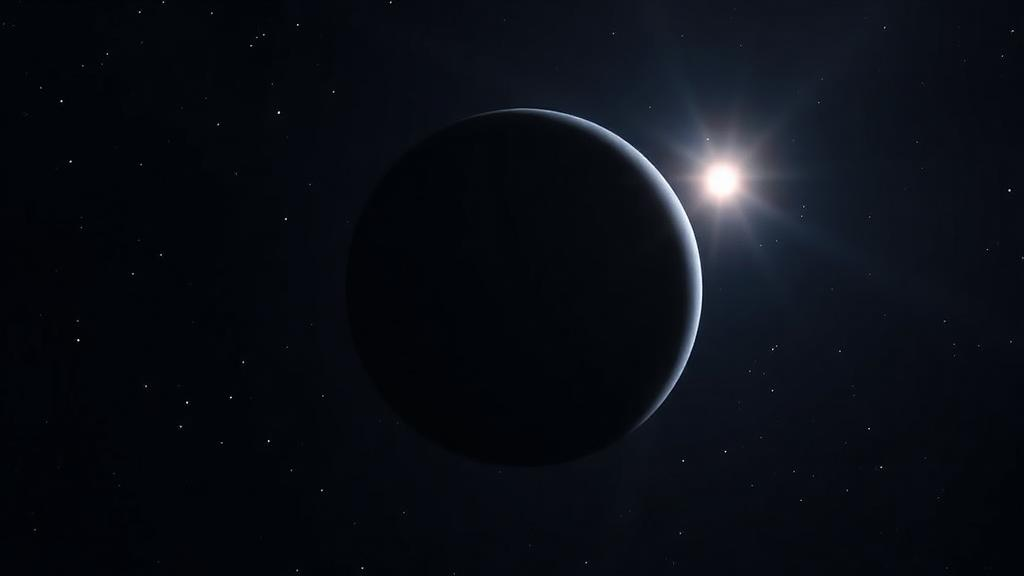
Astronomers have identified the first known planet orbiting a small, cool star on a retrograde path, circling its host in the direction opposite to the star’s own rotation. The world, designated GJ 3090 b, is a small Neptune-sized planet whose three-dimensional orbit has now been measured with enough precision to reveal that it is not merely tilted relative to its star but is travelling backwards around it. The finding, published in Astronomy & Astrophysics Letters with contributions from researchers at Queen Mary University of London, offers a rare window into the turbulent processes that can sculpt planetary systems and raises pointed questions about how planets inherit their orbits in the first place.
The expectation that planets should orbit in the same direction as their host star is one of the most basic predictions of planet formation theory. Stars and their planets are born together from a single rotating cloud of gas and dust that collapses into a flattened, spinning disk. Because the star forms at the center of that disk and the planets condense within it, both should initially share the same sense of rotation, with planetary orbits aligned closely to the star’s equatorial plane. Deviations from this alignment, known as orbital obliquity, are therefore treated as evidence that something unusual happened after the planets formed, whether a violent gravitational encounter, a slow secular torque from a distant companion, or some other perturbation powerful enough to wrench the system out of its primordial configuration.
Measuring that alignment for a planet as small as GJ 3090 b is a formidable technical challenge. The team used the NIRPS near-infrared spectrograph, an instrument specifically designed to study planets around M dwarfs, the small, cool stars that account for the majority of stars in the Galaxy. By resolving the star’s spectrum at high resolution during planetary transits, the researchers could detect the subtle Doppler distortions produced as the planet blocks light from different parts of the rotating stellar surface, a technique known as the Rossiter-McLaughlin effect. Combining this signal with the planet’s known orbital parameters allowed them to reconstruct the full three-dimensional orientation of the orbit. The result was an obliquity of approximately 136 degrees, a value that places the planet firmly on a retrograde trajectory rather than merely on an inclined one.
Dr. Andrew Winter, a lead author from Queen Mary University of London, emphasized how extraordinary the configuration is. The planet, he noted, is not simply tilted relative to its star but is orbiting in the opposite direction altogether, a fact that immediately raises the question of how such an unusual orbit could have come about. Retrograde planets are among the most valuable laboratories in exoplanet science precisely because their orbits are so difficult to produce. In the standard picture, a sufficiently massive planet or a companion star can gravitationally disturb a planet’s orbit and tilt it dramatically over millions or billions of years, in some cases flipping it past the 90-degree threshold where it begins to move backwards relative to the star’s spin.
That standard picture gave the team a clear investigative strategy: look for the hidden companion. If a massive outer planet or a second star were lurking in the GJ 3090 system, its gravitational influence could plausibly have driven the observed misalignment through well-understood dynamical mechanisms such as the Kozai-Lidov effect or long-term secular perturbations. The researchers therefore searched their observational data for evidence of another massive object, examining radial velocity trends and other indicators that would betray the presence of an unseen companion. The search came up empty. Their observations found no evidence for a wide stellar companion, nor for a sufficiently massive outer planet that could readily account for the planet’s extreme orbital misalignment.
The absence of an obvious culprit makes the system particularly intriguing and has pushed the team toward explanations rooted in the system’s earliest history rather than in later violence. Yann Carteret, a PhD student at the University of Geneva who participated in the study, said the team looked for the kind of massive companion that could have forced the planet into such an extreme orbit but found no evidence for one, suggesting that researchers may need to think differently about how this system acquired its unusual architecture. One possibility the researchers propose is that the young star acquired a second, misaligned disk of gas and dust from its surrounding environment, perhaps through the accretion of material whose angular momentum was oriented differently from that of the original disk. Planets forming from this later material would inherit its orientation, producing a retrograde orbit without any catastrophic encounter ever taking place.
If that scenario is correct, the backwards orbit of GJ 3090 b would not be the scar of a later collision or perturbation but a fossil preserving the unusual conditions under which the planetary system formed. Assistant Professor Vincent Bourrier of the University of Geneva described the idea that a planetary system could be rebuilt from a second, differently oriented disk as particularly exciting, noting that it suggests the environment around a young star can play a far larger role in determining the architecture of its planets than researchers might have expected. Young stars are often born in dense clusters where gas flows, stellar flybys and infalling clouds are common, and any of these processes could in principle deliver misaligned material onto an existing disk, resetting the stage on which planets assemble.
Beyond its implications for formation theory, the study demonstrates the growing power of near-infrared observations for characterizing planets around M dwarfs. These small, cool stars emit most of their light at infrared wavelengths, making instruments like NIRPS far more effective than optical spectrographs for capturing the faint signals needed to measure orbital geometry. GJ 3090 b is now the smallest planet around an M dwarf for which a three-dimensional orbital obliquity has been measured, a milestone that opens an important new class of targets for comparative studies. Until recently, most obliquity measurements were restricted to hot Jupiters and other giant planets orbiting larger stars, leaving the demographic picture badly skewed toward systems that may not be representative of planetary systems as a whole.
The measurement also matters for what it says about the diversity of planetary architectures around the Galaxy’s most common stars. If small planets around M dwarfs can routinely end up on strongly misaligned or even retrograde orbits, then the tidy picture of coplanar, aligned systems that underpins much of exoplanet statistics may need substantial revision, particularly for the low-mass planets that current surveys are finding in abundance around nearby red dwarfs. The researchers caution that further observations will be needed to test the proposed second-disk formation scenario and to establish whether other planetary systems contain similarly extreme orbital configurations, work that will require expanding the still-tiny sample of small planets with measured obliquities.
For now, GJ 3090 b stands as a vivid reminder that planetary orbits are not always the quiet inheritances they are often assumed to be. The movements of planets with unusual orbits can act as fossils of planetary formation, preserving clues about the events and environments that shaped their systems billions of years ago. Whether the backwards Neptune owes its trajectory to a second misaligned disk, an as-yet-undetected companion, or some mechanism not yet imagined, its orbit is a message from the earliest epoch of the system’s history, and astronomers are only beginning to learn how to read it.
Subject of Research: Measurement of a retrograde orbital obliquity for the Neptune-sized exoplanet GJ 3090 b around an M dwarf star
Article Title: First ‘backwards’ planet discovered around a small star challenges ideas about how planets form
Article References: First ‘backwards’ planet discovered around a small star challenges ideas about how planets form. (n.d.). Original publication
Image Credits: AI Generated
DOI: Not provided
Keywords: exoplanet, retrograde orbit, GJ 3090 b, M dwarf, orbital obliquity, NIRPS, protoplanetary disk, planet formation, Astronomy & Astrophysics, spectroscopy, Queen Mary University of London, University of Geneva
Cite Scienmag News
Grant Pearson. (October 6, 2026). Astronomers Find First Backwards Planet Circling a Small Cool Star. Scienmag. https://scienmag.com/astronomers-find-first-backwards-planet-circling-a-small-cool-star/
Grant Pearson. "Astronomers Find First Backwards Planet Circling a Small Cool Star." Scienmag, 6 October 2026, https://scienmag.com/astronomers-find-first-backwards-planet-circling-a-small-cool-star/. Accessed 6 October 2026.
Grant Pearson. "Astronomers Find First Backwards Planet Circling a Small Cool Star." Scienmag. October 6, 2026. https://scienmag.com/astronomers-find-first-backwards-planet-circling-a-small-cool-star/


