


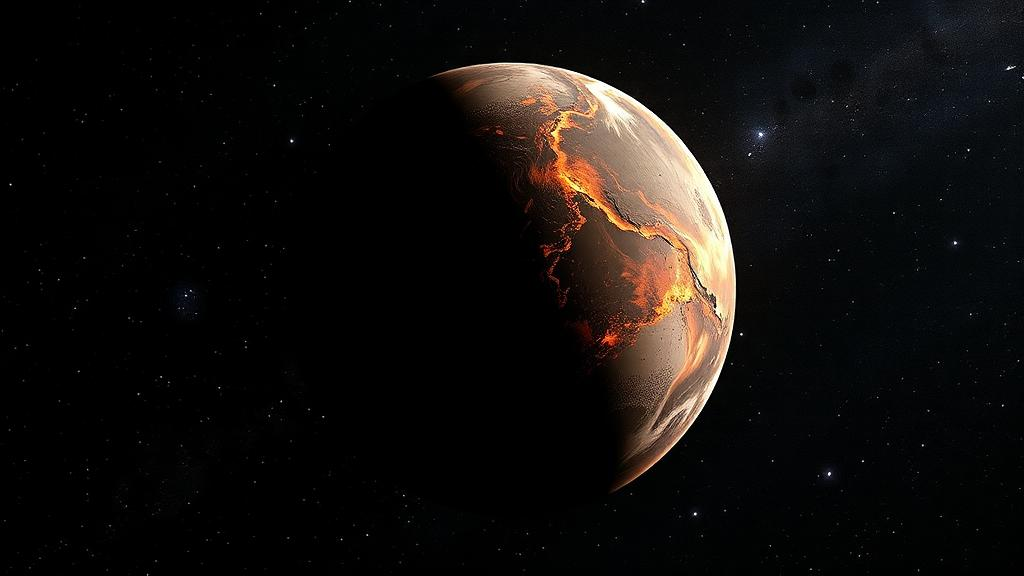
In a discovery that reads like cosmic mythology made real, astronomers have identified what appears to be the first known second-generation planet orbiting a white dwarf — a world that seems to have been built from the very material its host star expelled as it died. The finding, led by researchers at the University of Warwick and funded by the European Research Council, is published in Nature Astronomy and centers on the white dwarf HS 0209+0832, a collapsed stellar core whose atmosphere carries a chemical fingerprint so unusual that it has forced scientists to rethink what kinds of planets can form in the wreckage of stellar death.
White dwarfs are the end state of the vast majority of stars, including our own Sun. When a star exhausts the nuclear fuel in its core, it sheds its outer layers into space and leaves behind an Earth-sized ember of dense matter that slowly cools over billions of years. These remnants are not quiet in a chemical sense. Because white dwarfs have intense surface gravities, any heavy elements in their atmospheres should rapidly sink out of view, settling into the dense interior within a relatively short astronomical timescale. When astronomers detect metals such as silicon, iron, or magnesium in a white dwarf’s spectrum, they know the star must be actively accreting material — almost always debris torn from asteroids or minor planets in the surrounding system that wandered too close and were shredded by tidal forces.
That is precisely why the atmosphere of HS 0209+0832 stood out. In a typical polluted white dwarf, the accreted material is dominated by rock-forming elements, reflecting the composition of ordinary terrestrial planets and asteroids that condensed from the original protoplanetary disc. But HS 0209+0832 displays an extraordinary abundance pattern featuring unusually high levels of heavy elements, including zinc, copper, and — most strikingly — niobium, detected at concentrations more than one thousand times higher than those measured in the Sun. This marks the first time niobium has ever been identified in the atmosphere of a white dwarf, and the anomaly demanded an explanation that conventional models of planetary debris could not provide.
The key to the puzzle lies in how those elements were forged. Dr Nicholas Stone of the University of Wisconsin-Madison explained that the pattern is a telltale sign of the s-process, a slow neutron-capture nuclear reaction that builds heavy elements inside dying stars during their bloated red giant phase. As an aging star swells and burns helium and other fuels in shells around its core, it manufactures elements far heavier than those produced during its long stable lifetime, then dredges them up and eventually expels them into space. A planet formed from pristine interstellar material — a so-called first-generation planet — simply should not carry this chemical signature. The presence of s-process products in the material raining onto the white dwarf told the team that whatever is feeding the star was made from the star’s own death ejecta.
The researchers’ conclusion is remarkable: the white dwarf is most likely consuming a newly formed, second-generation giant planet that condensed out of a fresh disc of material created during the star’s demise. When the dying star cast off its outer layers, that expelled matter did not simply vanish into interstellar space. Instead, some of it apparently settled into an orbiting disc around the remnant, and from that disc a new Jupiter-sized gas giant coalesced — a phoenix world rising from the ashes of the star it now circles. Because the disc was composed of the star’s own processed material, it was naturally enriched in the unusual heavy elements now visible in the white dwarf’s atmosphere, providing a coherent explanation for every chemical oddity the team observed.
First author Jamie Williams, a PhD student in the Department of Physics at the University of Warwick, emphasized how unexpected the find was. Second-generation planets are worlds that form out of the material a star casts off as it dies, he noted, and they are incredibly rare — finding one around a white dwarf was completely unexpected. He described the discovery as being a bit like finding a planet that has risen from the ashes of the very star it once orbited, an image that captures both the scientific novelty and the poetic resonance of the result. Similar reborn worlds have long been suspected around pulsars, the rapidly spinning neutron stars that can also acquire discs from stellar debris, but this is the first evidence that a second generation of planets can form around a white dwarf, a far more common type of stellar remnant.
The rarity itself is informative. Forming a protoplanetary disc in this situation is not easy, Williams explained, and that difficulty helps account for why such planets have never been seen before. A single, isolated star dies and sheds its mass in a roughly symmetrical way, sending material streaming outward in all directions with no preferred plane in which it could gather and collapse. For a disc to form — the necessary cradle for planet birth — HS 0209+0832 likely required a companion star whose gravitational influence pulled the ejected material back into orbit around the remnant rather than letting it escape into the galaxy. This requirement for a stellar partner in the system’s past adds a crucial constraint to models of how planets can form in post-main-sequence environments and suggests that searches for similar worlds should focus on white dwarfs with the right evolutionary history.
Independent support for the planet hypothesis came from NASA’s TESS satellite, which monitors the brightness of hundreds of thousands of stars in search of transits and other variability. In the TESS data, the researchers detected a faint but regular brightness signal repeating every 4.4 days, originating directly from the planet itself rather than from an eclipse or transit. Such a periodic modulation is consistent with a Jupiter-sized gas giant tidally locked in a tight orbit around the white dwarf, with one hemisphere perpetually facing the star. At that close distance, the planet’s outer atmosphere is expected to be boiling away under the intense radiation, and the escaping material — rich in the s-process elements inherited from the dead star — rains down onto the white dwarf’s surface, producing exactly the unusual chemical signature observed in its spectrum.
If the second-generation planet candidate is confirmed through follow-up observations, HS 0209+0832 would become the first white dwarf known to host a reborn world, and the discovery would open an entirely new search strategy. Rather than hunting for planets directly around dead stars, which is observationally extremely challenging, astronomers could look for the same carbon and heavy-element signature in the light of other polluted white dwarfs. Any white dwarf whose accreted debris carries s-process enrichment would be a promising candidate for hosting its own second-generation planet, turning atmospheric chemistry into a detection tool for a previously hidden population of exotic worlds.
Professor Boris Gänsicke of the University of Warwick, an ERC grantee and co-author of the study, captured the significance of the result. What is remarkable about the planet around HS 0209+0832, he said, is that it is not a planet from somewhere else, nor a survivor from the system’s birth — it looks like it was built from the very material its own star cast off as it died. In a sense, he observed, the system has given birth to a new world using the foundations of the old one. The discovery also raises a question that extends to our own cosmic doorstep: how many more such phoenix planets might be scattered across the galaxy, and could our own Solar System one day host a second-generation planet formed from the ashes of the Sun? In roughly five billion years, when the Sun becomes a white dwarf and sheds its outer layers, the same physics documented around HS 0209+0832 will play out in our neighborhood — and any worlds that condense from that ejecta will carry the Sun’s own chemical legacy, a final, luminous act of stellar recycling written into the atmospheres of the dead.
Subject of Research: Discovery of a second-generation planet candidate accreting onto the white dwarf HS 0209+0832
Article Title: The phoenix planet: astronomers find a world reborn from its star's ashes
Article References: The phoenix planet: astronomers find a world reborn from its star's ashes. (n.d.). Original publication
Image Credits: AI Generated
DOI: Not provided
Keywords: white dwarf, second-generation planet, exoplanet, s-process elements, niobium, stellar evolution, planetary formation, HS 0209+0832, TESS, accretion, Nature Astronomy, University of Warwick
Cite Scienmag News
Grant Pearson. (October 6, 2026). Astronomers discover a planet reborn from the ashes of its dead star. Scienmag. https://scienmag.com/astronomers-discover-a-planet-reborn-from-the-ashes-of-its-dead-star/
Grant Pearson. "Astronomers discover a planet reborn from the ashes of its dead star." Scienmag, 6 October 2026, https://scienmag.com/astronomers-discover-a-planet-reborn-from-the-ashes-of-its-dead-star/. Accessed 6 October 2026.
Grant Pearson. "Astronomers discover a planet reborn from the ashes of its dead star." Scienmag. October 6, 2026. https://scienmag.com/astronomers-discover-a-planet-reborn-from-the-ashes-of-its-dead-star/


