


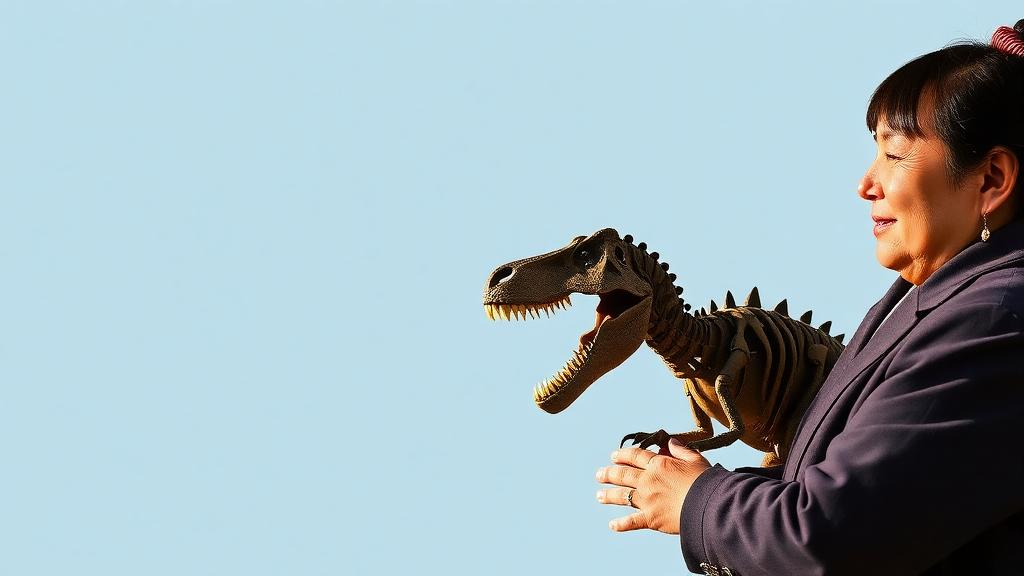
In September, Mongolian palaeontologist Dr Bolortsetseg Minjin received one of her country’s highest recognitions when she was awarded a state honour medal by the President of Mongolia, Ukhnaagiin Khürelsükh. The decoration acknowledges a career devoted to safeguarding Mongolia’s extraordinary fossil heritage, recovering specimens that were illegally exported to foreign markets, and transforming dinosaurs from distant museum objects into a living source of national pride and scientific opportunity for Mongolian children. Upon receiving the medal, Minjin dedicated the honour to the many collaborators, colleagues and supporters who have helped her advance Mongolian palaeontology over the years, a gesture that reflects the collaborative character of a field in which a single researcher rarely works alone.
Minjin’s path to national recognition has been shaped by a combination of rigorous research and determined advocacy. She is a resident researcher associated with the American Museum of Natural Heritage in New York, an affiliation that has allowed her to bridge the worlds of Mongolian field palaeontology and major international research institutions. At the same time, she is the founder of the Institute for the Study of Mongolian Dinosaurs in Umnugovi, in the Gobi region of southern Mongolia, where many of the country’s most celebrated Cretaceous fossils have been unearthed. The institute works at the intersection of science, education and community engagement, bringing dinosaur-themed science directly to the communities that live alongside some of the world’s most productive fossil beds.
Among the achievements cited in connection with her honours is her role in recovering and repatriating Mongolian dinosaur fossils that were being illegally exported. The most notable of these cases involved a skeleton of Tarbosaurus bataar, a large tyrannosaurid theropod closely related to Tyrannosaurus rex that roamed the Gobi Desert roughly 70 million years ago. Tarbosaurus is known almost exclusively from Mongolia and neighbouring regions of Asia, which makes specimens of the genus part of Mongolia’s irreplaceable natural patrimony. The repatriation of such a skeleton was more than a legal victory; it was a statement that fossils taken without permission from their country of origin can, with persistence and international cooperation, be returned home.
For her earlier work on fossil recovery and repatriation, Minjin had already received Mongolia’s Polar Star medal, one of the nation’s longstanding state decorations. The new state honour medal awarded this September therefore marks a second national acknowledgement of her contribution, underscoring how central fossil protection has become to Mongolia’s cultural and scientific policy. Fossil trafficking has long been a serious concern in countries with rich vertebrate-bearing sediments, because illegally collected specimens are frequently stripped of their geological and stratigraphic context, the very information that allows scientists to reconstruct ancient ecosystems. When fossils are looted, science loses data even when the bones themselves survive; when they are repatriated with their histories documented, both the nation and the research community recover something of what was lost.
Minjin’s influence extends beyond specimen recovery into the realm of public science. Her work to expand dinosaur-themed science in Mongolia has included educational programming designed to reach young audiences in a country where palaeontology was historically dominated by foreign expeditions. By establishing a research and education presence in Umnugovi, close to the fossil localities themselves, she has helped ensure that the economic and intellectual benefits of dinosaur discoveries flow, at least in part, to local communities. This model, in which local scientists lead research and outreach in their own country, has become an increasingly important touchstone in global discussions about who owns, studies and communicates the deep past.
International audiences will soon have the opportunity to hear Minjin describe this work first-hand. Delegates attending the 7th International Palaeontology Congress in Cape Town can learn more from her experiences as a keynote speaker in the Communicating Palaeosciences Symposium, scheduled for 2 December 2026. In her address, she will share insights into how she helped build awareness around Mongolia’s dinosaur heritage, drawing on nearly two decades of experience at the front lines of fossil protection, repatriation and public education. Her perspective is expected to resonate with researchers and communicators grappling with similar questions of heritage, access and equity in other fossil-rich nations.
The Communicating Palaeosciences Symposium, within which Minjin’s keynote will sit, is designed to bring together researchers and science communicators from across the world to explore how fossils, human evolution and the deep past can be communicated beyond traditional academic audiences. The premise of the symposium is that palaeontology’s stories, extinction, deep time, evolution and the origins of humanity, are among the most powerful in all of science, yet they are frequently conveyed through channels that fail to reach, or fail to respect, the communities most connected to the fossils themselves. Conveners of the symposium argue that the discipline must become more deliberate about how, and to whom, it speaks.
Science communication expert Dr Marina Joubert of Stellenbosch University in South Africa, the symposium convenor, framed the event’s ambitions in terms of inclusion and social relevance. “We will be focusing on how palaeontology is communicated to the public – and how it can become more inclusive, culturally sensitive and relevant to society,” she says. Her co-convener, Professor Anusuya Chinsamy-Turan of the University of Cape Town, who also chairs the organising committee of the 7th International Palaeontology Congress, emphasised the practical goal of the gathering. “Through our engagement with palaeontologists actively engaged in science communication, we hope to uncover good practices and strategies for more effective communication,” she says. Together, the two conveners have assembled a programme that treats communication not as an afterthought to research but as a skill and a responsibility in its own right.
The topics on the symposium agenda reflect the breadth of that ambition. Sessions will address ways to decolonise palaeontology, examining how the discipline’s history of extraction and foreign domination can be confronted and reimagined; misinformation in palaeoanthropology, a growing concern in an era when human-origins claims spread rapidly online; children’s natural-history education, which shapes the next generation of scientists and citizens; and the use of museums and exhibitions to spark public curiosity about the deep past. During the symposium, Dr Frederick Manthi of the National Museums of Kenya will also deliver a keynote address, focusing on the promotion of palaeoscience in Africa through the Kenyan experience, a national story of hominin discoveries, museum development and public engagement that parallels Minjin’s Mongolian narrative in instructive ways.
The Communicating Palaeosciences Symposium at IPC7 is presented with support from the Palaeontological Scientific Trust (PAST) and the South African Department of Science, Technology and Innovation (DSTI), partnerships that signal institutional commitment to public engagement as a core function of the palaeosciences. For Minjin, the Cape Town keynote will be an opportunity to place Mongolia’s experience within a global conversation: a demonstration that fossil protection, repatriation and community-centred education are not local curiosities but transferable strategies. Her state honour medal, awarded by her president and dedicated to her supporters, stands as evidence that governments increasingly recognise what the symposium’s conveners argue, that a nation’s fossils are most secure, and most valuable, when the people who live among them are empowered to understand, protect and celebrate them.
Subject of Research: Recognition of Mongolian palaeontologist Dr Bolortsetseg Minjin for fossil protection and repatriation, and public communication of palaeoscience at the 7th International Palaeontology Congress
Article Title: IPC7 keynote speaker receives national honor for her work to protect Mongolia’s fossils
Article References: IPC7 keynote speaker receives national honor for her work to protect Mongolia’s fossils. (n.d.). Original publication
Image Credits: AI Generated
DOI: Not provided
Keywords: Bolortsetseg Minjin, Mongolia, palaeontology, fossil repatriation, Tarbosaurus bataar, science communication, IPC7, Communicating Palaeosciences Symposium, dinosaur education, cultural heritage, Cape Town, decolonising palaeontology
Cite Scienmag News
Courtney Benton. (October 5, 2026). Mongolian palaeontologist honoured by her nation for protecting dinosaur fossils. Scienmag. https://scienmag.com/mongolian-palaeontologist-honoured-by-her-nation-for-protecting-dinosaur-fossils/
Courtney Benton. "Mongolian palaeontologist honoured by her nation for protecting dinosaur fossils." Scienmag, 5 October 2026, https://scienmag.com/mongolian-palaeontologist-honoured-by-her-nation-for-protecting-dinosaur-fossils/. Accessed 5 October 2026.
Courtney Benton. "Mongolian palaeontologist honoured by her nation for protecting dinosaur fossils." Scienmag. October 5, 2026. https://scienmag.com/mongolian-palaeontologist-honoured-by-her-nation-for-protecting-dinosaur-fossils/


