


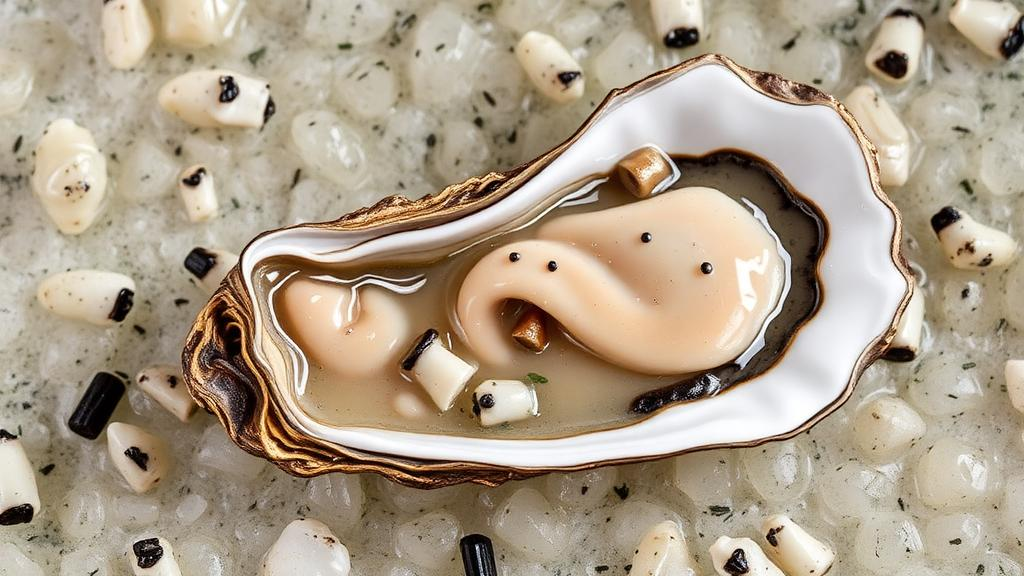
The Pacific oyster spends its life bathed in seawater teeming with bacteria and viruses, yet it survives without the adaptive antibodies that shield vertebrates. A new study published in BMC Biology suggests that part of the answer lies in an unexpected place: the chemistry of the mucus that coats the animal’s soft tissues. Researchers led by Fan Mao and Yang Zhang at the South China Sea Institute of Oceanology of the Chinese Academy of Sciences report that oxidation–reduction reactions occurring outside oyster cells appear to act as a regulatory switch, tuning the antimicrobial potency of a mucosal defensin protein and, in doing so, helping to maintain the delicate balance of microbes living on the oyster’s surfaces.
Redox chemistry—the continuous shuttling of electrons between molecules—is one of the most fundamental processes in biology. Inside cells, redox state governs everything from enzyme activity to gene expression, and elaborate protein networks keep it tightly controlled. What happens outside cells, in the extracellular space, has been far harder to study, particularly in invertebrates. For filter-feeding animals like oysters, whose mucosal surfaces are in permanent contact with a shifting microbial world, the question is not academic. Their mucus is simultaneously a habitat for commensal bacteria, a first line of defense against pathogens, and a chemical environment whose composition could plausibly reshape all of these functions at once.
To probe this environment, the team characterized the mucosal proteome of Magallana gigas, the Pacific oyster, and compared it with proteins found in the animal’s plasma. The comparison revealed that mucus is not simply diluted blood plasma; it carries its own distinctive protein signature, enriched for enzymes involved in redox regulation. Among these were thioredoxin and glutaredoxin, two evolutionarily ancient protein families whose members catalyze the reduction and oxidation of disulfide bonds—the covalent bridges formed between pairs of cysteine amino acids in proteins. When the researchers challenged oysters with pathogens, including the bacterium Vibrio ZJ51 and the devastating virus OsHV-1, expression of these redox regulators in mucus rose significantly, hinting that the extracellular redox machinery is not a passive background feature but something the animal actively deploys during infection.
The centerpiece of the study is a mucosa-specific defensin the authors named Mg-Defm. Defensins are small, cysteine-rich antimicrobial peptides found across much of the animal kingdom, and bivalves possess their own branch of this family. Mg-Defm carries conserved cysteine residues that form intramolecular disulfide bonds, giving the peptide a defined three-dimensional fold. What makes the new work striking is the demonstration that this fold is not merely structural decoration. When the researchers treated Mg-Defm with dithiothreitol, or DTT, a chemical agent that reduces disulfide bonds back to free cysteine pairs, the peptide underwent measurable conformational changes consistent with bond reduction. Its shape shifted—and so did its function.
That functional shift was dramatic. Reduced Mg-Defm showed a five- to six-fold increase in bactericidal activity against Vibrio species compared with its oxidized counterpart. In other words, the redox state of the peptide itself appears to modulate how lethal it is to bacteria. This finding reframes defensin regulation in an invertebrate context. Rather than relying solely on producing more or less of the peptide, the oyster may be able to tune the activity of molecules already deployed in its mucus simply by altering the extracellular redox environment around them. The authors propose that the multiple redox regulators upregulated during infection could collectively form an extracellular switch that activates Mg-Defm when pathogens appear.
The corollary is equally consequential. If redox state controls antimicrobial activity, then disturbing that state should disturb the microbial community. The researchers tested this in two ways: through genuine pathogenic infection and through chemically induced reduction of the mucosal environment using DTT. Both interventions triggered profound microbial dysbiosis—a collapse of the normal balance of the mucosal microbiome. That a purely chemical perturbation, without any living pathogen involved, could destabilize the microbial community underscores how sensitive the system is to redox chemistry. It suggests that the oyster’s resident microbes live within a redox window maintained by the host, and that pushing the chemistry outside that window reshapes who can thrive on the mucosal surface.
For aquaculture, the implications are hard to ignore. The Pacific oyster is one of the most widely farmed animals in the world’s oceans, and its industry suffers recurrent, sometimes catastrophic losses to OsHV-1 and Vibrio infections. If extracellular redox state genuinely gates antimicrobial defenses, it offers a new dimension to consider in breeding programs, disease diagnostics, and husbandry. Redox markers in mucus could potentially serve as early indicators of infection or stress, and interventions that stabilize the mucosal redox environment might help preserve microbiome homeostasis during vulnerable periods. The study’s authors are careful to frame their conclusions as proposing a potential role for extracellular redox regulation rather than proving a complete mechanistic pathway, but the framework they outline gives the field a concrete and testable model.
The work also speaks to a broader question in immunology: how did animals defend themselves before adaptive immunity evolved? Invertebrates depend entirely on innate mechanisms—physical barriers, pattern-recognition receptors, and antimicrobial effectors like defensins. The idea that these effectors can be regulated post-secretion, by the redox chemistry of the surrounding fluid rather than by the cell that made them, adds a layer of sophistication to innate immunity that is easy to overlook. It also raises evolutionary questions. Disulfide-rich antimicrobial peptides are ancient, and redox-sensitive regulation of protein activity is equally so. The convergence of the two in a molluscan mucus layer hints that extracellular redox control may be a general and underappreciated principle of mucosal defense, one that vertebrates may share in their own mucus-covered surfaces.
Methodologically, the study illustrates the value of looking at mucus as an organ of sorts in its own right. By cataloging the mucosal proteome separately from plasma, the researchers could identify which redox enzymes are actually deployed at the host–microbe interface rather than inferring from whole-animal data. The combination of proteomics, expression analysis after pathogen challenge, biochemical characterization of a purified defensin, and microbiome profiling under both infectious and chemical perturbation gives the redox-switch hypothesis multiple independent lines of support. Supplementary analyses, including evolutionary comparisons of bivalve defensins and sequence alignments across species, situate Mg-Defm within the larger family of cysteine-rich antimicrobial peptides and reinforce that its disulfide architecture is conserved.
Many questions remain. The precise enzymes that reduce or oxidize Mg-Defm in living mucus, the kinetics of the switch during a natural infection, and the identity of the microbial taxa most sensitive to redox-driven dysbiosis all await direct demonstration. The authors themselves note that the upregulated redox regulators possibly form the extracellular switch, and that infection may alter the mucosal redox microenvironment in a way that modulates Mg-Defm activity—language that appropriately marks the model as a proposal grounded in strong correlative and biochemical evidence. Even so, the study opens a genuinely new window onto how a soft-bodied animal with no antibodies manages to coexist with a dense and dangerous microbial world. The answer, it seems, may be written in the oxidation state of its mucus—a chemical dial that the oyster can turn when pathogens arrive, and one that keeps its microscopic tenants in check when they do not.
Subject of Research: Extracellular redox regulation of mucosal antimicrobial defensins and microbiota homeostasis in the Pacific oyster
Article Title: Extracellular redox regulation in Pacific oyster mucosal immunity and microbiota homeostasis
Article References: Mao, F., Song, J., Jin, X., Wong, N.-K., Wu, S., Kawsar, M. A., Xiao, S., Xiang, Z., Yu, Z., & Zhang, Y. (2026). Extracellular redox regulation in Pacific oyster mucosal immunity and microbiota homeostasis. BMC Biology. https://doi.org/10.1186/s12915-026-02751-z
Image Credits: AI Generated
DOI: 10.1186/s12915-026-02751-z
Keywords: Pacific oyster, Magallana gigas, redox regulation, mucosal immunity, defensin, Mg-Defm, thioredoxin, glutaredoxin, microbiome, Vibrio, OsHV-1, antimicrobial peptide
Cite Scienmag News
Morgan Morrow. (October 5, 2026). Oysters Use a Chemical Redox Switch in Mucus to Control Their Microbiome. Scienmag. https://scienmag.com/oysters-use-a-chemical-redox-switch-in-mucus-to-control-their-microbiome/
Morgan Morrow. "Oysters Use a Chemical Redox Switch in Mucus to Control Their Microbiome." Scienmag, 5 October 2026, https://scienmag.com/oysters-use-a-chemical-redox-switch-in-mucus-to-control-their-microbiome/. Accessed 5 October 2026.
Morgan Morrow. "Oysters Use a Chemical Redox Switch in Mucus to Control Their Microbiome." Scienmag. October 5, 2026. https://scienmag.com/oysters-use-a-chemical-redox-switch-in-mucus-to-control-their-microbiome/


