


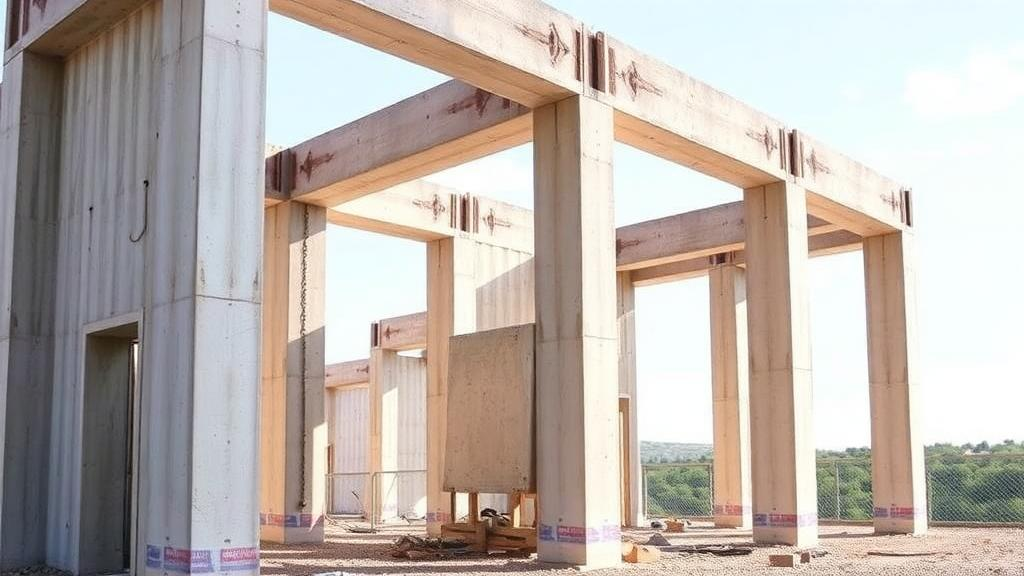
Every earthquake that strikes a city built of reinforced concrete frames delivers a brutal lesson about the walls between the columns. Engineers have long treated infill walls as non-structural partitions, elements that merely fill the gaps left by the load-bearing skeleton. Yet decades of post-earthquake surveys tell a different story: these walls interact with the frame around them, stiffening it, redirecting forces, and sometimes triggering catastrophic failure modes that no designer anticipated. A new experimental study published in the Bulletin of Earthquake Engineering now examines this interaction for one of the most promising modern building materials, the ceramsite aerated concrete block, and the results carry implications for how lightweight, energy-efficient buildings should be designed in seismic regions.
Ceramsite aerated concrete blocks, known in the literature as CACB, have been spreading rapidly through construction markets because they solve two problems at once. The blocks are remarkably light, thanks to a porous internal structure produced by gas-forming reactions during manufacture, and their trapped air voids give them excellent thermal insulation. That combination lowers dead loads on foundations and cuts heating and cooling energy, making the blocks attractive for sustainable construction. But lightness and insulation say nothing about how a wall made from these blocks behaves when the ground beneath a building shakes. A team led by Li Ruige of Taizhou University, working with collaborators from construction and materials companies in Zhejiang Province, set out to answer that question with full-scale laboratory testing rather than assumptions.
The researchers built three reinforced concrete frame specimens. One was left bare, with no infill walls at all, serving as the reference structure. The other two were fitted with CACB infill walls, one configuration solid and one incorporating a window opening, reflecting the reality that most real walls contain doors or windows. Each specimen was then subjected to quasi-static cyclic loading, a laboratory technique in which horizontal forces are pushed back and forth across the structure in progressively larger excursions. This method mimics the repeated reversals a building experiences during an earthquake and allows engineers to measure bearing capacity, stiffness, ductility, and energy dissipation with precision that real seismic events can never provide.
The findings confirm that infill walls are anything but passive. Compared with the bare frame, the frames containing CACB walls carried substantially higher horizontal loads before failing. The walls acted as diagonal bracing elements within the frame, engaging the surrounding beams and columns in compression and fundamentally altering the load path through the structure. Crucially, the walls also changed how the structure failed. Instead of concentrating damage at discrete plastic hinge zones in the beams and columns, the classic ductile mechanism that seismic design codes try to cultivate, the infilled frames developed a more uniform distribution of cracks across their members. Whether that redistribution is beneficial or hazardous depends on the design intent, but it demonstrates that ignoring infill walls in analysis means misjudging the entire failure sequence.
Stiffness and ductility told a trade-off story. The CACB infill walls increased the initial lateral stiffness of the frames, meaning the structures deflected less under a given load. That sounds desirable, and for serviceability it is, but the added stiffness came at the price of reduced ductility, the capacity to deform far beyond yield without losing strength. Ductility is the property that lets a building absorb earthquake energy through controlled damage rather than sudden collapse. The frames with solid infill walls, without window openings, lost even more ductility than the frames with pierced walls, because the unbroken panel presents a stiffer, more rigid constraint to the frame. Meanwhile, as loading cycles intensified, the infilled frames degraded in stiffness significantly faster than the bare frame, as cracking spread through the lightweight block masonry and the wall gradually shed its share of the load back to the concrete members.
Energy dissipation, the ultimate measure of how much seismic shaking a structure can absorb, produced one of the study’s most nuanced results. The solid CACB infilled frames dissipated more energy than the bare frame, with friction between cracking block surfaces and the frame interfaces contributing to damping. The frames with window openings, however, dissipated slightly less energy than the bare frame. The opening interrupts the diagonal compression strut that a solid wall forms, concentrating damage around the window reveals and reducing the effective contact area available for frictional energy loss. For architects and engineers, this means that the seismic contribution of an infill wall cannot be assessed without accounting for its openings, a detail that simplified design models routinely overlook.
To extend the reach of the experiments, the team built finite element models of all three specimens in ABAQUS, a commercial simulation platform widely used in structural engineering. The models reproduced the hysteresis loops, the force-displacement fingerprints of cyclic loading, as well as the skeleton curves that trace peak capacity across loading stages. Simulated failure characteristics and the entire force process agreed well with the laboratory observations. This validation matters because validated models allow researchers to explore configurations that would be prohibitively expensive to test physically, and it gives practicing engineers a computational tool they can trust when assessing existing buildings or designing new ones with CACB infill.
The most forward-looking part of the study concerns a humble material more familiar from car door seals than from structural engineering: ethylene propylene diene monomer, or EPDM, a synthetic rubber prized for its durability and elasticity. The researchers analyzed what happens when EPDM is placed as a flexible buffer between the infill wall and the surrounding frame. The simulation results showed that this soft interface significantly increased structural deformation capacity, energy dissipation, and ductility. In effect, the rubber layer decouples the stiff wall from the deforming frame, allowing the frame to flex during shaking without the wall acting as an unintended brace that attracts forces and then shatters. The authors conclude that EPDM functions as an effective flexible connection capable of reducing earthquake damage.
This finding places the study within a growing international research movement toward seismic isolation of infill walls. Conventional wisdom held that the stiffer the connection between wall and frame, the better the composite action. Earthquake after earthquake has exposed the flaw in that logic: rigidly connected infills create soft-story mechanisms when they fail on one floor but not another, and they shear off column ends by imposing concentrated contact forces. Flexible connections, whether rubber buffers, slotted details, or specially engineered joints, aim to let the wall ride along with the frame rather than fight it. The Taizhou results provide quantitative evidence that a simple, inexpensive elastomer strip can capture many of these benefits for lightweight aerated concrete construction.
The broader significance of the work lies at the intersection of two urgent agendas. Cities in seismic zones need buildings that protect their occupants during rare but devastating events, and the entire construction sector needs materials that cut embodied carbon and operational energy. Lightweight aerated blocks serve the second agenda beautifully, and this study shows that with informed structural design, and possibly a strip of rubber at the wall-frame interface, they can serve the first as well. The research, funded by the Zhejiang Provincial Natural Science Foundation under grant LGG20E080006 and supported by regional building materials companies, offers a template for how emerging sustainable materials should be vetted: not only for their thermal and weight advantages, but for the full, sometimes surprising, structural behavior they introduce when the ground begins to move.
Subject of Research: Seismic performance of reinforced concrete frames with ceramsite aerated concrete block infill walls
Article Title: Experimental study on seismic performance of reinforced concrete frame with ceramsite aerated concrete block infill wall
Article References: Ruige, L., Huadong, C., Yuhua, L., Jinfa, L., Yanru, W., Chongxin, L., & Lingchao, D. (2026). Experimental study on seismic performance of reinforced concrete frame with ceramsite aerated concrete block infill wall. Bulletin of Earthquake Engineering. https://doi.org/10.1007/s10518-026-02642-2
Image Credits: AI Generated
DOI: 10.1007/s10518-026-02642-2
Keywords: ceramsite aerated concrete block, infill wall, seismic performance, reinforced concrete frame, quasi-static cyclic loading, ductility, stiffness degradation, energy dissipation, EPDM flexible connection, ABAQUS finite element simulation, earthquake engineering, lightweight building materials
Cite Scienmag News
Violet Maxwell. (October 5, 2026). Lightweight Infill Walls Reshape How Concrete Frames Survive Earthquakes. Scienmag. https://scienmag.com/lightweight-infill-walls-reshape-how-concrete-frames-survive-earthquakes/
Violet Maxwell. "Lightweight Infill Walls Reshape How Concrete Frames Survive Earthquakes." Scienmag, 5 October 2026, https://scienmag.com/lightweight-infill-walls-reshape-how-concrete-frames-survive-earthquakes/. Accessed 5 October 2026.
Violet Maxwell. "Lightweight Infill Walls Reshape How Concrete Frames Survive Earthquakes." Scienmag. October 5, 2026. https://scienmag.com/lightweight-infill-walls-reshape-how-concrete-frames-survive-earthquakes/


