


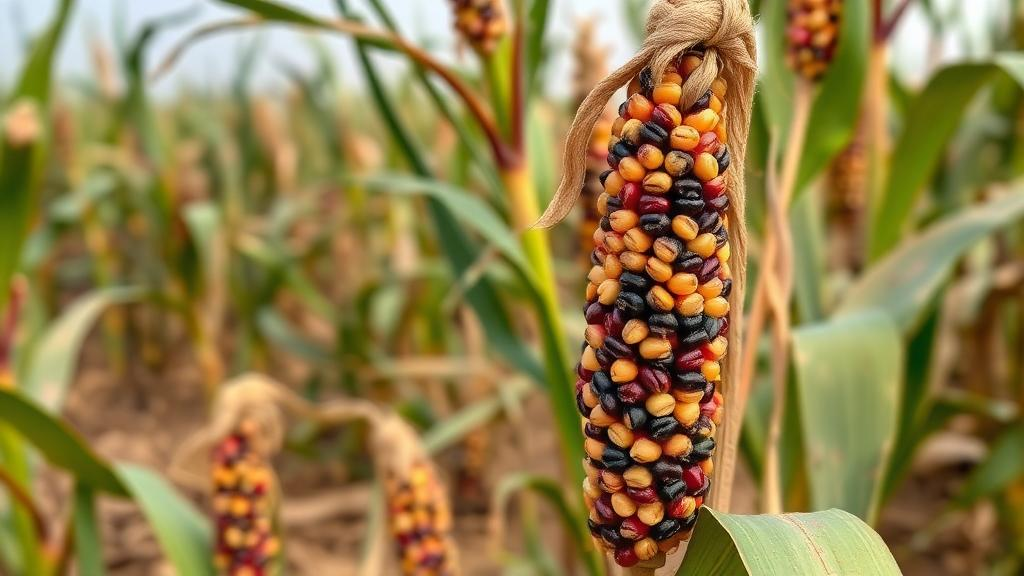
On smallholder farms across Kaduna State in northwestern Nigeria, the same fields that feed families year after year are also quietly accumulating a suite of heavy metals, some of them delivered in the very fertilizers farmers apply to boost yields. A new study published in the journal Environmental Geochemistry and Health has now traced exactly how six of these metals move from fertilized tropical soils into three of the region’s most important food crops, and the results point to an unexpected culprit on the dinner plate. Maize, the staple grain consumed across much of West Africa, emerged as the crop of greatest concern, with a computed non-carcinogenic hazard index well above the safety threshold used by public health regulators.
The research, carried out by Olawale Gabriel Olowomofe of the Federal University, Oye Ekiti, and Babatope Ebenezer Faweya of Ekiti State University, Ado Ekiti, focused on paired samples of soil and edible plant tissue collected from fertilized farms at five locations across Kaduna State. The crops chosen for scrutiny were okra, a widely eaten vegetable; maize, the dominant cereal; and cassava, the starchy root that anchors food security for millions of smallholders. Thirty paired soil-and-crop samples were collected in total, a design that allowed the researchers to compare, plot by plot, what was present in the ground against what actually ended up in the portion of the plant that people eat.
Each sample was digested using the United States Environmental Protection Agency’s standard acid digestion method 3050B and then analysed by flame atomic absorption spectrometry, a workhorse technique that quantifies metal concentrations by measuring the light absorbed by atoms excited in a flame. The team targeted six metals: lead, copper, iron, zinc, cadmium and nickel. These were not chosen arbitrarily. Lead and cadmium are toxic even at low exposures and have no known physiological benefit, while copper, zinc and nickel are essential or trace nutrients that become harmful at elevated doses. Iron, abundant in tropical soils, served as a useful benchmark for natural geochemical background.
The soil numbers told the first part of the story. Mean concentrations across the surveyed farms were 20.54 milligrams per kilogram for lead, 42.95 for copper, 3,350 for iron, 116.47 for zinc, 0.141 for cadmium and 38.41 for nickel. The edible tissues, by contrast, contained far lower levels: 0.650 milligrams per kilogram of lead, 15.83 of copper, 908.57 of iron, 50.07 of zinc, 0.014 of cadmium and just 0.174 of nickel. That gap between soil and plant is expected, because plant roots act as selective filters, but the size of the gap varies enormously from metal to metal and from crop to crop, and that variation is precisely what determines dietary exposure.
To capture that variation, the researchers calculated transfer factors, simple but powerful ratios that express the concentration of a metal in edible tissue relative to its concentration in the corresponding soil. A transfer factor near one would mean the plant takes up the metal almost without discrimination; a factor far below one means the soil-plant barrier is doing its job. Across all three crops, lead transfer remained low, a reassuring sign that even where soil lead is elevated, the metal is strongly bound to soil particles and poorly mobilized into food. Yet the crops were not identical. Maize accumulated more lead in its edible tissue than either cassava or okra, a difference the authors attribute to the physiology of the cereal and the specific tissues harvested.
The team went beyond simple ratios, deploying multivariate statistics to untangle the relationships among metals, soil properties and crop types. Multivariate approaches such as correlation and factor analysis can reveal whether metals move together, which in turn hints at shared sources. Metals that co-vary across fields may share a common origin, such as phosphate-based fertilizers, which are known to carry trace cadmium and lead as impurities, or they may reflect background geology. Previous work on fertilizers sold commercially in Nigeria has documented trace metal content in inorganic products, and global assessments, including a 2025 analysis in Science, have warned that toxic metal pollution of agricultural soils now threatens both crop productivity and human health on a planetary scale.
The most consequential part of the study, however, was the dietary risk assessment. The researchers computed the target hazard quotient, or THQ, a standard screening metric that estimates the ratio of a contaminant’s estimated daily intake to a reference dose considered safe over a lifetime of exposure. A THQ below one is conventionally interpreted as negligible non-carcinogenic risk; values above one signal that the screening threshold has been crossed and that more detailed assessment is warranted. For maize, the combined THQ came out at 2.98, nearly three times the threshold, with copper and lead driving most of the hazard. Cassava also edged over the line at 1.07, while okra registered a negligible 0.011, roughly 270 times below the limit.
Carcinogenic risk was assessed separately for the two metals with recognized cancer potency, lead and cadmium, using slope factors drawn from regulatory toxicology databases. The combined lead-plus-cadmium cancer risk was again highest for maize, at 3.17 multiplied by ten to the power of minus five. In risk communication terms, this figure sits within the range that many agencies treat as acceptable or borderline, typically one in a million to one in ten thousand, but its position near the upper end of that band, driven by a staple consumed daily, gives it practical weight. The authors emphasize that these are screening-level estimates based on average consumption patterns and mean concentrations, not measurements of individual exposure, and that real-world risk will vary with diet, portion size and local soil conditions.
Why does maize stand out? The answer likely lies in a combination of plant biology and consumption volume. Cereals are known in the soil-plant literature to translocate certain metals more efficiently than fruiting vegetables or root crops, and maize kernels constitute a dietary staple eaten in large quantities across Nigeria, multiplying any per-kilogram hazard by sheer intake. Cassava’s marginal exceedance reflects a similar logic: the root stores what it takes up, and cassava is eaten in volume. Okra, consumed in smaller amounts and apparently efficient at excluding metals from its fruit, poses little concern despite growing in the same fields. The study’s crop-specific design is what makes this hierarchy visible; a single-crop survey would have missed it entirely.
The practical implications reach beyond Kaduna State. The findings identify maize and cassava as priority crops for continued monitoring of copper and lead in agricultural fields subject to routine fertilizer use, and they suggest that fertilizer composition deserves attention as a manageable input in the metal balance of tropical farmland. Simple interventions, from sourcing lower-impurity fertilizers to periodic soil testing and crop rotation, could bend the exposure curve without undermining the productivity that fertilization is meant to deliver. The authors have deposited their underlying data in the Zenodo repository, making the dataset available for reuse in wider regional assessments. As global attention turns to the slow accumulation of toxic metals in the world’s farmland, this study offers a granular, crop-by-crop picture of where the risk actually sits on the plate, and a reminder that the safety of a harvest depends as much on what farmers put into the soil as on what the soil already contains.
Subject of Research: Heavy metal transfer from fertilized tropical smallholder soils to food crops and associated dietary health risks in Kaduna State, Nigeria
Article Title: Assessment of crop-specific heavy metal transfer and dietary exposure in fertilized tropical smallholder soils in Kaduna State Nigeria
Article References: Olowomofe, O. G., & Faweya, B. E. (2026). Assessment of crop-specific heavy metal transfer and dietary exposure in fertilized tropical smallholder soils in Kaduna State Nigeria. Environmental Geochemistry and Health, 48(15), Article 622. https://doi.org/10.1007/s10653-026-03521-0
Image Credits: AI Generated
DOI: 10.1007/s10653-026-03521-0
Keywords: heavy metals, soil contamination, fertilizer, maize, cassava, okra, dietary exposure, transfer factor, target hazard quotient, Nigeria, smallholder agriculture, food safety
Cite Scienmag News
Alan Morgan. (October 5, 2026). Heavy Metals in Nigerian Smallholder Farms Reveal Maize as Top Dietary Risk. Scienmag. https://scienmag.com/heavy-metals-in-nigerian-smallholder-farms-reveal-maize-as-top-dietary-risk/
Alan Morgan. "Heavy Metals in Nigerian Smallholder Farms Reveal Maize as Top Dietary Risk." Scienmag, 5 October 2026, https://scienmag.com/heavy-metals-in-nigerian-smallholder-farms-reveal-maize-as-top-dietary-risk/. Accessed 5 October 2026.
Alan Morgan. "Heavy Metals in Nigerian Smallholder Farms Reveal Maize as Top Dietary Risk." Scienmag. October 5, 2026. https://scienmag.com/heavy-metals-in-nigerian-smallholder-farms-reveal-maize-as-top-dietary-risk/


