


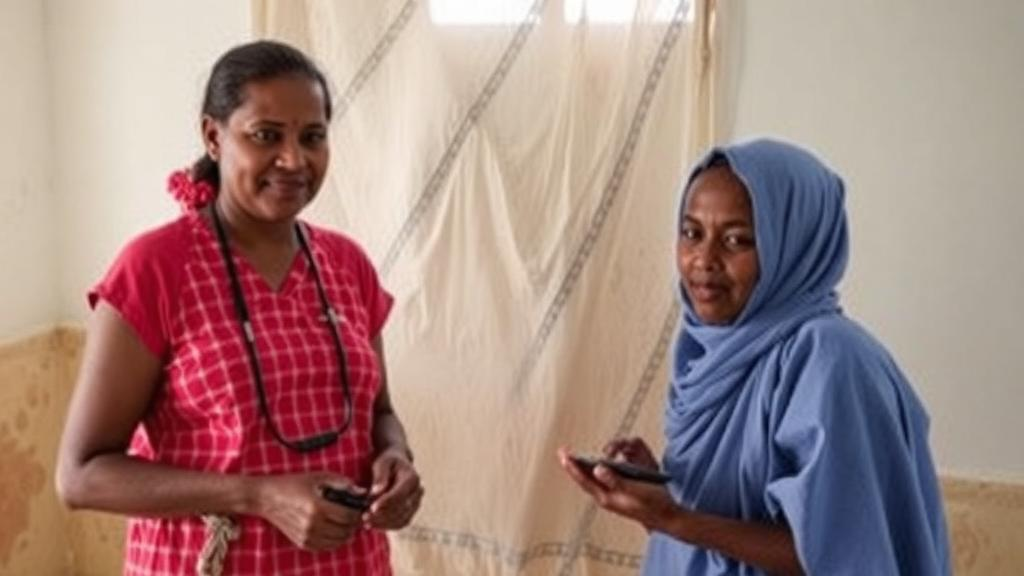
In the remote villages of rural Uganda, the person most likely to deliver first-line healthcare is not a doctor or a nurse but a community health worker, often a volunteer with modest training who provides health education, basic treatment, and referrals to a health system that may be hours away on foot. These workers are the connective tissue of primary healthcare across much of sub-Saharan Africa, and global health strategists see their rapid scale-up as essential to addressing chronic health workforce shortages and achieving universal health coverage. Yet the volunteer model has a structural weakness that programs have struggled to fix for decades: community health workers are frequently underfunded, poorly supplied, thinly supervised, and unpaid or irregularly remunerated, which drives attrition and erodes the very trust that makes them effective. A new study published in BMC Health Services Research examines whether a hybrid model, in which health workers remain embedded in the public system while supplementing their income through small-scale sales of essential health products, can break that cycle.
The research, led by Martha Akulume of the School of Public Health at Makerere University in Kampala together with colleagues from Madiro, the University of Toronto, and Vrije Universiteit Amsterdam, investigated what the team calls a CHW+ approach. The model combines three elements: pragmatic micro-entrepreneurship, a sustainable supply chain, and telehealth support. It is implemented by a not-for-profit organization, Healthy Entrepreneurs, using a revolving fund to facilitate access to health commodities. In practice, each community health worker, designated a CHW+, remains a recognized part of Uganda’s public health structure, typically as a member of the Village Health Team system, while also operating as a micro-entrepreneur who purchases essential health products at a subsidized rate and sells them to neighbors at an affordable markup. The margin becomes income; the revolving fund recycles proceeds into fresh stock; and the telehealth component connects workers to clinical advice when cases exceed their training.
The appeal of the design is that it attacks three persistent failure points simultaneously. Unreliable access to essential supplies, one of the most cited grievances of community health workers, is addressed by a distribution chain that does not depend on government procurement cycles. Insufficient remuneration is addressed by the sales margin, which rewards activity and availability rather than depending on donor budgets. Limited supervision is partially offset by telehealth support and organizational follow-up. But the researchers were careful not to assume that a clever design guarantees success on the ground. Their central question was empirical: what factors actually determine whether the CHW+ model functions, and functions durably, in the varied social, economic, and political landscapes of rural Uganda?
To answer it, the team deployed a mixed-methods design with two complementary strands. The first was qualitative: 31 key-informant interviews with people positioned to observe the model from different angles, including health officials, organizational staff, and other stakeholders. The second was quantitative: a descriptive analysis of order volume, order frequency, and persistence among 1,003 CHW+ workers operating across four districts. Order data served as a proxy for the economic pulse of each worker’s micro-enterprise. A community health worker who places regular, sustained orders is likely reaching customers, earning income, and staying engaged; one whose orders spike and then vanish may have hit a barrier, lost motivation, or been pulled away by other obligations. Ethics approval was obtained from the Makerere University Institutional Review Board and the Uganda National Council of Science and Technology, and all key informants provided written informed consent.
From the triangulation of interviews and order data, five domains emerged as the forces shaping the model’s functioning: demand for CHW+ services, national and district policies, community influences, organizational dynamics, and individual CHW+ characteristics. The demand domain proved especially consequential. Community health workers were most valuable in areas where the public health system suffered frequent stock-outs of essential medicines, because in those settings the CHW+ became the only reliable local source of items such as oral rehydration salts and basic treatments. Where government supply chains functioned well, or where proximity to a health facility gave residents easy alternatives, the commercial channel mattered less. Most strikingly, the presence of other non-governmental organizations distributing free medicines could actively undermine the model, since free products outcompete even affordable ones in poor communities.
The policy domain operated at two levels. National policies set the formal status of community health workers and the boundaries of what they may legitimately do and sell, while district-level leadership determined how much practical room the model had to operate. The study found that local leadership changes could be destabilizing: in some districts, an initial surge of activity was followed by decline after a supportive official was replaced by one who was indifferent or hostile. Conversely, districts with engaged local leaders and supportive structures saw sustained success. This sensitivity to administrative turnover is a sobering finding for program designers, because it means the durability of a health financing innovation can hinge on personnel decisions far above the village level.
Community influences formed the third domain, and they were largely economic. Population density, household purchasing power, and local market dynamics all shaped how much a CHW+ could realistically sell. In densely settled, economically active areas, a worker could build a viable customer base; in sparsely populated or impoverished areas, the same effort yielded far less. Competition from private drug shops and other commercial outlets also mattered, positioning the CHW+ within a real marketplace rather than a protected niche. The fourth domain, organizational dynamics, captured how the implementing NGO’s own performance, including the reliability of its supply chain, the attractiveness of its product portfolio, and the quality of its support, translated into worker activity. A model that depends on workers buying and reselling products is only as strong as the pipeline behind them.
The fifth domain was individual. Financial literacy, entrepreneurial skill, and confidence in handling money and stock distinguished thriving CHW+ workers from struggling ones. Equally important was the presence or absence of alternative income sources: workers who relied entirely on the micro-enterprise faced pressure that could push them out of health work altogether, while those with diversified livelihoods could persist through lean periods. This finding cuts against the intuition that the model works best for those who need it most. The workers most able to sustain a micro-enterprise may be those least dependent on it, which raises equity questions about who ends up serving the poorest communities.
Taken together, the district-level variation tells the most important story of the study. Some districts sustained success, supported by strong demand and local backing. Others followed a boom-and-bust trajectory, with an initial surge of enthusiasm and orders followed by decline, often triggered by leadership changes or the arrival of an NGO distributing free products. The authors conclude that a pragmatic micro-entrepreneurship approach can support community health workers, but only under specific conditions, and that implementation must be context-sensitive and continuously monitored rather than rolled out as a uniform template. The model is not a self-sustaining machine; it is a fragile ecosystem whose health depends on demand, policy goodwill, community economics, organizational competence, and individual capacity all aligning at once.
The implications reach well beyond Uganda. As governments and donors search for ways to finance community health programs that donor fatigue has left chronically underfunded, hybrid models that blend public service with earned income are increasingly attractive. This study offers both a proof of concept and a caution. It demonstrates that community health workers can remain embedded in the public system while operating micro-enterprises, and that order data can serve as a real-time monitor of program vitality. But it also shows that such models can be wounded by forces no training curriculum can control: a change of district official, a rival NGO’s free medicine distribution, or a local economy too thin to support retail. Sustainable community health, the research suggests, is less a business plan than an ongoing negotiation between a program and its context, one that demands vigilance long after the launch celebration ends.
Subject of Research: Factors shaping a micro-entrepreneurship model for community health workers in rural Uganda
Article Title: Towards a sustainable approach: understanding the factors shaping a micro-entrepreneurship approach for community health workers in rural Uganda
Article References: Akulume, M., van Lettow, M., Rutebemberwa, E., van Leth, F., Hoekstra, T., & Kok, M. O. (2026). Towards a sustainable approach: understanding the factors shaping a micro-entrepreneurship approach for community health workers in rural Uganda. BMC Health Services Research. https://doi.org/10.1186/s12913-026-15765-8
Image Credits: AI Generated
DOI: 10.1186/s12913-026-15765-8
Keywords: community health workers, micro-entrepreneurship, rural Uganda, health systems, supply chain, telehealth, universal health coverage, mixed methods, NGO, sustainability, attrition, revolving fund
Cite Scienmag News
Ophelia Keating. (October 5, 2026). Selling Health, Saving Lives: How Micro-Entrepreneurship Could Keep Rural Health Workers Afloat. Scienmag. https://scienmag.com/selling-health-saving-lives-how-micro-entrepreneurship-could-keep-rural-health-workers-afloat/
Ophelia Keating. "Selling Health, Saving Lives: How Micro-Entrepreneurship Could Keep Rural Health Workers Afloat." Scienmag, 5 October 2026, https://scienmag.com/selling-health-saving-lives-how-micro-entrepreneurship-could-keep-rural-health-workers-afloat/. Accessed 17 October 2026.
Ophelia Keating. "Selling Health, Saving Lives: How Micro-Entrepreneurship Could Keep Rural Health Workers Afloat." Scienmag. October 5, 2026. https://scienmag.com/selling-health-saving-lives-how-micro-entrepreneurship-could-keep-rural-health-workers-afloat/


