


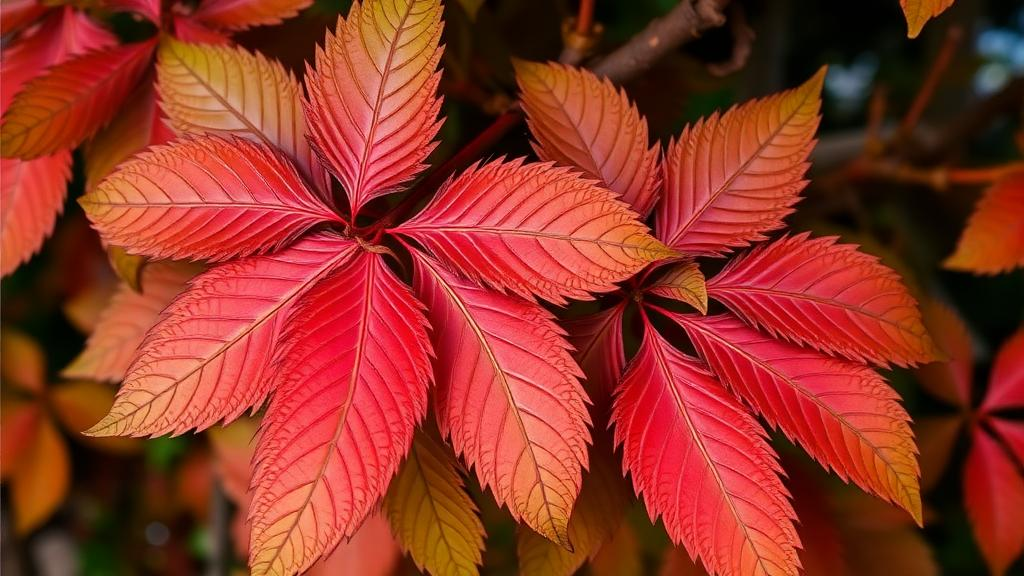
Eucalyptus trees are famous for their tall trunks and aromatic oils, but some of their most striking features are their leaves. When environmental conditions turn harsh, certain eucalyptus leaves abandon their familiar green and flush into deep reds and purples, a change driven by the accumulation of plant pigments called anthocyanins. These pigments are more than decoration: they act as a chemical shield, helping the tree cope with stresses such as intense light and nutrient scarcity. A new study published in BMC Plant Biology by Zhiyu Zeng, Yaodan Tang, and colleagues at Guangxi University has now mapped, in unprecedented detail, the genetic machinery that governs this color change, and the results point to a surprising regulatory layer that most studies of plant pigmentation have overlooked.
The research team combined several powerful sequencing technologies to compare two kinds of eucalyptus leaves: ordinary green leaves and anthocyanin-rich red leaves. Using PacBio full-length transcriptome sequencing, a method that reads RNA molecules from end to end rather than in fragments, they captured 25,953 high-quality transcripts from green leaves and 32,821 from red leaves. This long-read approach matters because it allows scientists to see entire RNA molecules, including the subtle variations that shorter-read methods often stitch together incorrectly or miss entirely. Alongside this, the team performed standard RNA sequencing to measure how abundantly each transcript was produced in the two leaf types.
The scale of hidden diversity they uncovered was remarkable. Of the transcripts they identified, 10,766 in green leaves and 11,637 in red leaves represented novel isoforms of genes that had already been annotated in the eucalyptus genome. In other words, a substantial fraction of the tree’s RNA output consists of versions of known genes that had never been catalogued before. The primary engine of this diversity was alternative splicing, the process by which a single gene’s RNA copy is cut and reassembled in different ways to produce multiple distinct messenger RNAs, each of which can potentially encode a different protein or carry different regulatory properties.
Alternative splicing is well known in animals, where it allows a limited set of genes to generate an enormous range of proteins, but its role in plants, and in plant pigment biology specifically, has received far less attention. What makes the new study particularly intriguing is its finding that most of the structural genes involved in anthocyanin biosynthesis, the enzyme-coding genes that chemically build the pigment step by step, each produced multiple alternatively spliced isoforms. This pattern suggests that the splicing machinery is not simply noise; it may be an active regulatory mechanism that fine-tunes how much pigment a leaf produces, or when and where it produces it, depending on the circumstances the tree faces.
Turning from the structural genes to their controllers, the researchers searched the transcriptome for transcription factors, the DNA-binding proteins that switch genes on and off, with links to flavonoid biosynthesis, the broader chemical pathway to which anthocyanins belong. They identified twelve MYB genes as candidates. The MYB family is one of the largest families of transcription factors in plants, and members of a particular subgroup, including the well-studied MYB113 gene, are famous master switches that activate entire suites of anthocyanin biosynthesis genes at once. Among the twelve candidates, the team found three homologs of MYB113, which they named MYB113a, MYB113b, and MYB113c.
The three homologs did not behave identically. When the researchers exposed the plants to different environmental and hormonal cues, including cytokinin, a plant hormone involved in growth and development; varying levels of nitrogen, a nutrient whose scarcity often triggers pigment production; and high-light treatment, a classic stress that induces anthocyanin accumulation, each MYB113 gene responded with its own distinct expression pattern. This divergence implies that the three genes have specialized over evolutionary time, potentially allowing the tree to deploy pigment production in response to different combinations of signals rather than a single generic stress response.
One of the three stood out for an unexpected reason. MYB113c showed relatively low sequence similarity to MYB113 genes that had been functionally characterized in other plant species, raising the question of whether it truly worked as an anthocyanin regulator at all. To answer this, the team carried out functional analyses in both eucalyptus itself and in tobacco, a widely used experimental plant that serves as a convenient testing ground for gene function. The outcome was clear: despite its unusual sequence, MYB113c acts as a positive regulator of anthocyanin accumulation, promoting the buildup of the red pigment when it is active. This finding expands the known repertoire of anthocyanin switches and suggests that sequence-based predictions alone can miss functional regulators in less-studied tree genomes.
The broader significance of the work lies in how it connects two levels of gene regulation. On the transcriptional level, the study identifies specific MYB113 genes that respond to environmental signals and likely drive the expression of pigment-building enzymes. On the post-transcriptional level, it reveals that the very genes in the anthocyanin pathway are extensively reshaped by alternative splicing, adding a layer of control that operates after a gene has been switched on. Together, these layers may explain how eucalyptus achieves precise, condition-dependent control over a metabolically costly process like pigment production, producing anthocyanins only when the protective benefit outweighs the expense.
For plant scientists, the study provides a rich catalog of full-length transcripts and novel isoforms in a genus of enormous ecological and economic importance. Eucalyptus plantations cover vast areas of the tropics and subtropics, supplying timber, paper pulp, and oils, and the trees’ responses to stress are of direct practical concern. Understanding which regulators link environmental cues to anthocyanin accumulation could eventually inform breeding programs aimed at producing trees better equipped to handle high light, drought, or poor soils, or even ornamental varieties with enhanced red coloration.
For the wider public, the study is a reminder that a splash of red in a forest canopy is the visible tip of an intricate molecular process. A single gene can yield many RNA messages; a family of related switches can each listen for different signals; and a tree integrates all of this information to decide whether its leaves should stay green or turn red. The Guangxi University team’s work, published open access so that anyone can read the full details, shows that even in a well-studied group of plants, fundamental discoveries about how genes are read, spliced, and regulated are still waiting to be made, one full-length RNA molecule at a time.
Subject of Research: Transcriptional and post-transcriptional regulation of anthocyanin biosynthesis by MYB113 genes in Eucalyptus
Article Title: Transcriptional and post-transcriptional insights into MYB113-associated anthocyanin regulation in Eucalyptus
Article References: Zeng, Z., Tang, Y., Liao, Y., Lin, K., Ye, K., Xu, Z.-F., & Ni, J. (2026). Transcriptional and post-transcriptional insights into MYB113-associated anthocyanin regulation in Eucalyptus. BMC Plant Biology. https://doi.org/10.1186/s12870-026-10027-5
Image Credits: AI Generated
DOI: 10.1186/s12870-026-10027-5
Keywords: Eucalyptus, anthocyanin, MYB113, alternative splicing, transcriptomics, PacBio sequencing, flavonoid biosynthesis, transcription factors, plant stress response, cytokinin, nitrogen, high light
Cite Scienmag News
Juliet Wilcox. (October 5, 2026). Hidden RNA Switches May Explain How Eucalyptus Leaves Turn Red Under Stress. Scienmag. https://scienmag.com/hidden-rna-switches-may-explain-how-eucalyptus-leaves-turn-red-under-stress/
Juliet Wilcox. "Hidden RNA Switches May Explain How Eucalyptus Leaves Turn Red Under Stress." Scienmag, 5 October 2026, https://scienmag.com/hidden-rna-switches-may-explain-how-eucalyptus-leaves-turn-red-under-stress/. Accessed 5 October 2026.
Juliet Wilcox. "Hidden RNA Switches May Explain How Eucalyptus Leaves Turn Red Under Stress." Scienmag. October 5, 2026. https://scienmag.com/hidden-rna-switches-may-explain-how-eucalyptus-leaves-turn-red-under-stress/


