


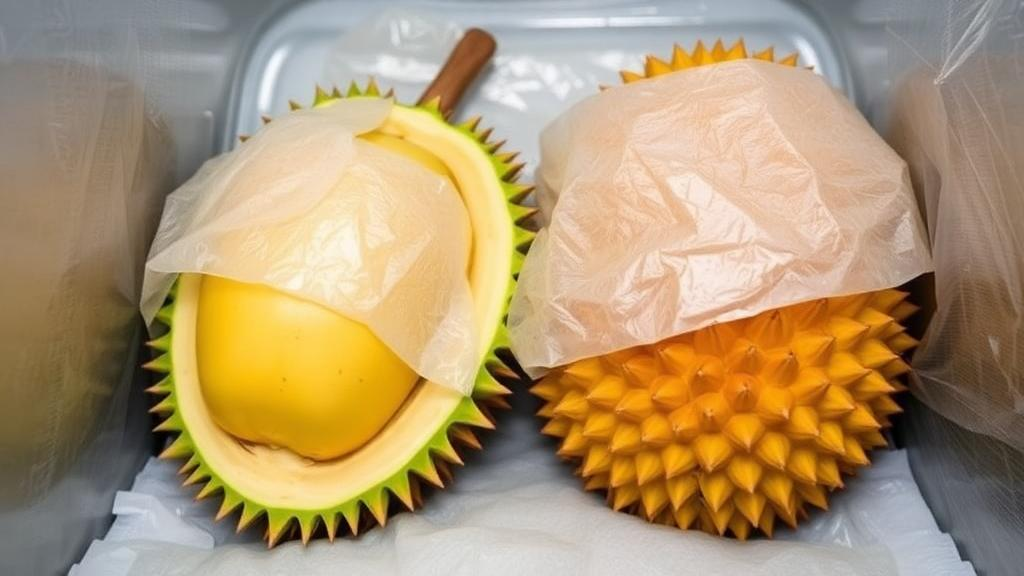
The durian has earned its title as the king of fruits through a combination of creamy texture and an aroma so powerful that the fruit is banned from hotels and public transport across Southeast Asia. Among the many cultivars grown in Malaysia, Musang King commands the highest prices and the fiercest loyalty, and its international market depends on a remarkable piece of cold-chain engineering: whole fruits are flash-frozen at minus 110 degrees Celsius for two hours, then stored at minus 20 degrees for months until they reach distant customers. But what actually happens inside the pulp during that long, deep freeze has remained largely a mystery. A new study published in the Journal of Agriculture and Food Research now offers the most detailed chemical portrait yet of Musang King durian during twelve months of frozen storage, and the results reveal that even at temperatures where cellular metabolism is essentially arrested, the fruit’s chemistry is far from static.
A research team led by Eliwanzita Sospeter, working with Phebe Ding and Teh Huey Fang, harvested thirty fully ripe Musang King durians from commercial orchards in Raub, Pahang, during the November 2022 season. The fruits, each weighing around 1.4 kilograms and free of defects, were rushed to a processing facility in nearby Bentong for cryogenic freezing. Researchers verified that the thermal centre of each fruit reached roughly minus 19.5 degrees Celsius, a threshold that satisfies international quick-frozen food standards, before the fruits were sealed in polystyrene boxes and placed in frozen storage. Six fruits were pulled from the freezer at each of five time points: zero, three, six, nine and twelve months. After a standardized two-hour thaw at 25 degrees, matching common Malaysian commercial practice, the pulp from each fruit was analyzed for texture, acidity, sugars, volatile aroma compounds, polar metabolites and fatty acids.
The physicochemical results were a study in contrasts. Pulp firmness and soluble solids content, the two attributes most directly tied to the eating experience, barely budged across the entire year, a testament to how effectively cryogenic freezing limits ice-crystal damage to cellular structures. Yet the subtler chemistry told a different story. Titratable acidity fell by nearly 26 percent over twelve months, reducing sugars rose by 20 percent, and the ratio of soluble solids to acidity climbed by more than 39 percent. Because the balance between sweetness and acidity is central to how consumers perceive fruit flavor, these shifts matter even if a refractometer reading looks unchanged. The researchers attribute the declining acidity to gradual changes in the organic acid pool, potentially amplified during thawing, while the rising reducing sugars likely reflect the conversion of non-reducing sugars into their reducing forms.
To peer deeper into the fruit’s biochemistry, the team turned to gas chromatography coupled with high-resolution Orbitrap mass spectrometry, an analytical setup capable of resolving dozens of compounds in a single run. From the polar metabolite fraction, they putatively identified 41 compounds spanning amino acids, sugars, organic acids and sugar alcohols. Principal component analysis showed that samples separated cleanly by storage duration, with the first two components alone capturing nearly 55 percent of the variation. Freshly frozen fruit and three-month samples clustered together, indicating that the early months of storage are chemically quiet, but by six months the metabolite landscape had shifted decisively, and nine- and twelve-month samples carried their own distinct signatures.
A supervised modeling approach called partial least squares-discriminant analysis then pinpointed the compounds most responsible for those differences. Nineteen polar metabolites emerged as discriminant markers, including eight sugars, four organic acids, three amino acids and derivatives, two sugar alcohols, a nucleoside and an amine. Notably, the amino acids L-aspartic acid, glutamic acid and 3-hydroxyproline all increased significantly as storage lengthened. Since glutamate and aspartate are key contributors to umami and sour taste notes in fruit, their accumulation has direct flavor implications. The authors are careful about interpretation, however: at minus 20 degrees, active stress metabolism is implausible. They suggest instead that ice-induced disruption of vacuolar and cellular membranes exposes proteins to peptidases, allowing slow proteolytic degradation during storage and accelerated breakdown during thawing to release free amino acids.
The sugar profile evolved in equally intriguing ways. Levels of D-mannose, sucrose, D-xylose, palatinose and several other carbohydrates rose significantly, while mannose-6-phosphate declined. The sucrose increase is compatible with a cryoprotective role, since sugars are known to stabilize membranes and maintain osmotic balance during freezing stress in many plant tissues. But the researchers also raise a more prosaic possibility: ice crystals that form and recrystallize over months of storage progressively rupture cellular compartments, and when the fruit is later thawed and extracted, those damaged tissues simply release more of their soluble contents. In other words, some of the measured chemical change may reflect increased extractability rather than genuine biochemical transformation, a caveat the team acknowledges throughout the study.
Pathway enrichment analysis mapped the discriminant metabolites onto known biochemical networks and highlighted three significantly enriched routes: alanine, aspartate and glutamate metabolism; galactose metabolism; and glyoxylate and dicarboxylate metabolism. Citric acid, a central intermediate of the tricarboxylic acid cycle, declined steadily and mirrored the drop in titratable acidity, while succinic, gluconic and glyceric acids all rose. The enrichment analysis identifies biochemical associations rather than proving mechanisms, but it provides a coherent framework linking the observed shifts in amino acids, sugars and organic acids to the fruit’s core metabolic architecture.
The volatile compounds that give durian its infamous aroma showed their own time-dependent evolution. The headspace of Musang King is dominated by esters and sulfur compounds, and the profiling captured 53 volatile substances overall. The story here was one of loss and replacement: fruity, sweet-smelling esters such as ethyl butanoate, methyl butanoate and ethyl propanoate, which are hallmark contributors to durian’s appealing notes, declined steadily and in some cases vanished entirely by twelve months. Meanwhile, sulfur-heavy compounds including trithiolanes and thiazoles, along with several alcohols, increased in the three-, six- and twelve-month samples. Curiously, methyl octanoate and methyl hexanoate, absent at the start, appeared only after six months of storage, suggesting that cumulative structural damage from ice recrystallization may progressively liberate compounds that were previously locked away. Thirteen volatile markers were flagged as discriminant compounds, and together with the metabolite markers they paint a picture of an aroma profile that drifts measurably away from the fresh fruit over the course of a year.
One dataset offered reassuring stability: the relative proportions of the nine fatty acids identified in the pulp showed no significant change across the full storage period, echoing earlier findings in sweet corn and olives stored at sub-zero temperatures. Because the analysis measured relative composition rather than absolute concentrations, the authors caution that absolute amounts could still have shifted. The final integration step, a multiple factor analysis combining all four data blocks, accounted for 75 percent of total variance in its first two dimensions and revealed a non-monotonic trajectory: minimal change from zero to three months, a pronounced shift by six months, and then a partial reversal in direction at nine and twelve months. The volatile and metabolite datasets drove the primary dimension of variation, while physicochemical attributes and fatty acids contributed along a separate axis.
The study comes with honest limitations. All samples were thawed before analysis, so storage effects and thawing effects cannot be fully disentangled, and the discriminant markers were identified at putative level without confirmation against authentic reference standards. No sensory panel was involved, so the link between these chemical shifts and what a durian lover actually tastes remains to be established. Even so, the work delivers something the Malaysian durian industry has lacked: a molecular timeline of its flagship export’s journey through the frozen supply chain. With thirteen flavor-linked markers now identified, the groundwork is laid for validated quality tests that could tell exporters, regulators and consumers exactly how much chemical drift a given frozen Musang King has experienced, and ultimately help define how long the king of fruits can reign from the freezer without losing its crown.
Subject of Research: Chemical quality changes in Musang King durian during 12 months of frozen storage
Article Title: Integrated metabolomic and chemometric profiling reveals quality-related chemical changes in Musang King durian during long-term frozen storage
Article References: Sospeter, E., Ding, P., & Fang, T. H. (2026). Integrated metabolomic and chemometric profiling reveals quality-related chemical changes in Musang King durian during long-term frozen storage. Journal of Agriculture and Food Research, 31, Article 103314. https://doi.org/10.1016/j.jafr.2026.103314
Image Credits: AI Generated
DOI: 10.1016/j.jafr.2026.103314
Keywords: durian, Musang King, frozen storage, metabolomics, volatile organic compounds, fatty acids, cryogenic freezing, food quality, flavor chemistry, GC-MS, postharvest, Malaysia
Cite Scienmag News
Alexandra Wallace. (October 4, 2026). Frozen for a Year: Metabolomics Tracks How Musang King Durian Changes in Storage. Scienmag. https://scienmag.com/frozen-for-a-year-metabolomics-tracks-how-musang-king-durian-changes-in-storage/
Alexandra Wallace. "Frozen for a Year: Metabolomics Tracks How Musang King Durian Changes in Storage." Scienmag, 4 October 2026, https://scienmag.com/frozen-for-a-year-metabolomics-tracks-how-musang-king-durian-changes-in-storage/. Accessed 4 October 2026.
Alexandra Wallace. "Frozen for a Year: Metabolomics Tracks How Musang King Durian Changes in Storage." Scienmag. October 4, 2026. https://scienmag.com/frozen-for-a-year-metabolomics-tracks-how-musang-king-durian-changes-in-storage/


