


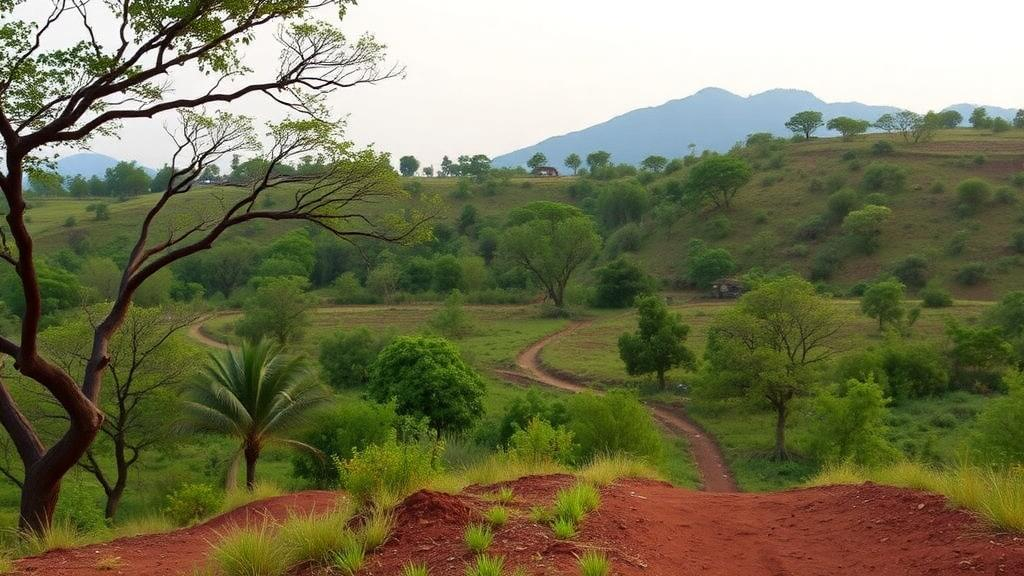
For decades, the global conservation movement has been haunted by an uncomfortable question: do protected areas help or harm the people who live around them? A new study from Ethiopia offers one of the most statistically rigorous answers yet, and it leans decisively toward help. Researchers from Arba Minch University examined the livelihoods of 440 households living adjacent to Borena Saynt Werehimeno National Park, a protected landscape in the Ethiopian Highlands, and found that families who participated in community-based conservation schemes earned substantially more than comparable families who did not. After correcting for the fact that participation is voluntary and therefore self-selected, the economists estimated that involvement raised annual household income by 32.8 percent and consumption expenditure by 23.7 percent. The findings, published in the journal Discover Sustainability, challenge the long-standing ‘parks versus people’ narrative that has framed conservation policy debates for half a century.
The research team, led by Bizuayehu Ambaye Misganaw, confronted a methodological problem that plagues nearly every evaluation of conservation programs: the families who join such schemes are almost certainly different from those who stay out. Perhaps they are more entrepreneurial, better educated, or simply live closer to the park boundary. If analysts naively compare participants with non-participants, they risk attributing to the program advantages that motivated households would have achieved anyway. To untangle this, the authors deployed an endogenous switching regression model, a statistical framework that simultaneously models the decision to participate and the income outcomes that follow. Crucially, they used a spatial proximity instrument, exploiting variation in households’ distance from the park to isolate exogenous drivers of participation from unobserved traits like ambition or skill.
The technical machinery matters because the stakes are high. Protected areas now cover a substantial share of the terrestrial surface of many developing countries, and Ethiopia’s national parks sit amid some of the densest rural populations on the continent. When a park fences off grazing land or restricts firewood collection, the costs fall on herders and farmers who often have no safety net. When tourism revenue or employment flows in, the benefits may be captured by outsiders or local elites. Whether community-based conservation, an approach that formally involves residents in managing and benefiting from protected resources, can deliver genuine welfare gains has therefore become a central empirical question for both conservation biology and development economics.
Borena Saynt Werehimeno National Park provides an ideal testing ground. Located in the Amhara region of the Ethiopian Highlands, the park protects Afroalpine and sub-afroalpine ecosystems, including habitat for the endangered walia ibex and the Ethiopian wolf. Surrounding communities have historically depended on the same slopes for livestock grazing, agriculture, and natural resources, creating exactly the kind of tension that community-based conservation was designed to defuse. Under the model practiced at BSWNP, local households can participate in conservation-linked activities that generate alternative income streams, reducing pressure on park resources while giving residents a financial stake in the park’s survival.
The headline numbers conceal a subtler and arguably more interesting finding. While participants’ incomes rose by nearly a third, their consumption expenditure rose by a smaller margin, 23.7 percent. The authors interpret this divergence through the lens of the permanent income hypothesis, the classic economic theory holding that households base consumption decisions on their expected long-run income rather than short-term windfalls. Households experiencing a sudden boost to earnings, the study suggests, may channel the surplus into long-term asset accumulation and debt repayment rather than immediate spending. This pattern is consistent with the livelihood resilience framework, which emphasizes that rural families build resilience by strengthening their asset base, diversifying income sources, and reducing vulnerability to shocks rather than simply consuming more in the present.
The counterfactual analysis adds a critical caveat that could reshape how conservation programs are designed. When the researchers modeled what would happen if non-participating households were enrolled in the scheme, they found that these families would actually experience a 3.7 percent decline in short-term consumption. The explanation lies in liquidity constraints: joining a conservation program often requires upfront investments of time, labor, or forgone income before the benefits materialize. Families living hand to mouth cannot easily absorb that initial dip. In other words, the very households that conservation programs most want to reach may be the ones least able to afford participation, at least without transitional support.
Who participates, and who does not, follows a pattern that carries its own policy lessons. The study found that participation was positively associated with off-farm income and with the age of the household head, suggesting that families with diversified earnings and established local standing are better positioned to engage with conservation schemes. Conversely, participation was negatively associated with farmland ownership and with high dependency ratios, meaning households with many children or elderly members relative to working adults. Large families with ample land may feel less need for alternative income, while those burdened by dependents may lack the labor flexibility to invest in conservation activities. The result is a participation profile that skews toward relatively advantaged households, a pattern that could quietly widen local inequality if left unaddressed.
The authors did not rely on a single statistical approach. As robustness checks, they re-estimated their results using propensity score matching, which pairs participants with observably similar non-participants, and two-stage least squares instrumental variable regression. Both methods confirmed the core findings, lending credibility to the headline estimates. The research also followed rigorous ethical protocols, receiving approval from the ethics committee of Arba Minch University’s Department of Economics and field authorization from the park administration, with oral informed consent obtained from all participants in Amharic and no direct identifiers recorded. Focus group discussions and key informant interviews supplemented the household survey, grounding the quantitative estimates in the lived experience of the communities involved.
What do these results mean for the global debate over conservation and development? The study contributes to a growing body of evidence that the ‘parks versus people’ framing is too crude. Under the right governance conditions, protected area engagement can generate meaningful livelihood improvements rather than dispossession. But the authors are careful to stress that their findings are specific to BSWNP and cannot be generalized without attention to local institutional and socio-economic conditions. A community-based scheme that works in the Ethiopian Highlands may fail in a different ecological or political context. The value of this study lies less in its specific percentages than in its demonstration that rigorous causal methods can be applied to conservation policy, replacing ideology with evidence.
The policy prescriptions that follow are concrete. To advance Sustainable Development Goal 1 on poverty reduction and Goal 15 on life on land, the authors argue, conservation programs should integrate transitional safety nets that buffer the initial financial risks of participation. Ethiopia’s own Productive Safety Net Program, one of the largest social protection schemes in sub-Saharan Africa, offers a possible template: temporary transfers could help liquidity-constrained households bridge the gap between joining a conservation scheme and reaping its returns. Outreach efforts could also target land-rich and dependent-heavy households that currently opt out. If the promise of community-based conservation is to be fulfilled, the study suggests, the movement must ensure that its benefits are not only real but reachable, and that the families standing at the park’s edge are given every chance to share in what the park protects.
Subject of Research: Livelihood impacts of community-based conservation around Borena Saynt Werehimeno National Park, Ethiopia
Article Title: Impacts of protected area conservation on local community livelihoods in Borena Saynt Werehimeno National Park, Ethiopia
Article References: Misganaw, B. A., Dilnesaw, M. M., & Massa, M. M. (2026). Impacts of protected area conservation on local community livelihoods in Borena Saynt Werehimeno National Park, Ethiopia. Discover Sustainability. https://doi.org/10.1007/s43621-026-04653-0
Image Credits: AI Generated
DOI: 10.1007/s43621-026-04653-0
Keywords: protected areas, community-based conservation, Ethiopia, rural livelihoods, endogenous switching regression, livelihood resilience, conservation-development trade-offs, household income, Borena Saynt Werehimeno National Park, sustainable development goals, Impacts, protected
Cite Scienmag News
Margaret Porter. (October 4, 2026). Ethiopian Park Study Finds Community Conservation Lifts Rural Incomes by a Third. Scienmag. https://scienmag.com/ethiopian-park-study-finds-community-conservation-lifts-rural-incomes-by-a-third/
Margaret Porter. "Ethiopian Park Study Finds Community Conservation Lifts Rural Incomes by a Third." Scienmag, 4 October 2026, https://scienmag.com/ethiopian-park-study-finds-community-conservation-lifts-rural-incomes-by-a-third/. Accessed 4 October 2026.
Margaret Porter. "Ethiopian Park Study Finds Community Conservation Lifts Rural Incomes by a Third." Scienmag. October 4, 2026. https://scienmag.com/ethiopian-park-study-finds-community-conservation-lifts-rural-incomes-by-a-third/


