


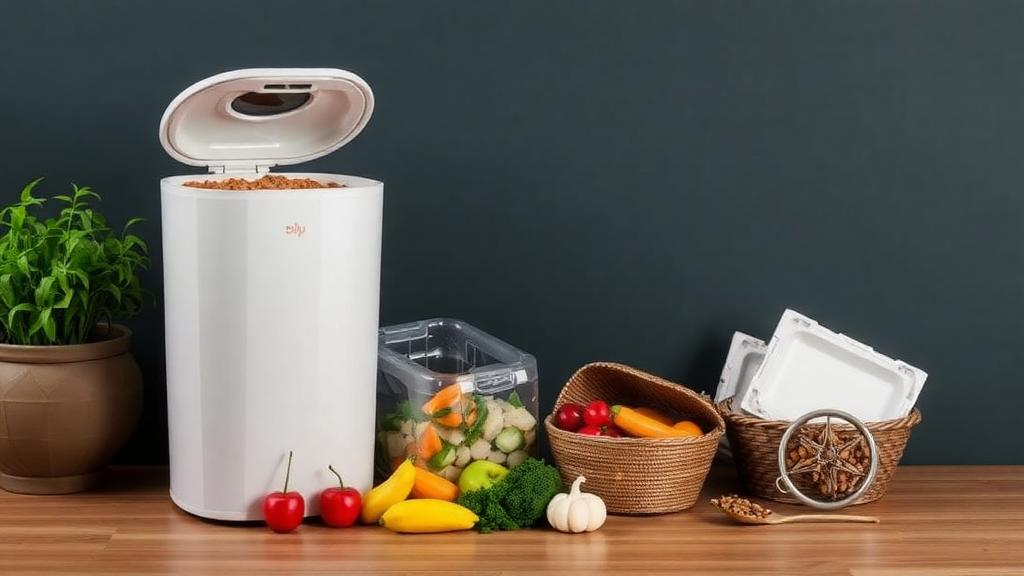
Food waste is one of the most stubborn problems in the global food system, and the kitchen bin is where much of it ends up. More than sixty percent of the food wasted worldwide is discarded by household consumers, yet researchers and policymakers have long lacked a reliable way to measure exactly what people throw away at home. A new study published in Discover Sustainability by Aidan Beery and Patrick J. Donnelly of Oregon State University’s School of Electrical Engineering and Computer Science tackles this measurement gap head-on with an AI-enabled smart compost bin that photographs, weighs, and logs kitchen scraps as they are discarded. The work, funded by the Foundation for Food and Agriculture Research and the Kroger Zero Hunger Zero Waste Foundation, is a deliberate step toward solving a data problem that has quietly undermined one of the world’s most important sustainability targets.
The stakes are framed by United Nations Sustainable Development Goal 12.3, which calls on nations to halve global food waste by 2030. Progress toward that goal depends on accurate measurement, and that is precisely what is missing at the household level. National estimates of food waste are typically assembled from surveys, municipal waste audits, or extrapolations from retail and manufacturing data, none of which capture the true composition and quantity of what individual families discard. Without trustworthy household-level numbers, it is nearly impossible to know whether interventions such as meal planning apps, portion guidance, or composting incentives actually reduce waste. The Oregon State team argues that this lack of a robust measurement methodology has actively hindered global efforts to meet the 12.3 target, and their smart compost bin is designed to close that gap with hardware that fits naturally into the daily routine of a normal kitchen.
The device itself is elegantly simple in concept. It is a compost bin instrumented to collect three streams of data every time food waste is added: an image of the scraps, the weight of the deposit, and environmental readings from onboard sensors. By combining visual and mass information at the moment of disposal, the bin produces a rich, instance-level record of each waste event rather than a coarse weekly tally. This matters because food waste is notoriously heterogeneous. A single evening’s compost deposit might contain coffee grounds, melon rinds, chicken bones, and moldy bread, all commingled together. Separating and identifying those components after the fact is one of the hardest problems in waste research, and the smart bin’s approach of capturing data at the point of disposal sidesteps much of that difficulty.
One of the most practical innovations in the system is the way it streamlines annotation, the laborious process of labeling data so that machine learning models can learn from it. Traditional food waste studies require researchers to manually sort, identify, weigh, and photograph discarded items, a process that is slow, unpleasant, and prone to error. The Oregon State system merges weighing and imaging into a single step, so that the act of tossing scraps into the bin automatically generates a labeled data point. Even more cleverly, the bin supports hands-free verbal labeling at the time of measurement through automatic speech recognition. A user can simply say what they are throwing away as they drop it in, and the spoken description is captured alongside the image and weight data. This design turns an everyday chore into continuous, low-effort data collection, which is exactly what a large-scale measurement campaign requires.
The hardware is paired with a companion smartphone application called CompostSense, which serves two purposes at once. For households, the app provides waste analytics, giving users feedback about what and how much they are composting over time. That feedback loop is valuable in its own right, since behavioral research suggests that people waste less food when they can see the scale of their own discards. For the research team, the app doubles as a platform for collecting instance-level food waste image annotations, allowing participants to confirm or correct the labels attached to each waste event. This dual-use design means that every household enrolled in a study simultaneously benefits from the technology and contributes to the dataset that makes the technology smarter, a virtuous cycle that few prior food waste measurement tools have achieved.
Underpinning the whole effort is a candid assessment of why computer vision has not yet been applied successfully to household food waste. Vision models have transformed fields from medical imaging to autonomous driving, but they depend on large, well-annotated datasets. For commingled food waste, no such publicly available dataset exists, and the authors identify this paucity as the central reason researchers have been unable to leverage modern vision advances for automatic food waste measurement. Images of food waste are genuinely difficult: items are partially occluded, stained, decomposing, and piled on top of one another in ways that differ radically from the clean, well-lit food photography found in existing food recognition datasets.
To demonstrate that difficulty concretely, the team trained and evaluated computer vision models for food image recognition, including instance segmentation approaches built on modern YOLO-family architectures, and showed that performance does not transfer from ordinary food imagery to the food waste domain. A model that can segment a plated meal with impressive accuracy stumbles when confronted with a soggy, overlapping mass of scraps in a dimly lit bin. This negative result is arguably as important as the hardware itself, because it establishes empirically that simply reusing existing food recognition models will not solve the waste measurement problem. Instead, the field needs a large, purpose-built dataset of real commingled food waste images, collected in real kitchens under real conditions.
That dataset is the immediate goal of the project’s next phase. The authors describe a forthcoming field study in which fifty smart compost bins will be deployed to households to curate a large, novel dataset of commingled food waste images. Each bin will passively accumulate images, weights, environmental data, and speech-based labels over months of ordinary use, producing exactly the kind of in-the-wild training data that laboratory studies cannot replicate. With fifty simultaneous deployments, the study will also capture geographic and cultural variation in diets and disposal habits, which is essential if the resulting models are to generalize beyond a single community. The annotation workflow, with its single-step weighing and imaging plus verbal labeling, is designed to keep participant burden low enough that such a long-running deployment remains feasible.
The broader implications extend well beyond measurement. Reliable household food waste data would allow governments to benchmark progress toward SDG 12.3 with unprecedented granularity, letting cities compare neighborhoods, evaluate programs, and direct resources where waste is worst. For individual households, real-time analytics could nudge behavior in ways that surveys never can, showing a family that it discards the equivalent of several meals each week. Downstream, better sorted and quantified compost streams could improve biogas production and composting operations, since feedstock composition strongly affects both processes. The researchers are careful to frame the current work as infrastructure for science rather than a finished consumer product, but the architecture they describe, from sensor-laden bin to speech-labeled dataset to smartphone feedback, sketches a complete pipeline from raw kitchen scraps to actionable knowledge.
The study also offers a quiet lesson about how applied AI research actually progresses. Rather than promising a turnkey waste recognition system, Beery and Donnelly identify the true bottleneck, the absence of public commingled food waste data, and build the hardware, software, and human-centered annotation tools needed to remove it. The undergraduate engineering team at Oregon State University that fabricated the bins and built the CompostSense app contributed to a system whose value will compound over time: every household that uses it makes the underlying models better, and better models make the next generation of bins more capable. As the fifty-bin field study moves forward, the project stands as a template for tackling other stubborn sustainability measurement problems, showing that sometimes the most impactful AI research begins not with a clever algorithm but with a well-designed bin that listens, weighs, and watches as we throw food away.
Subject of Research: Automatic household food waste measurement using an AI-enabled smart compost bin with computer vision and speech recognition
Article Title: Towards automatic household food waste measurement with the smart compost bin
Article References: Beery, A., & Donnelly, P. J. (2026). Towards automatic household food waste measurement with the smart compost bin. Discover Sustainability. https://doi.org/10.1007/s43621-026-04774-6
Image Credits: AI Generated
DOI: 10.1007/s43621-026-04774-6
Keywords: food waste, smart compost bin, computer vision, machine learning, SDG 12.3, sustainability, household waste measurement, automatic speech recognition, instance segmentation, food waste dataset, composting, Oregon State University
Cite Scienmag News
Blake Davidson. (October 4, 2026). Smart Compost Bin Brings AI to the Fight Against Household Food Waste. Scienmag. https://scienmag.com/smart-compost-bin-brings-ai-to-the-fight-against-household-food-waste/
Blake Davidson. "Smart Compost Bin Brings AI to the Fight Against Household Food Waste." Scienmag, 4 October 2026, https://scienmag.com/smart-compost-bin-brings-ai-to-the-fight-against-household-food-waste/. Accessed 4 October 2026.
Blake Davidson. "Smart Compost Bin Brings AI to the Fight Against Household Food Waste." Scienmag. October 4, 2026. https://scienmag.com/smart-compost-bin-brings-ai-to-the-fight-against-household-food-waste/


