


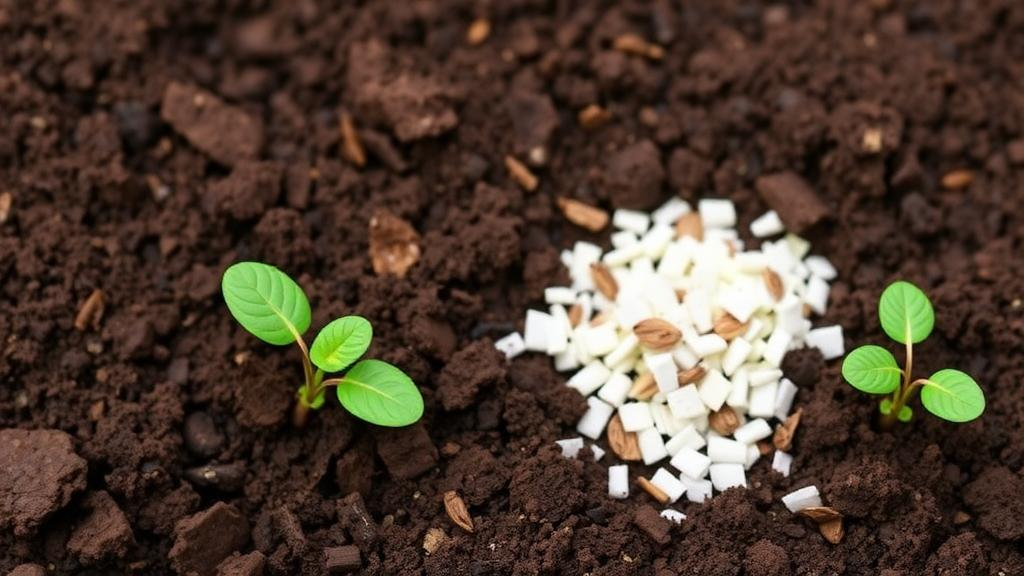
Plants are quietly engineering the ground beneath them. Up to a fifth of the carbon a plant fixes through photosynthesis leaks out of its roots into the soil, and among those exuded compounds are polyphenols, the stress-driven secondary metabolites that plants deploy against drought, pathogens, and other threats. A new study published in Advanced Science shows that these humble molecules do far more than defend the plant: they chemically dismantle and rebuild soil minerals, and that same trick can be hijacked to create a new class of fertilizers that grew lettuce, pak choi, and corn up to two-and-a-half times larger than conventional mineral treatments.
The research team, led by Jong-Rok Jeon of Gyeongsang National University and Frank Caruso of the University of Melbourne, focused on tannic acid, or TA, a widely available plant polyphenol rich in catechol groups that grip metal ions with remarkable tenacity. Their central hypothesis was elegant: when stressed plants secrete polyphenols into the rhizosphere, the zone of soil hugging the roots, those molecules should coordinate with metal ions in soil minerals such as calcium phosphate, ferric oxide, and aluminum hydroxide, destabilizing the mineral lattices and dissolving nutrients that would otherwise remain locked away.
To test this, the researchers leached soil collected from Jinju in South Korea with TA solutions and analyzed the leachates by inductively coupled plasma optical emission spectroscopy. The results were striking. Aluminum and manganese, undetectable in leachates from untreated soil, appeared at concentrations of roughly ten parts per million when TA was present. Calcium, iron, and magnesium leached at levels up to fifteen times higher, and phosphorus surged to twenty-two times the control values. Even when the soil was first heated to 600 degrees Celsius to burn off organic matter, TA still boosted leaching, though less dramatically, suggesting the polyphenol acts directly on mineral structures rather than merely on organic complexes.
Fluorescence excitation-emission matrices told a subtler story. Leachates from TA-treated soil showed a distinct redshift in their fluorescence signatures compared with both untreated soil leachates and free TA in water, a hallmark of metal-organic coordination. And when the team precipitated mineral-like particles from the leachates, those particles carried up to six times more phenolic content and four to ten times more phosphorus when TA had been present, direct evidence that dissolved metals, phosphate, and polyphenols reassemble together into new hybrid minerals. The authors caution that the TA concentrations used were deliberately high as a proof of concept, so the magnitude of dissolution should not be extrapolated directly to field conditions, but the mechanism itself is clear.
That mechanism carries a tantalizing implication the researchers call soil memory. Because mineral-associated organic matter is notoriously stable, shielded from microbial enzymes by its inorganic armor, polyphenols locked into newly formed minerals could preserve a chemical record of past plant stress, potentially influencing how the soil treats the next generation of plants. Most rhizosphere research has focused on how secondary metabolites sculpt microbial communities; this work adds a slower, geological dimension in which plant biochemistry literally rewrites the crystal structure of the ground.
The team then turned observation into engineering. Using alkaline wet precipitation, they coprecipitated TA with calcium phosphate and with struvite, a phosphorus- and nitrogen-rich mineral recovered from waste streams and increasingly viewed as a sustainable fertilizer alternative. Thermogravimetric analysis confirmed TA loadings proportional to the amount added, and infrared spectroscopy, X-ray photoelectron spectroscopy, and pyrolysis gas chromatography-mass spectrometry all revealed the catechol-metal coordination bonds holding the hybrid together. The calcium-to-phosphorus ratio shifted as TA disrupted the lattice stoichiometry, and solid-state nuclear magnetic resonance showed that the local phosphate environments had been fundamentally altered.
The most consequential change was structural. X-ray diffraction of pristine calcium phosphate showed the sharp peaks of crystalline monetite; with TA incorporated, those peaks broadened and faded, and quantitative crystallinity fell from 67.2 percent to as low as 36.2 percent. Grazing-incidence wide-angle X-ray scattering and electron diffraction confirmed the amorphization, while electron microscopy captured the particles morphing from globular to sharp, wedge-like shapes. The same pattern held for struvite, where TA coordination with magnesium interfered with crystal ordering at both precipitation pH values tested. Disordered, amorphous minerals dissolve more readily than their crystalline counterparts, and the dissolution experiments bore this out: TA-loaded calcium phosphate released up to 85 percent more phosphorus than untreated particles, and TA-loaded struvite released up to twice as much. Crucially, the effect persisted in acidic conditions mimicking root exudates, in acetate buffer, and in humic-acid-containing water, meaning the fertilizers respond to the chemistry of a real rhizosphere.
The payoff came in the greenhouse. Lettuce grown in soil pots treated with TA-loaded calcium phosphate particles produced nearly double the biomass of lettuce grown with plain calcium phosphate, with 3 percent and 8 percent TA loadings performing equally well. Pak choi and corn, grown in different soil types, showed enhancements of up to 2.5-fold, demonstrating that the strategy is not crop- or soil-specific. Tannic acid alone, applied at equivalent amounts, produced only marginal growth, confirming that the benefit arises from the mineral hybridization rather than the polyphenol as a nutrient. Struvite-TA particles delivered a roughly 30 percent biomass increase over plain struvite, and soil DNA analysis revealed that the treated soils were enriched in beneficial microbes, including Lysobacter, Nitrospira japonica, and Adhaeribacter in the calcium phosphate experiments, and Sphingomonas, Massilia, and Chitinophagaceae with struvite, taxa associated with plant growth promotion, stress tolerance, and pathogen suppression.
The synergy appears to be threefold: faster nutrient release from the disordered lattice, co-delivered TA that may stimulate plant physiology and chelate metals to prevent reprecipitation, and a reshaped microbiome tilted toward plant-beneficial species. Because calcium phosphate and struvite can be synthesized from circular-economy feedstocks such as livestock bones and wastewater sludge, and TA is extracted in bulk from renewable plant material, the approach aligns neatly with sustainable agriculture goals. The authors note that metal-phenolic networks are known to evolve structurally during aging, so the low-crystallinity state may even persist or deepen over time, though long-term storage stability remains to be verified.
Significant hurdles stand between bench and field. The cost and scalable supply of TA, optimization of the coprecipitation process for bulk manufacturing, and the economic feasibility of the whole pipeline all require further study, and the authors have filed a patent application covering the technology. Still, the conceptual leap is hard to overstate: a molecule plants already secrete under stress has been shown to govern the crystallinity of soil minerals, and by mimicking that process, researchers have built fertilizers that dissolve on demand, feed beneficial microbes, and grow substantially bigger crops. It is a vivid demonstration that the boundary between plant biochemistry and soil geology is far blurrier, and far more exploitable, than anyone assumed.
Subject of Research: Metal-phenolic complexation between plant polyphenols and soil minerals and its application in low-crystallinity fertilizers
Article Title: Metal–Phenolic Complexation Governs Soil Mineral Crystallinity to Enhance Crop Growth
Article References: Jeon, J.-R., Mazaheri, O., Wang, T., Zavabeti, A., Yoon, H. Y., Phong, N. T., Joe, E.-N., Lin, Z., Pan, S., Kim, C.-J., & Caruso, F. (2026). Metal–Phenolic Complexation Governs Soil Mineral Crystallinity to Enhance Crop Growth. Advanced Science, Article e77994. https://doi.org/10.1002/advs.77994
Image Credits: AI Generated
DOI: 10.1002/advs.77994
Keywords: tannic acid, soil minerals, crystallinity, calcium phosphate, struvite, fertilizer, rhizosphere, root exudates, polyphenols, phosphorus, soil microbiome, sustainable agriculture
Cite Scienmag News
Alan Morgan. (October 4, 2026). Plant Tannins Reshape Soil Minerals Into Super Fertilizers That Boost Crops. Scienmag. https://scienmag.com/plant-tannins-reshape-soil-minerals-into-super-fertilizers-that-boost-crops/
Alan Morgan. "Plant Tannins Reshape Soil Minerals Into Super Fertilizers That Boost Crops." Scienmag, 4 October 2026, https://scienmag.com/plant-tannins-reshape-soil-minerals-into-super-fertilizers-that-boost-crops/. Accessed 4 October 2026.
Alan Morgan. "Plant Tannins Reshape Soil Minerals Into Super Fertilizers That Boost Crops." Scienmag. October 4, 2026. https://scienmag.com/plant-tannins-reshape-soil-minerals-into-super-fertilizers-that-boost-crops/


