


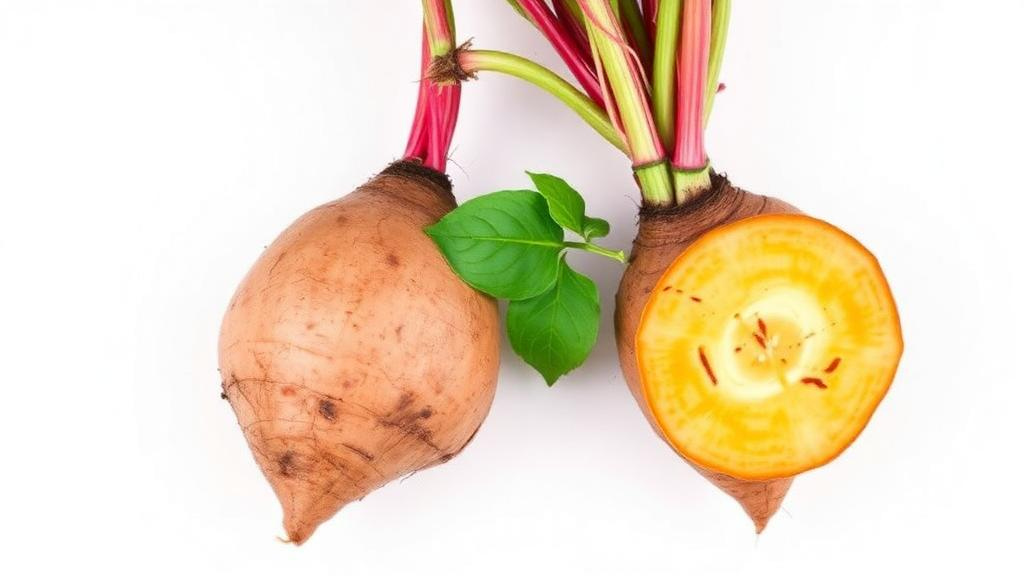
When soils run short of phosphorus, some plants simply cope better than others, and a new study of sweetpotato suggests the difference may lie in a chemical conversation happening invisibly at the root surface. Researchers in China have shown that the roots of a phosphorus-efficient sweetpotato variety release specific amino acids that recruit soil bacteria capable of unlocking phosphorus that is otherwise locked away from plants. The findings, published in the journal Plant and Soil, identify L-glutamine and citrulline as the central signal molecules linking root exudation to the assembly of phosphate-solubilizing bacterial communities, and they point toward a new generation of soil phosphorus activators that could reduce dependence on phosphate fertilizers.
Phosphorus is an essential macronutrient, yet in most soils the vast majority of it exists in forms that plant roots cannot absorb directly. Inorganic phosphate binds tightly to iron, aluminum, and calcium compounds, while a substantial share is tied up in organic molecules that require enzymatic cleavage before uptake. Farmers typically compensate with phosphate fertilizer, but a large fraction of applied phosphorus is rapidly immobilized, contributing both to rising input costs and to the accumulation of residual soil phosphorus that has been described as a missing piece in the global phosphorus crisis puzzle. Plants have therefore evolved strategies to mobilize their own phosphorus, including architectural changes to root systems and the secretion of organic acids and enzymes. Increasingly, scientists have recognized a third strategy: recruiting microbial partners from the surrounding soil.
The rhizosphere, the narrow zone of soil influenced by root activity, is one of the most biologically active habitats on Earth. Roots leak an enormous diversity of compounds, including sugars, organic acids, amino acids, and secondary metabolites, and these exudates act as both nutrient sources and signaling cues that shape which microorganisms colonize the root surface. Among the most agriculturally valuable of these recruits are phosphate-solubilizing bacteria, microbes that convert insoluble phosphorus compounds into bioavailable forms. Two functional genes serve as molecular markers for this capability. The phoD gene encodes alkaline phosphatase, an enzyme that liberates phosphate from organic molecules, while pqqC is involved in the biosynthesis of pyrroloquinoline quinone, a cofactor required by enzymes that dissolve mineral phosphorus. Tracking bacteria carrying these genes allows researchers to follow the phosphate-solubilizing community with precision.
In the new study, a team led by Xiaoya Zhu and Zhonghou Tang of the Xuzhou Institute of Agricultural Sciences in Jiangsu, working with colleagues at Jiangsu Normal University, focused on sweetpotato, a staple crop of global importance for food security. The researchers compared two genotypes with contrasting phosphorus efficiency: Sushu8, which performs well under low phosphorus conditions, and Xushu32, which is phosphorus-sensitive. They grew both varieties under phosphorus-deficient conditions and collected root exudates at two critical developmental windows, the seedling stage and the tuber expansion stage, when the crop’s underground storage organs are forming and demand for phosphorus peaks.
The experimental design was elegantly direct. Rather than merely characterizing the exudates, the team amended them into soil and observed what happened to the soil’s chemistry and its microbial communities. The results were striking. Soil treated with exudates from the phosphorus-efficient Sushu8 showed available phosphorus concentrations that were 37.83 to 43.26 percent higher than soil treated with exudates from the phosphorus-sensitive Xushu32. In other words, the chemical signature of the efficient variety’s roots was sufficient, on its own, to substantially increase the pool of phosphorus that plants can actually use, without any living plant present.
To identify which compounds were responsible, the researchers applied Random Forest analysis, a machine learning approach that ranks metabolites by their predictive power. Across both growth stages, two metabolites emerged as the key differentially expressed indicators: the amino acids L-glutamine and citrulline. Both were characteristic of the phosphorus-efficient genotype’s exudate profile, and both persisted as signature compounds from the seedling stage through tuber expansion. This developmental consistency is notable, because root exudation is known to change dramatically as plants grow, with different compounds dominating at different life stages. Finding the same two hub metabolites at both stages suggests they play a fundamental role in the phosphorus stress response of this genotype rather than serving a transient, stage-specific function.
The microbial side of the story proved equally revealing. Using LEfSe analysis, a method that identifies biomarker taxa distinguishing experimental groups, the team detected 29 biomarkers in soil conditioned with Sushu8 exudates from the seedling stage and 45 biomarkers from the tuber expansion stage, including representatives carrying the phoD and pqqC genes. One genus stood out above the rest: Roseomonas, a group of pqqC-harboring bacteria that was not only among the core dominant genera in the treated soils but was also identified as a key biomarker significantly associated with Sushu8 root exudates across both growth stages. The implication is that the efficient variety’s exudates consistently enrich for a bacterial group with the molecular machinery to solubilize mineral phosphorus.
Statistical confirmation came from Mantel tests, which assess correlations between two distance matrices, in this case linking metabolite profiles to microbial community structure. Both L-glutamine and citrulline were significantly correlated with the composition of phoD- and pqqC-harboring bacterial communities, and both showed significant positive correlations with Roseomonas specifically. Taken together, the authors conclude that these two amino acids function as core hub substances connecting root exudation to phosphate-solubilizing bacteria, effectively helping Sushu8 assemble a microbial support network that eases its adaptation to low phosphorus stress. The finding adds sweetpotato to a growing list of crops whose exudates have been shown to recruit beneficial microbes, echoing recent work demonstrating that localized glutamine leakage can drive the spatial structure of root microbial colonization.
What makes the study particularly compelling is its mechanistic clarity. Rather than documenting a vague association between plant health and soil microbes, the researchers traced a complete causal chain: a phosphorus-efficient genotype releases specific amino acids under stress, those amino acids enrich for bacteria carrying phosphorus-mobilizing genes, and the conditioned soil ends up with a dramatically larger pool of available phosphorus. Each link in that chain was tested independently, from the exudate amendment experiments to the gene-targeted community profiling to the metabolite-microbe correlation analyses. This level of resolution is what transforms an ecological observation into an actionable agricultural insight.
The practical implications could be significant. If L-glutamine and citrulline reliably recruit phosphate-solubilizing bacteria, they could be formulated as soil amendments or used to guide the development of microbial inoculants, the soil phosphorus activators the authors envision. Such products would help crops tap into residual soil phosphorus accumulated from years of fertilization, reducing both input costs and the environmental burdens of phosphate mining and runoff. For sweetpotato breeders, the two amino acids offer potential biomarkers for screening phosphorus-efficient germplasm. As global phosphorus reserves tighten and agriculture faces pressure to reduce its chemical footprint, the humble chemical whispers of sweetpotato roots may prove to be a blueprint for farming that feeds crops by feeding their microbial allies first.
Subject of Research: Root exudate-mediated recruitment of phosphate-solubilizing bacteria in sweetpotato under low phosphorus stress
Article Title: Soil phosphate-solubilizing bacteria conditioning with root exudates from different sweetpotato growth stages under low phosphorus stress
Article References: Zhu, X., Sun, J., Wang, J., Zhao, P., Zhang, Q., Yu, Y., Liu, M., Jin, R., & Tang, Z. (2026). Soil phosphate-solubilizing bacteria conditioning with root exudates from different sweetpotato growth stages under low phosphorus stress. Plant and Soil. https://doi.org/10.1007/s11104-026-09160-9
Image Credits: AI Generated
DOI: 10.1007/s11104-026-09160-9
Keywords: sweetpotato, root exudates, phosphate-solubilizing bacteria, phosphorus availability, L-glutamine, citrulline, rhizosphere microbiome, phoD, pqqC, Roseomonas, low phosphorus stress, soil microbiology
Cite Scienmag News
Morgan Morrow. (October 4, 2026). Sweetpotato Roots Recruit Phosphate-Solubilizing Bacteria with Two Key Amino Acids Under Low Phosphorus Stress. Scienmag. https://scienmag.com/sweetpotato-roots-recruit-phosphate-solubilizing-bacteria-with-two-key-amino-acids-under-low-phosphorus-stress/
Morgan Morrow. "Sweetpotato Roots Recruit Phosphate-Solubilizing Bacteria with Two Key Amino Acids Under Low Phosphorus Stress." Scienmag, 4 October 2026, https://scienmag.com/sweetpotato-roots-recruit-phosphate-solubilizing-bacteria-with-two-key-amino-acids-under-low-phosphorus-stress/. Accessed 4 October 2026.
Morgan Morrow. "Sweetpotato Roots Recruit Phosphate-Solubilizing Bacteria with Two Key Amino Acids Under Low Phosphorus Stress." Scienmag. October 4, 2026. https://scienmag.com/sweetpotato-roots-recruit-phosphate-solubilizing-bacteria-with-two-key-amino-acids-under-low-phosphorus-stress/


