


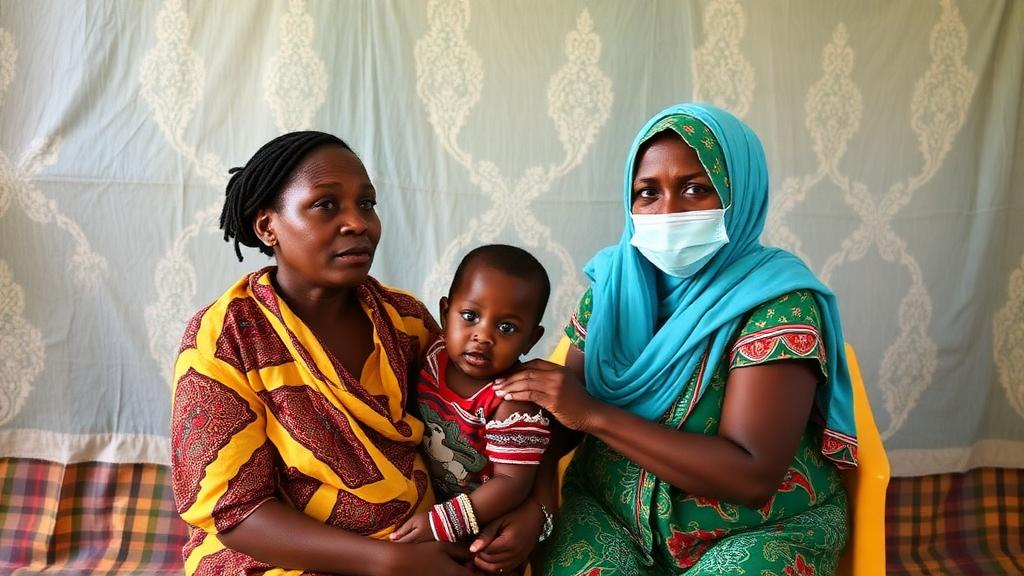
In the farming communities that stretch across rural Nigeria, a quiet determinant of child survival is drawing new scientific attention: whether a mother seeks healthcare for herself. A study published in BMC Pediatrics by Mobolaji Victoria Adejoorin of Lagos State University of Science and Technology and colleagues at the University of Ibadan and the Federal College of Animal Health and Production Technology examines how maternal healthcare-seeking behaviour shapes the timing and completeness of childhood vaccination among agricultural households. Drawing on data from the 2018 Nigeria Demographic and Health Survey, the researchers analysed records for 2,751 rural women with children under five, isolating a population where subsistence farming dominates daily life and where access to clinics, cash, and time off from farm labour can all be in short supply.
The stakes are considerable. Vaccination schedules recommended by the World Health Organization require doses at birth, six weeks, ten weeks, and fourteen weeks, with measles-containing vaccine delivered around nine months. Missing those windows leaves infants exposed during the most vulnerable months of life. Yet the study found that 55.83 percent of children in the sampled agricultural households were entirely unimmunised, a figure that underscores how far rural Nigeria remains from universal coverage. Even partial protection, the data showed, is unevenly distributed across households, and the reasons for that unevenness are social and behavioural as much as they are logistical.
To measure something as multifaceted as healthcare-seeking behaviour, the researchers turned to multiple correspondence analysis, a statistical technique related to principal component analysis that is designed for categorical data. Rather than collapsing a mother’s behaviour into a single yes-or-no indicator, the method allowed the team to combine several dimensions of maternal healthcare use into a continuous index. Those dimensions included whether the mother received prenatal care, how early in pregnancy she made her first antenatal visit, how many antenatal visits she attended, whether a skilled attendant was present at delivery, and whether she received postnatal care after childbirth. The resulting index ranged across households and averaged 0.54, which the authors characterise as moderate utilisation of maternal healthcare services.
That moderate average conceals a wide spectrum. At one end are mothers who attended the recommended four or more antenatal visits, delivered under the supervision of a trained health worker, and returned for postnatal checks. At the other are women who received none of these services, often because the nearest facility is distant, because farm work and childcare leave no slack in the day, or because the cost of a visit competes directly with household food and input expenses. The index approach matters because it treats healthcare-seeking as a pattern of behaviour rather than an isolated event, recognising that a woman who starts antenatal care early is also more likely to deliver with a skilled attendant and to bring her child forward for immunisation on schedule.
For the core analysis, the team employed an extended ordered probit model, a regression framework suited to outcomes that fall into a natural sequence. Vaccination status was ordered from no vaccination, through partial vaccination, to full vaccination, and the model estimated how each explanatory variable shifted children across those categories. The extension of the model allowed the researchers to account for the structure of the survey data and the possibility that unobserved household characteristics influence both maternal behaviour and child health outcomes. This is a more demanding test than a simple comparison of averages, because it asks whether the association between maternal healthcare use and vaccination holds once other factors are held constant.
The results were revealing in their specificity. Maternal healthcare-seeking behaviour, measured by the index, significantly improved the probability that a child would be partially vaccinated, meaning the child had received some but not all scheduled doses. Husband’s education also emerged as a significant driver of partial vaccination, a finding that points to the influence fathers exert over household health decisions in these communities. For the stricter outcome of full vaccination, the significant predictors were husband’s education and the mother’s full-time employment in agriculture, the latter being associated with improved full vaccination status. That last result is counterintuitive at first glance, since full-time farm work might be expected to compete with clinic visits, but it may reflect greater household resources, autonomy, or exposure to health information among women who work continuously in the agricultural economy.
The mechanism linking maternal care to child immunisation is straightforward but powerful. Antenatal visits are among the few reliable points of contact between rural mothers and the formal health system, and each contact is an opportunity for counselling on vaccination schedules, for the distribution of immunisation cards, and for building the trust that brings a mother back with her infant. A woman who delivers with a skilled attendant is physically present in a facility at a moment when birth doses of vaccines can be administered and follow-up appointments can be arranged. Postnatal care extends that contact into the critical early weeks. In effect, the healthcare-seeking index captures the density of a mother’s connections to the health system, and the study shows that denser connections translate into more vaccinated children.
The prominence of husband’s education carries its own policy weight. In many rural Nigerian households, decisions about spending money, travelling to a clinic, or allocating a woman’s time are made jointly or by the male head of household. An educated father is more likely to understand the value of immunisation, more likely to support the costs and logistics of a clinic visit, and more receptive to health messaging. The finding suggests that interventions aimed only at mothers may miss half of the decision-making structure, and that male involvement, which the authors highlight explicitly in their conclusions, could be a lever with outsized returns.
The authors argue that strengthening policies promoting maternal healthcare utilisation is essential, and they point to specific delivery channels: community-based and market-based health centres that sit closer to where agricultural families already gather. Bringing antenatal and vaccination services into markets and village centres reduces the transport and time costs that fall hardest on farming women, whose labour schedules are dictated by planting and harvest seasons. Outreach timed around agricultural calendars, integration of immunisation with antenatal and postnatal contacts, and engagement of male partners through community and religious structures all follow naturally from the study’s evidence base.
Limitations remain, as they do in any secondary analysis. The study relies on self-reported vaccination histories from the 2018 survey round, and recall of doses received years earlier can be imperfect even when vaccination cards are consulted. The cross-sectional design identifies associations rather than proven causal effects, however carefully the model controls for confounding. And the findings speak specifically to agricultural households in rural areas, a population that is large and underserved in Nigeria but not identical to the country as a whole. Still, the combination of a rigorous behavioural index, an ordered outcome model, and a nationally representative survey gives the conclusions unusual credibility for policy work. With more than half of children in these households receiving no vaccines at all, the study’s central message is hard to ignore: every point of contact a mother has with the health system is a point of contact for her child, and expanding those contacts, through accessible community services and the engaged support of fathers, may be one of the most direct routes to closing Nigeria’s immunisation gap.
Subject of Research: The effect of maternal healthcare-seeking behaviour on timely childhood vaccination among agricultural households in rural Nigeria
Article Title: Maternal healthcare-seeking behaviour and timely childhood vaccination among agricultural households in rural Nigeria
Article References: Adejoorin, M. V., Salman, K. K., Salawu, M. B., & Dairo, M. D. (2026). Maternal healthcare-seeking behaviour and timely childhood vaccination among agricultural households in rural Nigeria. BMC Pediatrics. https://doi.org/10.1186/s12887-026-07688-4
Image Credits: AI Generated
DOI: 10.1186/s12887-026-07688-4
Keywords: maternal health, childhood vaccination, Nigeria, agricultural households, healthcare-seeking behaviour, DHS survey, immunisation coverage, public health, antenatal care, rural health, ordered probit model, BMC Pediatrics
Cite Scienmag News
Ophelia Keating. (October 4, 2026). Mothers Who Seek Care Drive Timely Vaccination in Rural Nigeria’s Farming Households. Scienmag. https://scienmag.com/mothers-who-seek-care-drive-timely-vaccination-in-rural-nigerias-farming-households/
Ophelia Keating. "Mothers Who Seek Care Drive Timely Vaccination in Rural Nigeria’s Farming Households." Scienmag, 4 October 2026, https://scienmag.com/mothers-who-seek-care-drive-timely-vaccination-in-rural-nigerias-farming-households/. Accessed 4 October 2026.
Ophelia Keating. "Mothers Who Seek Care Drive Timely Vaccination in Rural Nigeria’s Farming Households." Scienmag. October 4, 2026. https://scienmag.com/mothers-who-seek-care-drive-timely-vaccination-in-rural-nigerias-farming-households/


