


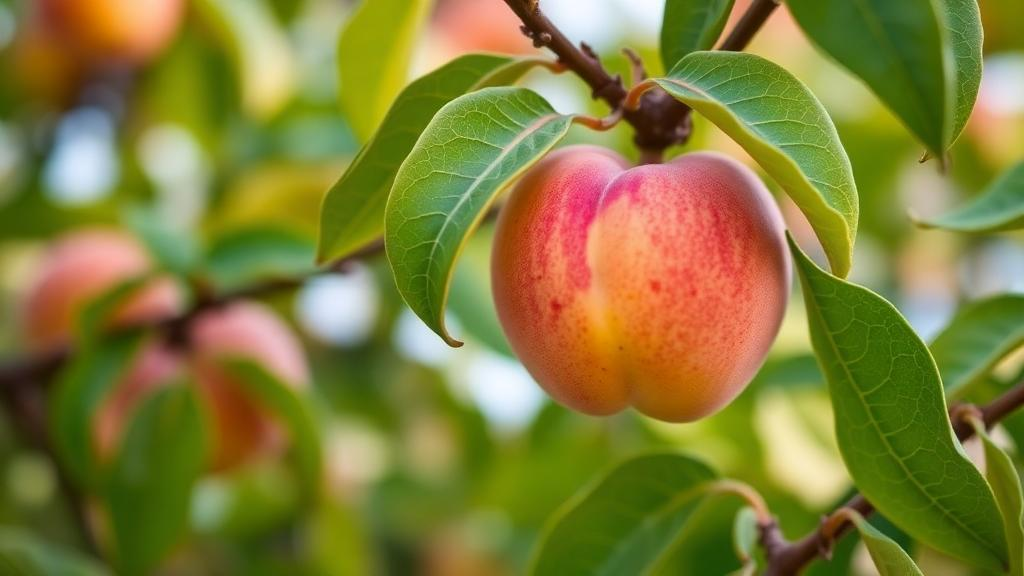
Why do some peaches glow with a deep, healthy green while others fade toward pale yellow or blush red? The answer, according to a new study published in Plant Cell Reports, lies in a single transcription factor that acts as a master switch for the green pigment chlorophyll during the earliest days of fruit development. Researchers led by Min Chen and Shenghui Jiang identified a gene called PpAPRR2 in peach (Prunus persica) and showed that it promotes chlorophyll accumulation and chloroplast development in the fruit peel. The finding not only fills a long-standing gap in the genetics of fruit coloration but also points to a molecular target that breeders and genetic engineers could exploit to improve fruit quality in peach and potentially in other crops.
Fruit peel color is far more than a cosmetic attribute. In peach, it is determined by the dynamic balance between two pigment systems: chlorophyll, which gives young fruit their green hue, and anthocyanins, the red-purple pigments responsible for the blush that develops as fruit mature. While the regulatory networks that control anthocyanin biosynthesis have been extensively mapped over the past two decades, the mechanisms governing chlorophyll accumulation and peel greening have remained comparatively obscure. This asymmetry has left a significant hole in the understanding of how fruit quality traits are wired at the genetic level, because the green-to-red transition affects not only appearance but also photosynthetic capacity, nutrient content, and consumer perception of freshness.
To close that gap, the research team began with a systematic survey of the peach genome. They identified nine members of the ARR-B family of transcription factors, a group of proteins related to the two-component signaling systems that plants use to relay hormonal and environmental signals. Among these nine candidates, one gene stood out: PpAPRR2, a pseudo-response regulator whose expression was predominantly active during early fruit development. Critically, the timing of its expression showed a strong positive correlation with chlorophyll levels in the peel, suggesting that the gene might be driving the greening process rather than merely riding along with it.
The first step in characterizing the protein was to determine where it operates inside the cell. Subcellular localization assays showed that PpAPRR2 accumulates in the nucleus, the expected address for a transcription factor that binds DNA and regulates other genes. This nuclear localization is consistent with the protein’s role in the ARR-B family, whose members typically function as downstream effectors in phosphorelay signaling cascades, translating signals from cytokinin and other pathways into changes in gene expression. With the protein confirmed as a nuclear player, the team moved on to the decisive question: what happens to fruit when the gene’s activity is manipulated?
The answer came from virus-induced gene silencing, or VIGS, a technique that uses an engineered viral vector to instruct the plant’s own machinery to suppress a target gene. When the researchers silenced PpAPRR2 in developing peach fruit, the effect was unmistakable. Chlorophyll content dropped, and the expression of photosynthesis-related genes declined in parallel. The silenced fruit lost their vibrant green coloration, demonstrating that PpAPRR2 is not a passive marker of greening but an active promoter of it. Without the gene’s function, the chlorophyll biosynthesis machinery in the peel sputters, and the fruit’s photosynthetic apparatus fails to develop properly during the critical early phase of growth.
Silencing experiments reveal what a gene does, but overexpression reveals what it can do, and for that the team turned to a heterologous system. They introduced the peach PpAPRR2 gene into tomato, a species with well-established transformation protocols and a fruit whose pigmentation has been studied intensively. The result was striking: transgenic tomato fruit carrying the peach gene developed a darker green color than their wild-type counterparts, accumulated more chlorophyll, and showed increased expression of genes involved in chlorophyll biosynthesis. In effect, a peach gene was able to reprogram the pigment economy of a distantly related fruit, evidence that the regulatory mechanism is conserved across species and that PpAPRR2 is a portable tool for enhancing greening.
Transcriptome analysis of the overexpressing tomato fruits added a genome-wide dimension to the picture. Sequencing of the messenger RNA population confirmed that photosynthetic pathways were promoted in the transgenic fruit, while genes involved in chlorophyll degradation were suppressed. This dual action, boosting construction of the photosynthetic apparatus while simultaneously slowing its dismantling, provides a mechanistic explanation for the elevated chlorophyll levels observed. It also suggests that PpAPRR2 does not operate in isolation but coordinates a broad transcriptional program that touches both the assembly and the maintenance of chloroplasts, the organelles where chlorophyll resides and photosynthesis takes place.
The study does not exist in a vacuum. APRR2-family genes have repeatedly surfaced in genetic analyses of fruit color across the plant kingdom. In tomato, an APRR2-like gene was linked to pigment accumulation through network inference analysis, and the celebrated Uniform ripening locus was shown to encode a Golden 2-like transcription factor regulating fruit chloroplast development. In cucumber, melon, watermelon, pepper, zucchini, and wax gourd, APRR2 orthologs or related pseudo-response regulators have been associated with immature fruit rind color, peel pigmentation, and chloroplast biogenesis. The peach work extends this emerging pattern to a stone fruit, a lineage that diverged from the tomato and cucurbit lineages tens of millions of years ago, and it strengthens the case that APRR2-type regulators represent an ancient and conserved module for controlling green fruit pigmentation.
The broader context of chloroplast regulation is also instructive. GLK transcription factors, such as the PpGLK1 gene previously characterized in peach by some of the same researchers, are known to coordinate expression of the photosynthetic apparatus in Arabidopsis and crops alike. Cytokinin signaling, which flows through genuine response regulators rather than pseudo-response regulators, is another established driver of chloroplast development. PpAPRR2 sits at an intriguing intersection of these systems: as a pseudo-response regulator, it belongs to the two-component signaling family, yet its demonstrated role in directly promoting chlorophyll biosynthesis genes suggests it functions as a transcriptional activator in its own right. Disentangling how PpAPRR2 interacts with GLK factors, hormonal signals, and the circadian clock, to which pseudo-response regulators are intimately tied, will be a central question for future work.
For growers and consumers, the practical implications are tangible. Peel color influences marketability, and greener immature fruit often signals better photosynthetic performance and, in some crops, higher nutritional value. Because PpAPRR2 overexpression enhanced greening in a heterologous species, the gene could serve as a target for genome editing or transgenic approaches aimed at tuning chlorophyll levels in peach and beyond. The authors also deposited their raw sequence data in a public archive, making the resource available to the wider community. As the genetic control of fruit coloration comes into sharper focus, regulators like PpAPRR2 are transforming what was once a purely descriptive trait, peel color, into an engineerable parameter of fruit quality, one transcription factor at a time.
Subject of Research: Regulation of chlorophyll biosynthesis and chloroplast development in peach fruit by the PpAPRR2 transcription factor
Article Title: PpAPRR2 regulates chlorophyll biosynthesis and chloroplast development during early fruit development in peach
Article References: PpAPRR2 regulates chlorophyll biosynthesis and chloroplast development during early fruit development in peach. (n.d.). https://doi.org/10.1007/s00299-026-04002-5
Image Credits: AI Generated
DOI: 10.1007/s00299-026-04002-5
Keywords: peach, PpAPRR2, chlorophyll, chloroplast development, fruit color, transcription factor, virus-induced gene silencing, tomato overexpression, transcriptome, plant biotechnology, Prunus persica, fruit quality
Cite Scienmag News
Juliet Wilcox. (October 3, 2026). Green Gene Switch Found That Paints Young Peaches and Boosts Fruit Photosynthesis. Scienmag. https://scienmag.com/green-gene-switch-found-that-paints-young-peaches-and-boosts-fruit-photosynthesis/
Juliet Wilcox. "Green Gene Switch Found That Paints Young Peaches and Boosts Fruit Photosynthesis." Scienmag, 3 October 2026, https://scienmag.com/green-gene-switch-found-that-paints-young-peaches-and-boosts-fruit-photosynthesis/. Accessed 3 October 2026.
Juliet Wilcox. "Green Gene Switch Found That Paints Young Peaches and Boosts Fruit Photosynthesis." Scienmag. October 3, 2026. https://scienmag.com/green-gene-switch-found-that-paints-young-peaches-and-boosts-fruit-photosynthesis/


