


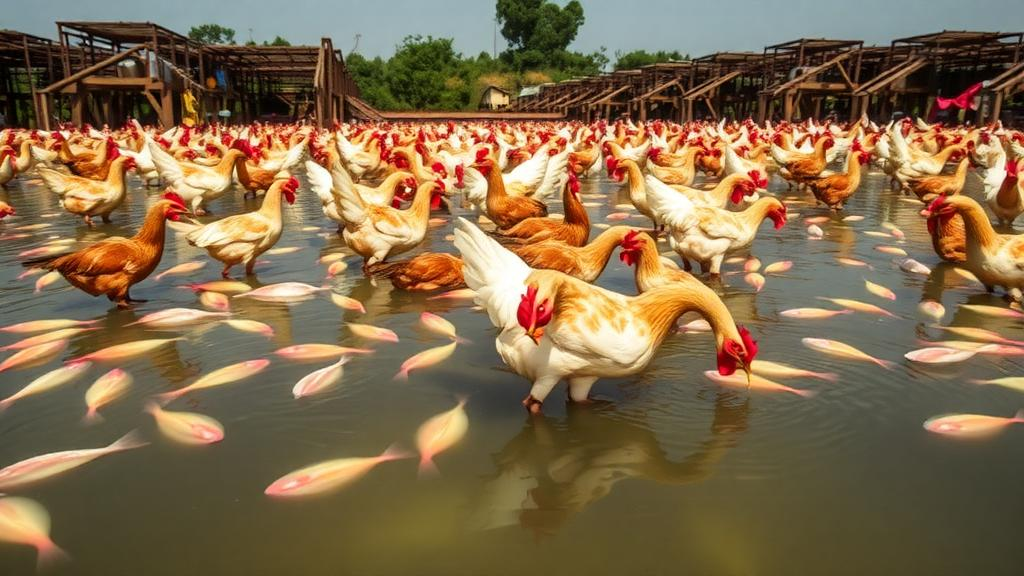
On a growing number of farms in southwestern Nigeria, chickens and fish share the same piece of land in a system that is as ingenious as it is potentially dangerous. Poultry houses are built directly over fish ponds or right beside them, and the droppings from the birds fall into the water below, fertilizing blooms of algae and microbes that the fish then eat. The arrangement cuts feed costs, squeezes more protein from a small footprint, and boosts farmer incomes, which is why integrated commercial fish-chicken farming is spreading rapidly in a country that is Africa’s second-largest poultry producer and its largest fish market. But a new study suggests the same circular design that makes these farms efficient may also be quietly circulating something far less welcome: antibiotic-resistant bacteria.
Researchers led by Oluwawemimo Adebowale of the Federal University of Agriculture, Abeokuta, surveyed 48 integrated farms in Lagos and Ogun states between May and September 2023, using structured interviews with farmers alongside on-site assessments of biosecurity. The results, published in BMC Agriculture, offer the first baseline data on antimicrobial use in this emerging Nigerian farming system, and they reveal a landscape of heavy antibiotic reliance, patchy disease prevention, and knowledge gaps that could accelerate the global crisis of antimicrobial resistance.
The scale of drug use on these farms is striking. Farmers reported deploying at least ten different classes of antibiotics, including fluoroquinolones, tetracyclines, macrolides, aminoglycosides, penicillins, sulphonamides, lincosamides, cephalosporins, nitrofurans, and polymyxins. In poultry, the most commonly used drugs were enrofloxacin, reported by 89.4 percent of farmers, oxytetracycline at 80.9 percent, doxycycline and tylosin at 78.7 percent, and colistin at 63.8 percent. For fish, oxytetracycline and enrofloxacin dominated. Many of these compounds fall into the World Health Organization’s highest priority critically important antimicrobials for human medicine, meaning they are drugs on which doctors depend when other treatments fail. Colistin, a polymyxin widely used on the surveyed farms, is considered a last-resort antibiotic in human medicine, reserved for infections that no other drug can touch.
The WHO classifies antibiotics into three stewardship tiers known as AWaRE: Access, for first-line drugs with low resistance risk; Watch, for broader-spectrum drugs that require careful monitoring; and Reserve, for last-line treatments. The study found that farmers were using drugs from all three groups, including Watch and Reserve categories, often without veterinary oversight. Nearly 96 percent of farmers purchased antimicrobials from veterinary pharmacies, and 79.2 percent used them to prevent disease rather than to treat diagnosed infections, a practice that blankets healthy animals in drugs and creates intense selection pressure for resistant microbes.
The biology of the integrated system amplifies the risk. When poultry droppings containing antibiotic residues and resistant bacteria wash into fish ponds, the aquatic environment becomes a mixing vessel where resistance genes can move between bacterial species. A previous Nigerian study cited by the researchers confirmed that multidrug-resistant gram-negative bacteria from chicken excreta were disseminating into pond environments and fish. Because bacteria readily exchange resistance genes through horizontal gene transfer, a pond fertilized with medicated poultry waste is essentially an evolutionary accelerator. Fish raised in that water, and inadequately cooked before consumption, can carry resistant pathogens to the dinner table.
Disease pressure on these farms helps explain the drug dependence. Chronic respiratory disease was the most commonly reported chicken ailment, affecting 68.8 percent of farms in the previous year, followed by infectious coryza and bacterial gastroenteritis from salmonellosis and colibacillosis. Among fish, fin rot was the leading complaint. Yet the study found that preventive measures were applied unevenly: nearly all farmers vaccinated and dewormed their chickens, but fewer than one in ten reported routine vaccination of fish, leaving aquaculture largely unprotected and dependent on reactive drug use when outbreaks struck.
Biosecurity, the frontline defense that reduces the need for antibiotics in the first place, was found wanting. Only 54.1 percent of farms had established biosecurity protocols at the time of the visit, and field assessors judged just 37.5 percent of farmers as having good biosecurity measures in practice. The overall biosecurity score averaged 64.7 percent, with more than half of participants rated as poor. Two-thirds of farms reported migratory wild birds on the premises, a known vector for disease introduction, while fewer than a third had designated biosecurity work zones separating clean and dirty operations. In a system where poultry and fish share water, waste, and space, such lapses leave multiple doors open for pathogens.
Perhaps the most encouraging finding is that knowledge and attitude appear to be levers for change. Farmers’ knowledge of antimicrobial use correlated positively with their actual practices, as did their attitudes, and the two were strongly linked to each other. Farmers who understood the risks tended to think differently about drugs, and farmers who thought differently tended to use them more responsibly. More than 94 percent of respondents said they were willing to attend training on appropriate antimicrobial use, with workshops, seminars, and veterinary extension officers identified as the preferred channels. The farmers themselves identified the main drivers of indiscriminate drug use as lack of awareness and training, quackery, inadequate access to veterinary services, weak antibiotic policy enforcement, and poor biosecurity.
The study’s authors are careful to note its limits. The sample of 48 farms is small, reflecting the fact that integrated fish-chicken farming is still an emerging system in Nigeria, and the findings may not generalize to the entire country. The survey also relied on self-reported data and did not directly test for resistant bacteria on the farms, which the researchers flag as a priority for future work using microbiological and genomic methods. Still, the correlations they documented, however modest in magnitude, point to a clear intervention strategy: educate farmers, strengthen biosecurity, and the demand for antibiotics should fall.
The stakes extend well beyond Nigerian farm gates. At the 2024 United Nations General Assembly high-level meeting on antimicrobial resistance, world leaders committed to reducing human deaths from drug-resistant infections by 10 percent by 2030, a goal that depends heavily on curbing antibiotic overuse in animal agriculture. Nigeria’s Federal Ministry of Livestock Development, working with the Food and Agriculture Organization, has already developed national biosecurity guidelines for poultry and aquaculture farmers, and Lagos and Ogun states have been beneficiaries of related training, which may partly explain the relatively positive knowledge scores in this study. But the researchers warn that without policy changes and sustained antimicrobial stewardship programs, meeting the WHO target that Access-group antibiotics account for the majority of national consumption will be difficult, especially in Africa. Integrated farms like those surveyed here represent a genuine opportunity for sustainable food production, the study concludes, but only if the invisible plumbing of resistance that connects chicken waste, pond water, and the human food chain is acknowledged and managed before it becomes a public health emergency.
Subject of Research: Antimicrobial use and biosecurity in integrated commercial fish-chicken farming in Southwest Nigeria
Article Title: Cross-sectional study of antimicrobial use on integrated commercial fish-chicken farming in Southwest Nigeria: the link with on-farm biosecurity, farmers’ knowledge, and attitudes
Article References: Adebowale, O., Oyawole, O., Sanni, I., Odunfa, O., Oladejo, O. O., Folorunsho, E. O., Ajibola, A. B., & Nelson, G. U. (2025). Cross-sectional study of antimicrobial use on integrated commercial fish-chicken farming in Southwest Nigeria: the link with on-farm biosecurity, farmers’ knowledge, and attitudes. BMC Agriculture, 1(1), Article 10. https://doi.org/10.1186/s44399-025-00012-y
Image Credits: AI Generated
DOI: 10.1186/s44399-025-00012-y
Keywords: antimicrobial resistance, antimicrobial use, integrated fish-chicken farming, biosecurity, aquaculture, poultry, Nigeria, WHO AWaRE classification, colistin, antimicrobial stewardship, One Health, food safety
Cite Scienmag News
Alan Morgan. (October 3, 2026). Antibiotic Overuse Exposed on Nigeria’s Fish-Chicken Farms Where Waste Feeds the Pond. Scienmag. https://scienmag.com/antibiotic-overuse-exposed-on-nigerias-fish-chicken-farms-where-waste-feeds-the-pond/
Alan Morgan. "Antibiotic Overuse Exposed on Nigeria’s Fish-Chicken Farms Where Waste Feeds the Pond." Scienmag, 3 October 2026, https://scienmag.com/antibiotic-overuse-exposed-on-nigerias-fish-chicken-farms-where-waste-feeds-the-pond/. Accessed 4 October 2026.
Alan Morgan. "Antibiotic Overuse Exposed on Nigeria’s Fish-Chicken Farms Where Waste Feeds the Pond." Scienmag. October 3, 2026. https://scienmag.com/antibiotic-overuse-exposed-on-nigerias-fish-chicken-farms-where-waste-feeds-the-pond/


