


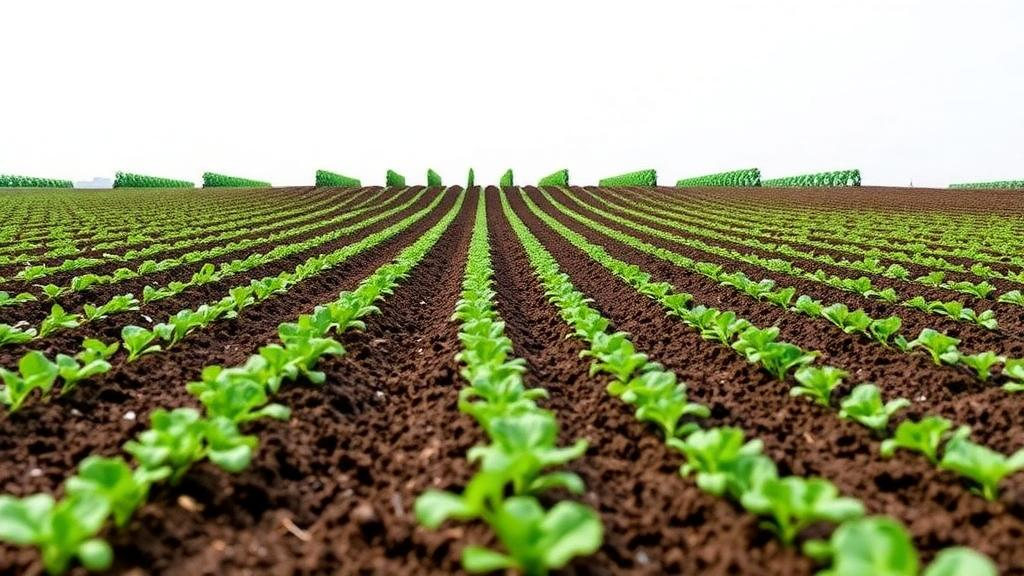
For years, agricultural scientists have promoted crop diversification as one of the most reliable levers for building soil organic carbon, the vast carbon reservoir that underlies both soil fertility and climate mitigation. The logic seemed straightforward: adding legumes or rice to a rotation changes the amount and quality of plant-derived carbon entering the soil, and that should translate into more carbon stored. But a large retrospective study of real working farms in China’s North China Plain now delivers a more nuanced and somewhat sobering message. Diversifying a rotation, by itself, does not guarantee greater soil organic carbon accumulation. What matters, the researchers conclude, is whether the extra carbon a diversified rotation delivers arrives in soils whose texture and moisture conditions actually favor carbon preservation.
The study, published in the journal Plant and Soil, was led by Xianjin Xie and Anning Zhu of the Institute of Soil Science at the Chinese Academy of Sciences, working with colleagues at the Soil and Fertilizer Station of Henan Province and Henan Agricultural University. Rather than relying on small, tightly controlled experimental plots, the team took advantage of an unusually rich observational resource: soil testing records collected between 2006 and 2020 through China’s Soil Testing and Fertilizer Recommendation program, combined with plot-level cropping histories and a modeled soil organic carbon baseline representing conditions in the 1980s. This allowed them to ask how soil organic carbon had changed across thousands of real farms where farmers, not researchers, made the management decisions.
The geographic focus was Henan Province, a major agricultural heartland of the North China Plain where intensive double cropping dominates the landscape. The researchers compared four on-farm rotation systems that structure farming across the province. The first and most widespread is the classic winter wheat–summer maize rotation, referred to as WM. The second, WML, substitutes soybean for maize in some summer seasons, creating a wheat–maize/soybean system. The third, WMP, brings peanut into the summer slot, producing a wheat–maize/peanut rotation. The fourth group, rice-inclusive systems or RIS, incorporates rice into the cropping sequence. Each system carries a distinct signature of carbon inputs, residue management, fertilizer use, and soil water dynamics, making them a natural experiment in how rotation design shapes the soil carbon balance.
To estimate how much soil organic carbon had accumulated since the 1980s, the team combined the modern soil testing records with a predicted historical baseline, then applied a statistically rigorous comparison framework. Because farms growing different rotations differ systematically in soil type, climate, and management intensity, a naive comparison would confound the effect of the rotation itself with the effect of where and how each rotation is practiced. The researchers therefore used within-county matching to pair fields that were otherwise comparable, and then fitted paired fixed-effects models to isolate the rotation effect. This quasi-experimental approach, borrowed in part from observational statistics, is what gives the study its credibility: it approximates the rigor of a controlled trial while operating at the scale of an entire province.
The headline result is that every rotation system accumulated soil organic carbon relative to the 1980s baseline, a finding consistent with broader evidence that Chinese croplands have been gaining carbon over recent decades, driven by rising yields, increased fertilizer and residue inputs, and policy interventions. In unmatched, province-wide summaries, the mean change in soil organic carbon was 4.15 grams per kilogram for the winter wheat–summer maize system, 3.73 grams per kilogram for the wheat–maize/soybean rotation, 3.30 grams per kilogram for the wheat–maize/peanut rotation, and 3.72 grams per kilogram for rice-inclusive systems. At first glance, these numbers suggest that the conventional wheat–maize double crop, often criticized as monoculture-like, actually performed best.
But the matched comparisons, which control for the confounding differences between farms, tell a subtler story. When fields were properly paired, the wheat–maize/soybean rotation showed no statistically distinguishable difference from the pure wheat–maize system, meaning that swapping in soybean did not help or hurt carbon accumulation on average. The wheat–maize/peanut rotation, however, accumulated 0.53 grams per kilogram less soil organic carbon than wheat–maize, a genuine disadvantage. Meanwhile, rice-inclusive systems accumulated 0.78 grams per kilogram more carbon than wheat–maize, making them the clear winner in the matched analysis. The divergence between the unmatched and matched results underscores why observational soil data demands careful causal design: raw comparisons across the province would have led to entirely different conclusions about which rotations build carbon.
Perhaps the most scientifically interesting finding is that the rotation effects were strongly conditional on soil texture and moisture. The carbon disadvantage of the peanut rotation was most pronounced in fields with low clay content and drier conditions, where sandy, well-aerated soils allow microbes to rapidly decompose the organic matter returned by crops before it can be stabilized. In contrast, the advantage of rice-inclusive systems was greatest in high-clay, wetter fields. This pattern aligns with well-established soil biogeochemistry. Clay particles provide reactive mineral surfaces that bind organic molecules and physically protect them from decomposition, while the flooded, oxygen-limited conditions of paddy rice cultivation slow microbial respiration and suppress the oxidative breakdown of organic matter. In waterlogged rice soils, alternating anaerobic conditions and iron redox chemistry further contribute to carbon preservation, a mechanism documented extensively in paddy soil research.
The study’s framing of carbon inputs versus carbon preservation offers a useful conceptual lens. Diversified rotations are often assumed to increase soil carbon because they increase or diversify plant-derived carbon inputs, including root biomass, rhizodeposition, and crop residues. Legumes, in particular, have been championed in global meta-analyses for their supposed carbon benefits, alongside their nitrogen-fixing capacity and yield advantages for subsequent cereal crops. Yet the Henan results show that the fate of those inputs depends on the receiving environment. A peanut rotation that returns substantial residue to a dry, sandy soil may lose carbon as fast as it gains it, while a rice system whose carbon inputs are modest by comparison may still accumulate more carbon because the soil environment locks it away. Carbon sequestration, in other words, is a coordination problem between supply and preservation, not a simple input-output ledger.
The practical implications for farmers and policymakers are significant. The findings suggest that blanket recommendations to diversify rotations for carbon sequestration are unlikely to deliver uniform benefits, and may even backfire in some settings. Instead, rotation choices should be matched to soil conditions: legume-inclusive rotations with peanut may be better justified by their yield and economic benefits than by carbon claims on light, dry soils, while rice-inclusive rotations on clay-rich, wetter land offer a genuine carbon sequestration opportunity. Because the analysis drew on administrative soil testing data rather than purpose-built experiments, it also demonstrates the power of on-farm observational datasets, and of statistical methods such as propensity-score-style matching and fixed-effects modeling, to answer agronomic questions at a scale no experimental network could match. The authors note that the underlying soil testing and household survey datasets are administrative and restricted, but derived data and code are available on reasonable request.
For a region as consequential as the North China Plain, where intensive double cropping feeds a large share of China’s grain production while straining groundwater resources, understanding which rotations genuinely store carbon is far from academic. The study, funded by China’s National Key Research and Development Program, adds to a growing body of work arguing that soil carbon management must be multi-pool and context-specific, attending to mineral associations, moisture regimes, and microbial processing rather than simply maximizing carbon inputs. As Xie and colleagues put it in their conclusion, crop diversification alone did not guarantee greater soil organic carbon accumulation; the rotation effect depended on the coordination between plant-derived carbon return and soil conditions that favor carbon preservation. For anyone hoping that a simple change in crop sequence will bank carbon in the ground, the message from thousands of real farms is clear: the soil decides.
Subject of Research: Soil organic carbon accumulation across on-farm crop rotation systems in the North China Plain
Article Title: Analysis of soil organic carbon changes across on-farm rotation systems in the North China Plain
Article References: Xie, X., Xin, X., Yang, W., Zhang, X., Yun, Y., Mu, L., Wang, X., Yan, J., Li, L., & Zhu, A. (2026). Analysis of soil organic carbon changes across on-farm rotation systems in the North China Plain. Plant and Soil. https://doi.org/10.1007/s11104-026-09139-6
Image Credits: AI Generated
DOI: 10.1007/s11104-026-09139-6
Keywords: soil organic carbon, crop rotation, North China Plain, carbon sequestration, crop diversification, legumes, rice paddy, soil texture, soil moisture, Henan Province, on-farm research, wheat-maize rotation
Cite Scienmag News
Alan Morgan. (October 2, 2026). Crop Rotation Alone Won’t Store More Soil Carbon, Landmark Farm Study Finds. Scienmag. https://scienmag.com/crop-rotation-alone-wont-store-more-soil-carbon-landmark-farm-study-finds/
Alan Morgan. "Crop Rotation Alone Won’t Store More Soil Carbon, Landmark Farm Study Finds." Scienmag, 2 October 2026, https://scienmag.com/crop-rotation-alone-wont-store-more-soil-carbon-landmark-farm-study-finds/. Accessed 2 October 2026.
Alan Morgan. "Crop Rotation Alone Won’t Store More Soil Carbon, Landmark Farm Study Finds." Scienmag. October 2, 2026. https://scienmag.com/crop-rotation-alone-wont-store-more-soil-carbon-landmark-farm-study-finds/


