


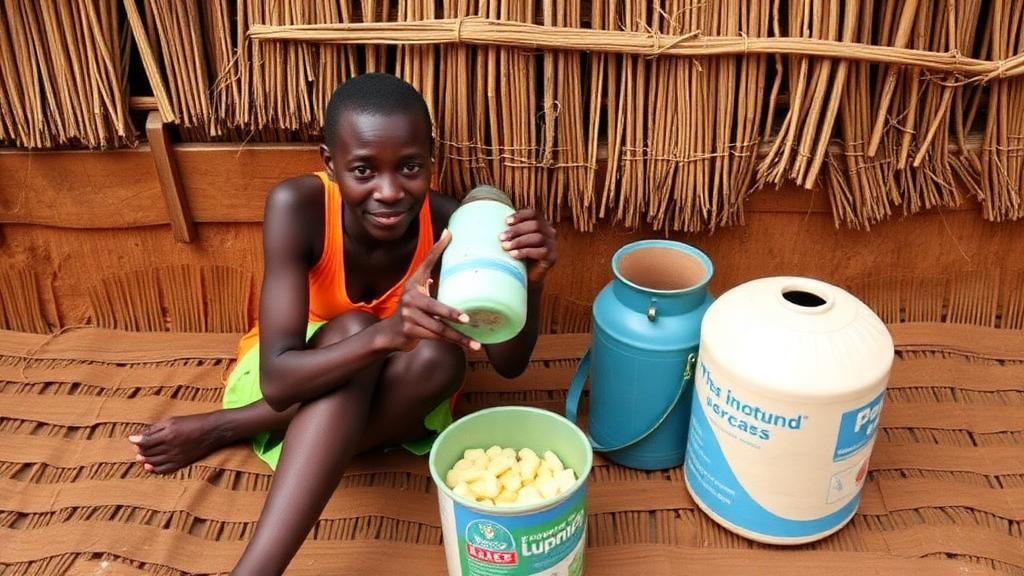
In the rolling farmlands of northern Uganda, a region still rebuilding after nearly three decades of insurgency, a quiet experiment in agricultural technology has produced one of the most surprising findings in recent food security research. A decade-long development project taught thousands of smallholder farmers how to harvest, dry, and store their crops more carefully. The expectation was straightforward: less grain lost to insects, mold, and premature harvesting should mean more food on the table and more varied diets at home. Yet when researchers finally measured the nutritional consequences, the results split in an unexpected direction. Some of the promoted technologies were clearly associated with richer, more diverse household diets. Others, paradoxically, appeared to leave families eating a narrower range of foods than their neighbors who never adopted them at all.
The study, published in BMC Agriculture, examined households across nine districts of the Acholi sub-region where the Project for the Restoration of Livelihoods in Northern Uganda, known as PRELNOR, operated between 2014 and 2024. Funded by the International Fund for Agricultural Development and implemented by Uganda’s Ministry of Local Government, the project pursued an integrated development approach designed to restore the region’s status as a major agricultural production area following the Lord’s Resistance Army conflict. Its stated goal was increased income, food security, and reduced vulnerability for poor rural households. But the 2022 Uganda Demographic and Health Survey showed that food insecurity in the Acholi sub-region remained above the national average, raising an uncomfortable question about whether such interventions were actually delivering on their nutritional promises.
To answer it, a research team led by scientists at Gulu University surveyed 722 smallholder households drawn from 228 farmer groups that had completed at least two years, or four production seasons, of PRELNOR support and had since been weaned off the program. The sampling followed a rigorous design: groups were selected proportionately across all districts and sub-counties using the Krejcie and Morgan sample size table, and individual respondents were chosen by lottery within each group. The questionnaire captured demographic and socioeconomic characteristics, adoption of the specific technologies promoted by the project, and a 24-hour recall of every food and beverage consumed by household members. That recall was scored against the twelve food groups defined by the Food and Agriculture Organization, from cereals and roots to eggs, fish, dairy, and oils, producing a household dietary diversity score ranging from zero to twelve.
The technologies themselves were deliberately simple. On the harvesting side, farmers were encouraged to assess crop maturity, harvest at the right maturity, and harvest at the right time, distinctions that matter because crops like maize and beans are often left to dry in the field after reaching maturity. For drying, the project promoted tarpaulins, raised platforms, and drying grain to the required moisture content of roughly 13.5 percent. For storage, the options included hermetic PICS bags, super gunny bags, and polypropylene bags. Adoption rates varied dramatically. More than 70 percent of farmers used tarpaulins for drying, prized for their portability, low cost, and the way they can be folded into a zipped envelope when rain threatens. But fewer than a quarter had adopted PICS bags, super gunny bags, or polypropylene bags for storage, and traditional gunny bags remained the most common container despite their high permeability to insects and rodents.
The technical logic behind the hermetic options is compelling. PICS bags work by sealing grain in a triple-layer plastic enclosure that restricts oxygen exchange; respiration by any insects trapped inside drives oxygen levels down and carbon dioxide up, suffocating the pests without chemical pesticides. Previous research has shown maize stored in hermetic bags suffering losses of only about two percent after one hundred days, and studies in Kenya found that drying grain on plastic sheets rather than bare ground cut aflatoxin contamination roughly in half. Aflatoxins, the carcinogenic toxins produced by Aspergillus molds, are a persistent threat to food safety across sub-Saharan Africa, and both premature harvesting and poor drying create the moist conditions these fungi need. In principle, every link in this chain should preserve not just calories but quality, keeping more nutritious food available for longer.
To isolate the true effect of adoption from the many other differences between farming families, the researchers turned to propensity score matching, a quasi-experimental technique that statistically constructs a counterfactual by pairing each adopter with non-adopters who share similar observable characteristics. Age, gender, education, household labor, land holdings, credit access, ox-plough use, and market access all proved to shape adoption decisions. Educated household heads were more likely to assess crop maturity, dry on tarpaulins, and use PICS bags, while older farmers drew on accumulated experience to judge maturity and female farmers were more likely than men to adopt PICS bags. Access to credit encouraged investment in higher-quality storage, and each additional unit of land under cultivation raised the probability of adopting PICS and polypropylene bags by 73 and 53 percent respectively, reflecting the greater storage needs that come with larger harvests.
The matched comparison delivered its verdict with striking clarity for three technologies. Households whose heads knew how to assess crop maturity gained between 0.54 and 0.72 points of dietary diversity, and those who dried their grain on tarpaulins gained between 0.67 and 0.84 points. The largest effect belonged to PICS bags: adopters saw their dietary diversity scores rise by roughly 1.51 to 1.69 points compared with their matched non-adopting counterparts. The mechanism is plausible and well supported by earlier work. Tarpaulin drying reduces quantitative losses, mold infection, and aflatoxin contamination, and studies in Tanzania found it increased food availability by 18 to 27 percent and household income gains by more than 100 percent over traditional methods. Hermetic storage lets farmers hold grain longer, avoiding distress sales at harvest-time lows and stretching food supplies across the lean season, which stabilizes consumption and supports varied meals.
But the same analysis produced its most provocative result in the opposite direction. Households that harvested at the right time, harvested at the right maturity, or stored grain in super gunny or polypropylene bags actually showed significantly lower dietary diversity than comparable non-adopters. The authors offer several candidate explanations, each grounded in economic theory rather than speculation. Better post-harvest quality commands better market prices, and farmers may have channeled their improved crops toward buyers rather than the family pot. Engel’s Law, the venerable observation that the share of income spent on food falls as income rises, suggests that additional earnings from higher-quality harvests may have been directed toward non-food goods. Low nutrition knowledge in rural households compounds the problem: without understanding what a balanced diet requires, families may convert agricultural gains into purchases that do nothing for dietary variety.
The researchers are careful to acknowledge the limits of their method. Propensity score matching can only control for observable characteristics, so unmeasured confounders such as nutrition knowledge, spending priorities, and intra-household decision-making may still bias the estimates. The study also evaluated each technology in isolation, leaving the combined effect of adopting several at once unexplored, and the three technologies with the clearest benefits were ironically among the least adopted. Still, the policy implications are hard to ignore. Reducing post-harvest losses is necessary but not sufficient for better nutrition; extension programs must pair technology promotion with nutrition education that guides new income toward diverse, nutritious foods. In a country where undernourishment has climbed from 18.6 percent in the mid-2000s to nearly 37 percent today, and where the population is projected to reach 100 million by 2050, the difference between a tarpaulin and a polypropylene bag may seem trivial. This study suggests it is anything but: the humblest tools, chosen and taught well, can quietly decide whether a harvest becomes a healthier dinner.
Subject of Research: Impact of post-harvest handling technology adoption on household dietary diversity among smallholder farmers in northern Uganda
Article Title: Does uptake of post-harvest handling technologies lead to better household nutrition? Empirical evidence from a project-based intervention in Northern Uganda
Article References: Fassinou, F. K., Okello, D. M., Olum, S., Asekenye, C., Kalule, S. W., & Odongo, W. (2025). Does uptake of post-harvest handling technologies lead to better household nutrition? Empirical evidence from a project-based intervention in Northern Uganda. BMC Agriculture, 1(1), Article 14. https://doi.org/10.1186/s44399-025-00016-8
Image Credits: AI Generated
DOI: 10.1186/s44399-025-00016-8
Keywords: post-harvest losses, dietary diversity, smallholder farmers, PICS bags, food security, Uganda, agricultural technology adoption, propensity score matching, aflatoxin, hermetic storage, PRELNOR, nutrition
Cite Scienmag News
Daisy Hatcher. (October 2, 2026). Simple Storage Tools Can Reshape Family Diets in Post-Conflict Uganda. Scienmag. https://scienmag.com/simple-storage-tools-can-reshape-family-diets-in-post-conflict-uganda/
Daisy Hatcher. "Simple Storage Tools Can Reshape Family Diets in Post-Conflict Uganda." Scienmag, 2 October 2026, https://scienmag.com/simple-storage-tools-can-reshape-family-diets-in-post-conflict-uganda/. Accessed 2 October 2026.
Daisy Hatcher. "Simple Storage Tools Can Reshape Family Diets in Post-Conflict Uganda." Scienmag. October 2, 2026. https://scienmag.com/simple-storage-tools-can-reshape-family-diets-in-post-conflict-uganda/


