


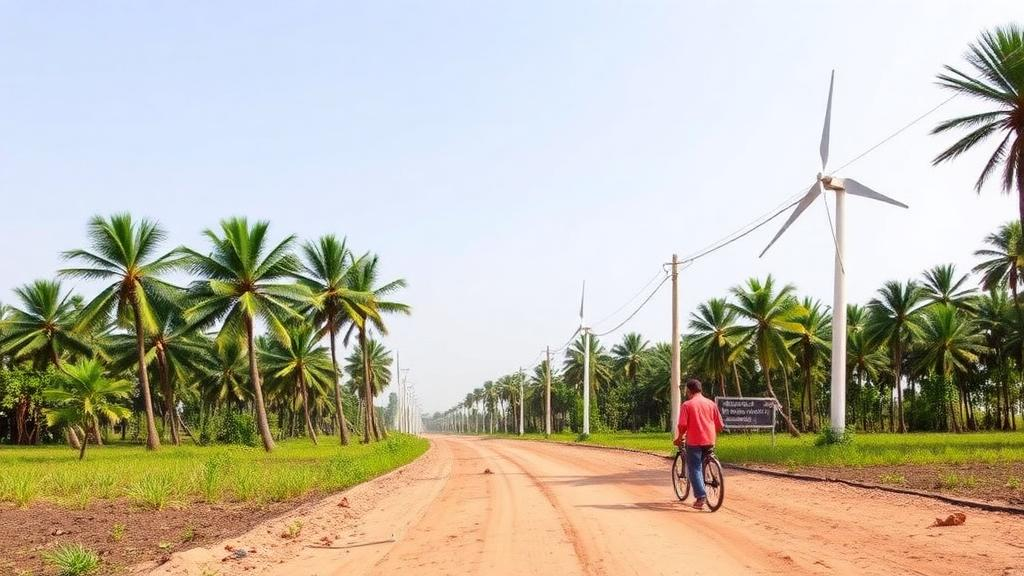
Palm oil is everywhere. It slips into roughly half of the packaged products on supermarket shelves, from biscuits and shampoo to biodiesel and lipstick, and the economies that produce it have grown wealthy on the back of that demand. Yet a new study suggests that the road to genuine, lasting prosperity for these crude palm oil giants does not run through ever-expanding plantations or raw economic growth alone. Instead, the research points to two quieter forces—institutional quality and renewable energy—as the variables most consistently tied to sustainable development across the world’s leading producing nations.
The study, published in the journal Discover Sustainability, was conducted by Suprianik Suprianik and colleagues at Universitas Jember in Indonesia, together with Zainul Hasan, now based at Airlangga University in Surabaya. The team set out to answer a deceptively simple question: in the countries that dominate global palm oil production, what actually drives sustainable development? To do so, they assembled panel data covering eight major crude palm oil-producing economies over a twenty-seven-year window, from 1996 to 2022, drawing on the World Bank’s World Development Indicators and the Worldwide Governance Indicators databases.
Measuring sustainable development is notoriously difficult, and the authors made a deliberate methodological choice that sets their work apart. Rather than relying on a single environmental metric or a composite index of uncertain provenance, they used Adjusted Net Savings, a World Bank indicator that captures whether a nation is genuinely building wealth for future generations. The measure starts with gross national savings and then adjusts for education spending, depletion of forests, minerals, and energy resources, and damage from carbon dioxide emissions and particulate pollution. In effect, it asks whether a country is consuming its natural capital faster than it is investing in its people and institutions—a question that cuts to the heart of the palm oil debate.
The explanatory variables were chosen to reflect the central tensions of commodity-driven economies. Permanent cropland intensity served as a proxy for how intensively land is devoted to agriculture, capturing the land-use pressure associated with plantation expansion. GDP per capita represented the level of economic development. Regulatory quality, drawn from the Worldwide Governance Indicators, measured the perceived ability of governments to formulate and enforce sound policies. Renewable energy consumption, expressed as a share of total final energy use, tracked progress along the energy transition. Together, these four variables formed the analytical backbone of the study.
The econometric machinery behind the findings is considerable. Because countries differ in their economic structures and because shocks in one economy can spill over into others, the authors needed methods that could handle both heterogeneity and cross-sectional dependence. Their baseline approach was the Pooled Mean Group Autoregressive Distributed Lag model, known as PMG-ARDL, which estimates short-run dynamics and long-run equilibrium relationships simultaneously while allowing the coefficients to vary across countries. To guard against spurious results, they ran two robustness checks—the Common Correlated Effects Mean Group and Augmented Mean Group estimators—both of which explicitly account for cross-country interdependence. The tests confirmed a stable long-run relationship among the variables, meaning the results describe a genuine equilibrium rather than a statistical accident.
The headline finding is striking in its simplicity: in the long run, regulatory quality and renewable energy consumption are positively associated with sustainable development, while permanent cropland intensity and GDP per capita show no significant direct relationship in the baseline model. In other words, stronger institutions and cleaner energy move the needle on Adjusted Net Savings, but neither the sheer intensity of cropland use nor the level of income per person does so on its own. That result challenges the intuition that palm oil prosperity translates automatically into sustainable development, and it equally challenges the assumption that plantation expansion is always the decisive driver of environmental outcomes in these economies.
The short-run picture adds an important nuance. When the authors examined year-to-year dynamics, renewable energy consumption emerged as the most consistent positive association with improved sustainable development outcomes. This suggests that the energy transition is not merely a long-term aspiration for palm oil economies but a lever that delivers measurable benefits within the span of a few years. The robustness estimations generally confirmed the direction of the main relationships, lending confidence that the pattern holds even when the statistical treatment of cross-country dependence and heterogeneous national responses is varied.
Why would regulatory quality matter so much? The authors’ interpretation, grounded in the logic of the indicator, is that well-functioning institutions shape how commodity wealth is managed. Governments capable of enforcing environmental standards, designing credible land-use policies, and resisting short-term capture can channel palm oil revenues into education, infrastructure, and resource stewardship rather than allowing depletion to erode the national balance sheet. Adjusted Net Savings is precisely the kind of measure that rewards such stewardship: a country that harvests its forests faster than it invests in human capital will see the indicator fall, even if GDP is rising. Institutions, in this framing, are the mechanism that converts commodity-based activity into long-term wealth accumulation.
The findings arrive at a moment when palm oil-producing economies face intensifying international scrutiny. Importing markets increasingly demand certified sustainable production, deforestation-free supply chains, and credible climate commitments, while domestic pressures—haze from land clearing, biodiversity loss, and the social costs of plantation expansion—continue to test public tolerance. The study’s results imply that the most effective responses are not simply agronomic. Strengthening regulatory institutions and accelerating the shift to renewable energy appear to be the variables most tightly linked to sustainable development outcomes, suggesting that governance and energy policy deserve at least as much attention as yield improvement and certification schemes.
For policymakers in Indonesia, Malaysia, and the other major producers covered by the analysis, the practical implications are concrete. Investments in renewable energy capacity—solar, geothermal, hydro, and bioenergy—offer a dual dividend: they reduce the carbon and pollution penalties that drag down Adjusted Net Savings while insulating economies from volatile fossil fuel imports. Meanwhile, reforms that raise regulatory quality, from transparent concession licensing to consistent enforcement of environmental law, provide the institutional scaffolding on which sustainable land management depends. The authors caution that their results describe associations across a panel of countries rather than causal effects in any single nation, and the absence of a significant direct link between cropland intensity and sustainable development in the baseline model suggests that the land-use question is mediated by other factors, likely including the very institutions the study highlights.
The research also carries a broader lesson for development economics. Commodity dependence is often portrayed as a curse, but this study reframes the problem: the curse is not the commodity itself but the failure to convert its proceeds into durable wealth. By showing that renewable energy and regulatory quality are the variables most consistently associated with sustainable development across nearly three decades of data, the authors offer a quantitative foundation for a policy agenda that treats the energy transition and institutional reform as inseparable from agricultural strategy. As the global palm oil industry confronts mounting environmental expectations, the evidence suggests that the producers who thrive will be those that transform plantation wealth into sustainable wealth—and that the transformation begins in the ministries and power grids as much as in the fields.
Subject of Research: The relationship between cropland intensity, regulatory quality, renewable energy consumption, and sustainable development in major crude palm oil-producing countries
Article Title: The roles of cropland intensity, regulatory quality, and renewable energy in major palm oil-producing economies
Article References: Suprianik, S., Viphindrartin, S., Zainuri, Z., Wilantari, R. N., & Hasan, Z. (2026). The roles of cropland intensity, regulatory quality, and renewable energy in major palm oil-producing economies. Discover Sustainability. https://doi.org/10.1007/s43621-026-04890-3
Image Credits: AI Generated
DOI: 10.1007/s43621-026-04890-3
Keywords: palm oil, sustainable development, adjusted net savings, regulatory quality, renewable energy, cropland intensity, PMG-ARDL, panel data, governance indicators, energy transition, land use, Indonesia
Cite Scienmag News
Faith Mcneil. (October 2, 2026). Palm Oil Giants’ Path to Sustainability Runs Through Regulation and Renewable Energy, Study Finds. Scienmag. https://scienmag.com/palm-oil-giants-path-to-sustainability-runs-through-regulation-and-renewable-energy-study-finds/
Faith Mcneil. "Palm Oil Giants’ Path to Sustainability Runs Through Regulation and Renewable Energy, Study Finds." Scienmag, 2 October 2026, https://scienmag.com/palm-oil-giants-path-to-sustainability-runs-through-regulation-and-renewable-energy-study-finds/. Accessed 2 October 2026.
Faith Mcneil. "Palm Oil Giants’ Path to Sustainability Runs Through Regulation and Renewable Energy, Study Finds." Scienmag. October 2, 2026. https://scienmag.com/palm-oil-giants-path-to-sustainability-runs-through-regulation-and-renewable-energy-study-finds/


