


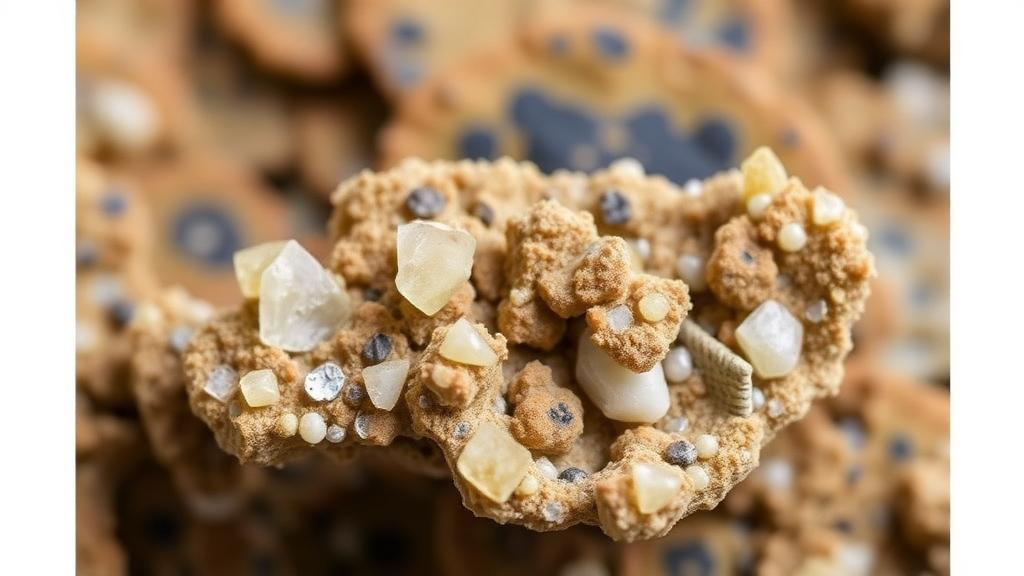
Arsenic in drinking water is one of the most stubborn contamination problems on the planet, affecting tens of millions of people across South Asia, Latin America, and parts of Europe and North America. Now a team of geochemists from AGH University of Krakow and Montanuniversität Leoben has reported a strikingly elegant fix: a common volcanic mineral, clinoptilolite zeolite, loaded with lead, that captures dissolved arsenate and locks it inside a naturally occurring, extraordinarily insoluble mineral called mimetite. The work, published in Environmental Geochemistry and Health, goes far beyond a simple proof of concept, systematically mapping how pH, arsenic concentration, reaction time, and the crowded chemistry of real natural waters govern the process.
The chemistry at the heart of the study is deceptively simple. The researchers first exchanged the sodium and calcium ions in natural clinoptilolite with lead, producing a zeolite that carries roughly 70 grams of lead per kilogram of material. When this lead-loaded zeolite is dropped into water containing arsenate, the pentavalent form of arsenic, lead ions slowly desorb from the zeolite framework. In the presence of chloride, those freed lead ions react with arsenate to precipitate mimetite, Pb5(AsO4)3Cl, an apatite-group mineral whose crystal structure binds arsenic so tightly that it barely dissolves even over geological timescales. The zeolite thus acts simultaneously as a lead reservoir and as a nucleation surface on which the new mineral grows.
The performance numbers are remarkable. In batch experiments with arsenate solutions ranging from 0.1 to 50 milligrams per liter, uptake began within one minute of contact. At pH values between 6 and 8, immobilisation reached up to 99 percent within a single hour, and dissolved arsenic frequently fell below the analytical detection limit of 0.02 milligrams per liter. Kinetic tests at pH 6 showed that a 5 milligram per liter arsenate solution dropped by roughly 88 percent within three minutes and below detection within a day. Even more impressively, the same portion of zeolite retained nearly complete sequestration efficiency through five consecutive reaction cycles, slipping only from 99.9 to 99.2 percent by the fifth run.
Acidity, however, is the system’s Achilles heel. At pH 2, arsenate removal fell to between 26 and 65 percent, and dissolved lead climbed as high as 140 milligrams per liter in the worst cases. The reason is twofold. First, mimetite becomes substantially more soluble under strongly acidic conditions, so the thermodynamic driving force for precipitation weakens. Second, arsenate speciation shifts: at low pH the dominant dissolved species is the fully protonated H3AsO4, which reacts far less readily with lead ions than the deprotonated H2AsO4− and HAsO4²− forms that prevail at circumneutral pH. Geochemical modelling with PHREEQC reproduced this behaviour precisely, predicting equilibrium arsenic concentrations of just 0.047 milligrams per liter at pH 6 but nearly 17 milligrams per liter at pH 2.
Lead release proved to be the mirror image of arsenic capture. Under neutral to alkaline conditions, less than one percent of the lead stored on the zeolite ever appeared in solution, because arsenate scavenged dissolved lead ions as fast as they desorbed, pulling more lead off the zeolite in a self-sustaining cycle. Control experiments without arsenate confirmed that sodium-chloride background solution alone mobilized almost no lead at pH 6 to 8. A 21-day stability test of the spent, mimetite-bearing material in neutral water showed no meaningful remobilization of either arsenic or lead, though the authors are careful to note that this short-term result cannot yet guarantee long-term environmental persistence under fluctuating pH, redox, and flow conditions.
Perhaps the most encouraging finding is how indifferent the mechanism is to competition. The researchers spiked arsenate solutions with a battery of co-occurring ions, including potassium, magnesium, calcium, aluminium, manganese, nickel, copper, zinc, and cadmium as cations, and fluoride, sulphate, and phosphate as anions. Arsenate sequestration stayed above 97 percent in essentially every case, because arsenate oxyanions do not compete for the zeolite’s cation-exchange sites; they are removed by precipitation instead. The accompanying cations followed their own separate pathways, mostly exchanging onto the zeolite or hydrolysing, while the anions subtly reshaped which lead minerals formed. Phosphate was incorporated into the precipitate, producing mixed mimetite-pyromorphite phases; sulphate diverted some lead into anglesite; fluoride hinted at limited substitution within the apatite structure.
The real test came with natural waters. The team collected samples from three arsenic-affected sites in Central Europe: geothermal water from the Vital Therme at Bad Wildbad in Germany’s Northern Black Forest, water from the Trująca River draining the historic gold and arsenic mining district of Złoty Stok in Poland, and two samples from the Upper Mur Valley in Austria, one oxidized surface water downstream of arsenic-bearing waste rock and one oxygen-poor water from a flooded mine gallery. Sequestration efficiencies ranged from 51 to 99 percent, with the mining-impacted surface waters performing best, exceeding 90 percent removal. The geothermal Bad Wildbad water was the laggard, and the authors suggest that reduced sulphur species in that water may convert arsenate into thioarsenate forms that cannot directly enter the mimetite structure.
In the natural waters, the mineralogy grew richer as well. Alongside mimetite, X-ray diffraction and electron microscopy revealed cerussite and anglesite, lead carbonate and lead sulphate phases that formed because bicarbonate and sulphate in the water competed for the released lead. This matrix dependence is a central lesson of the study: arsenic retention is not governed by a single reaction but by a network of coupled processes, including ion exchange, aqueous complexation, and competing mineral precipitation. Any field deployment would need to account for the full aqueous speciation of the target water, not just its arsenic concentration.
The practical implications are considerable. The authors position lead-modified clinoptilolite as a reactive material best suited to oxidized, circumneutral waters, exactly the conditions found in many contaminated groundwaters and mine-impacted surface streams. Where acidic waters are unavoidable, they propose a downstream phosphate stage that would precipitate any residual dissolved lead as pyromorphite-group minerals, among the least soluble lead phases known. Trivalent arsenite, the more mobile and toxic form of arsenic dominant in reducing groundwaters, would need to be oxidized first, since only arsenate participates in mimetite formation. Iron, a common companion of arsenic in natural waters, was deliberately excluded from the experiments to keep the mimetite pathway measurable, and the authors flag iron-bearing systems as a priority for future work.
What makes the study compelling beyond its engineering promise is its geochemical insight. It demonstrates that a porous aluminosilicate can be engineered to function as a self-regulating mineralizer, releasing metal ions only as fast as a low-solubility product consumes them. That coupled desorption-precipitation mechanism, the authors argue, is what governs arsenic mobility in natural lead-bearing environments too, from weathering ore deposits to contaminated aquifers. Longer flow-through tests, surface spectroscopy to resolve the fine details of interfacial reactions, and trials under dynamic redox conditions remain to be done. But the core result stands: with the right mineral scaffold and the right water chemistry, dissolved arsenic can be persuaded to become stone.
Subject of Research: Arsenate immobilisation from water through mimetite precipitation on lead-modified clinoptilolite zeolite
Article Title: Arsenate immobilisation and mimetite formation on Pb-modified zeolite under variable aqueous chemistry
Article References: Stępień, E., Dunkel, F., Manecki, M., & Bajda, T. (2026). Arsenate immobilisation and mimetite formation on Pb-modified zeolite under variable aqueous chemistry. Environmental Geochemistry and Health, 48(15), Article 591. https://doi.org/10.1007/s10653-026-03472-6
Image Credits: AI Generated
DOI: 10.1007/s10653-026-03472-6
Keywords: arsenic, arsenate, mimetite, clinoptilolite, zeolite, water treatment, mineral precipitation, geochemistry, lead, contaminated groundwater, apatite-group minerals, mine water
Cite Scienmag News
Sloane Callahan. (October 2, 2026). Lead-Treated Zeolite Traps Arsenic in Water by Growing a Rare Mineral. Scienmag. https://scienmag.com/lead-treated-zeolite-traps-arsenic-in-water-by-growing-a-rare-mineral/
Sloane Callahan. "Lead-Treated Zeolite Traps Arsenic in Water by Growing a Rare Mineral." Scienmag, 2 October 2026, https://scienmag.com/lead-treated-zeolite-traps-arsenic-in-water-by-growing-a-rare-mineral/. Accessed 2 October 2026.
Sloane Callahan. "Lead-Treated Zeolite Traps Arsenic in Water by Growing a Rare Mineral." Scienmag. October 2, 2026. https://scienmag.com/lead-treated-zeolite-traps-arsenic-in-water-by-growing-a-rare-mineral/


