


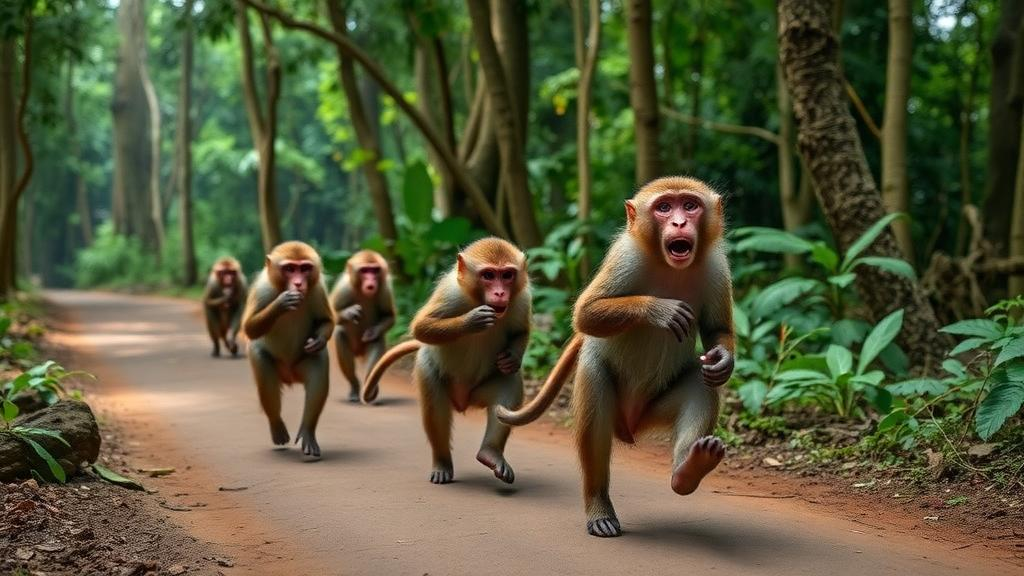
In the shadow of Mount Apo on the Philippine island of Mindanao, a troop of more than fifty long-tailed macaques has spent decades perfecting a daily routine that looks, on paper, a lot like a human commute. Every morning, after being fed by members of a local religious community, the animals leave the village of New Israel and head into the surrounding forest-agricultural mosaic to forage for wild food. By late afternoon, they stream back into the built-up area to rest, groom one another, and settle in for the night among houses, gardens, and a church. A new study published in Discover Conservation has now mapped this rhythm in unprecedented detail, using geographic information system tools borrowed from crime analysis and epidemiology to reveal exactly where and when the macaques do what they do.
The research, led by Kim Dianne Ligue-Sabio and colleagues at the University of the Philippines Mindanao, is notable not just for what it found but for how it found it. Over three fieldwork sessions conducted between May 2021 and May 2022, the team logged 270.5 hours of direct observation across 29 days, recording the behavior of visible troop members in 1,082 scan samples. Each scan lasted five minutes and was followed by a ten-minute pause, creating a fifteen-minute sampling cycle that ran from 6:00 AM to 6:00 PM. At every scan, the observers noted the primary behavior of each visible animal and recorded the GPS coordinates of the troop’s approximate center, generating a rich spatiotemporal dataset that could be interrogated with formal spatial statistics.
The five most frequently observed behaviors were moving, recorded in 99.26 percent of scans, resting at 92.42 percent, grooming at 68.48 percent, feeding at 67.74 percent, and foraging at 57.12 percent. To analyze these, the researchers turned to the Getis-Ord Gi* statistic, a hotspot detection method that identifies statistically significant clusters of activity, and to a more sophisticated technique called Emerging Hotspot Analysis. The latter builds a space-time cube, aggregating the fifteen-minute scans into hourly bins across a fishnet grid, then applies both the Getis-Ord statistic and the Mann-Kendall trend test to classify each bin as a new, consecutive, intensifying, persistent, diminishing, sporadic, oscillating, or historical hotspot or coldspot. The result is a map that shows not just where behaviors cluster, but how those clusters rise and fall through the day.
The temporal findings were strikingly clean. Foraging peaked between 8:00 and 9:00 in the morning and then declined steadily, a trend confirmed by the Mann-Kendall statistic. Grooming showed the opposite trajectory, climbing through the afternoon to peak between 4:00 and 5:00 PM. Feeding, resting, and moving showed no significant monotonic trends across the day. Read together, the data describe a troop that prioritizes energy acquisition early, exploiting both provisioned food and wild resources, and then shifts its attention to social bonding and rest as the day winds down. It is a familiar structure of primate time budgets, but here it plays out across a landscape divided between houses and forest.
The spatial analysis added a second layer of insight. Feeding, grooming, and resting clustered tightly, with significant spatial autocorrelation emerging at distance bands as short as two meters and never exceeding seventeen meters. This tight clustering suggests repeated use of specific, localized spots for social and resting activities, likely anchored to the fixed provisioning site and a consistent sleeping area within the village. Foraging, by contrast, only clustered at a thirty-meter bandwidth, and its hotspots extended deep into the forest-agricultural mosaic, well beyond the built-up zone. The researchers interpret this broader dispersion as a strategy for locating diverse food resources and reducing within-group competition by avoiding the repeated exploitation of the same patches.
Perhaps the most consequential finding concerns diet. Despite being fed regularly by the Moncadista community, a local religious sect that regards the macaques as spiritually connected to their ancestors and strictly prohibits hunting them, the animals continued to forage intensively for natural foods. Observers recorded them eating Chinese bamboo leaves, fruits, grass, and insects in the forest, alongside provisioned bananas, eggs, peanuts, and even junk food in the village. The persistence of foraging hotspots in the forest suggests that human provisioning alone does not meet the troop’s nutritional needs, particularly for a group of at least fifty individuals. Primates actively forage to maintain an optimal nutritional balance, and insects in particular provide protein that cultivated crops may lack. The implication for conservation is direct: even provisioned macaque populations depend on intact forest habitat.
The study also offers a window into why the macaques prefer the village for their downtime. Although there is no hunting pressure anywhere in the troop’s range, grooming and resting hotspots were concentrated in built-up areas while coldspots for these behaviors appeared throughout the forest. The researchers observed a telling incident in the forest: the appearance of a large red-tailed green rat snake triggered synchronized alarm calls and mobbing behavior by more than twenty macaques, a response never seen in the village. Farm deterrents such as dogs and slingshots are present in agricultural areas, while the macaques appear habituated to the domestic dogs within the settlement. This pattern fits the predator avoidance and human-shield hypotheses, in which prey animals use proximity to humans as a buffer against predators, combined with the proximity-to-food-resource hypothesis that favors resting sites near reliable food.
Methodologically, the paper makes a case for pairing static and dynamic spatial tools. The conventional hotspot analysis pinpointed key areas of activity that could serve as targets for management interventions, such as preserving foraging zones or timing tourism activities. The emerging hotspot analysis then revealed how those areas function differently across the day: feeding and foraging in the village produced oscillating hotspots, meaning the animals engaged in those behaviors elsewhere earlier, while grooming and resting produced consecutive hotspots that only intensified toward the end of the day. The two approaches validated each other where patterns agreed and exposed new structure where they diverged, though the researchers caution that aggregating scans into hourly bins may have smoothed away finer behavioral fluctuations.
The setting itself is unusual and worth savoring. New Israel sits within Mount Apo Natural Park, a protected area whose original tropical lowland dipterocarp forest has been transformed into a patchwork of residences, secondary forest, and small farms growing taro, cassava, sweet potato, and fruit trees. The community has built a small tourism industry around the macaques, complete with parks and ziplines. During the first fieldwork session, conducted amid COVID-19 pandemic restrictions when tourist visits were limited, the troop’s ranging area in the forest was markedly larger, at roughly 184,000 square meters, than in the later sessions, which shrank to under 95,000 square meters. The authors suggest that reduced tourist provisioning may have pushed the macaques to forage more widely, though visitor data were not systematically collected.
For a species whose fortunes have turned grim, the study carries real weight. In 2024, the International Union for Conservation of Nature reclassified the long-tailed macaque as Endangered, citing a 50 to 70 percent decline in global populations over three decades driven by hunting, biomedical exploitation, the pet trade, and habitat loss. Understanding how the species navigates human-modified landscapes is therefore no longer academic. The New Israel macaques demonstrate remarkable behavioral plasticity, running a daily circuit that treats village and forest as complementary resources rather than alternatives. The authors argue that conservation planning must account for both, protecting forest foraging grounds while managing the built-up areas where interactions occur. Future work, they note, should quantify provisioning rates, predator presence, and food distribution to build fuller models of what draws these adaptable primates back and forth across the boundary between two worlds.
Subject of Research: Spatiotemporal behavioral patterns of long-tailed macaques in a human-modified Philippine landscape
Article Title: Spatiotemporal patterns of behavior by long-tailed macaques Macaca fascicularis (Raffles 1821) in a human-modified environment
Article References: Ligue-Sabio, K. D., Plaza, A. R., Sabanal, B., Oguis, G. F., Torrefiel, J., & Gamalo, L. E. (2026). Spatiotemporal patterns of behavior by long-tailed macaques Macaca fascicularis (Raffles 1821) in a human-modified environment. Discover Conservation, 3(1), Article 3. https://doi.org/10.1007/s44353-025-00071-x
Image Credits: AI Generated
DOI: 10.1007/s44353-025-00071-x
Keywords: long-tailed macaques, Macaca fascicularis, hotspot analysis, emerging hotspot analysis, human-wildlife coexistence, behavioral ecology, foraging behavior, food provisioning, Mount Apo, conservation planning, primates, Philippines
Cite Scienmag News
Margaret Porter. (October 2, 2026). Endangered Macaques Run a Daily Commute Between Forest and Village, Hotspot Maps Reveal. Scienmag. https://scienmag.com/endangered-macaques-run-a-daily-commute-between-forest-and-village-hotspot-maps-reveal/
Margaret Porter. "Endangered Macaques Run a Daily Commute Between Forest and Village, Hotspot Maps Reveal." Scienmag, 2 October 2026, https://scienmag.com/endangered-macaques-run-a-daily-commute-between-forest-and-village-hotspot-maps-reveal/. Accessed 2 October 2026.
Margaret Porter. "Endangered Macaques Run a Daily Commute Between Forest and Village, Hotspot Maps Reveal." Scienmag. October 2, 2026. https://scienmag.com/endangered-macaques-run-a-daily-commute-between-forest-and-village-hotspot-maps-reveal/


