


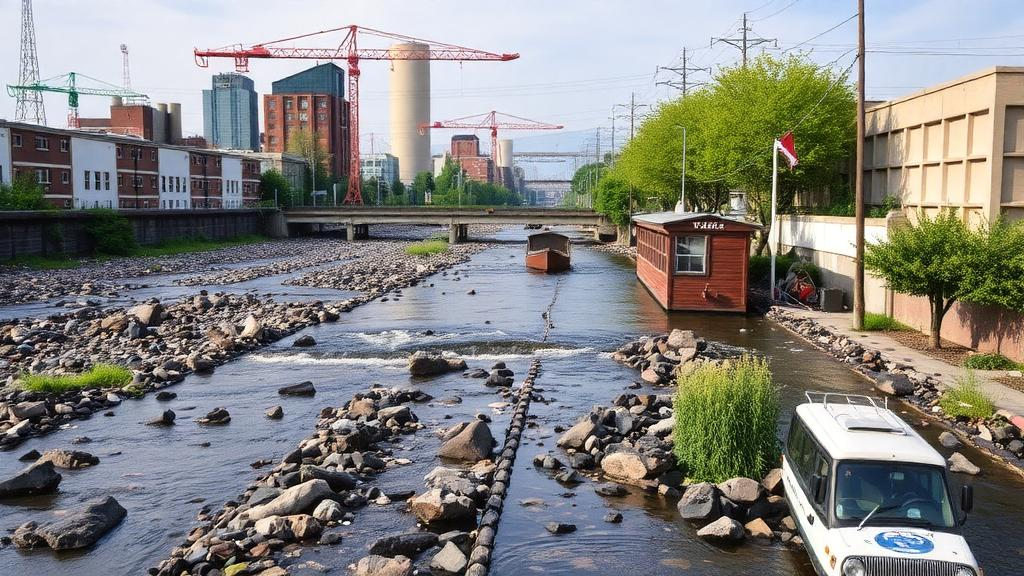
When a city grows, its streams quietly keep score. Every parking lot, factory floor, hospital and university campus leaves a fingerprint on the small waterways that thread through the urban fabric, and a new study from central Portugal suggests that the score depends not just on how much concrete a city has, but on what kind of economy built it. Researchers led by Aurea Luiza Lemes da Silva of the University of Aveiro and the University of Coimbra compared thirty urban streams across two neighboring Portuguese cities with strikingly different economic identities, and found that the type of local economic activity, not merely the degree of urbanization, shapes how well a stream can continue to deliver the services that people depend on.
The study, published in Environmental Science and Pollution Research, focused on Aveiro and Coimbra, two cities in central Portugal separated by less than a hundred kilometers but distinguished by their development histories. Aveiro, a coastal city built around manufacturing and local businesses, presents an industrial profile in which factories, workshops and commerce dominate the economic landscape. Coimbra, by contrast, is anchored by health and education, hosting major hospitals and one of the oldest universities in Europe, and its economy revolves around services tied to those institutions. The research team asked a deceptively simple question: do streams in these two cities, both subject to urban pressures, degrade in the same way, or does the underlying economic engine of each city leave a distinct ecological signature?
To answer it, the researchers selected thirty urban streams, fifteen in each city, and characterized each one using a combination of land-cover analysis and field-based ecological assessment. The degree of urbanization was quantified through impervious surface coverage, or IMD, measured within a 500-meter buffer around each stream. Impervious surfaces, which include roofs, roads, parking areas and other sealed ground, prevent rainwater from infiltrating the soil, so they serve as a standard proxy for the intensity of urban development and a direct driver of altered stream hydrology, water chemistry and habitat structure. In Aveiro, IMD values ranged from 1.2 percent to 67.0 percent, with a mean of 34.5 percent and a standard deviation of 19, while in Coimbra the range was 0.6 percent to 46.4 percent, with a mean of 24.4 percent and a standard deviation of 14. Those figures alone reveal that Aveiro’s streams, on average, sit in more heavily sealed catchments than their Coimbra counterparts.
The ecological side of the comparison relied on the Urban Stream Assessment System, known as UsAs, an integrative tool developed to evaluate biodiversity, ecosystem functions and ecosystem services in urban waterways. Ecosystem services are typically grouped into three categories: provisioning services, which include the material goods that ecosystems supply, such as water; regulating services, which include processes like water purification, flood mitigation and climate regulation; and cultural services, which encompass the recreational, aesthetic and educational benefits that people draw from nature. The UsAs framework scores indicators across these categories, allowing researchers to translate the ecological condition of a stream into a picture of the benefits it can realistically provide to the surrounding community. Applied to thirty streams in two cities, the framework produced a comparative map of how urban ecosystem services survive, or fail to survive, under different kinds of economic pressure.
The central finding was consistent and sobering: as impervious surface coverage increased, scores for ecosystem service indicators declined. This relationship held across the full gradient of urbanization sampled, from nearly unsealed catchments to heavily built-up ones. The mechanism is well understood in urban ecology. Sealed surfaces accelerate runoff, delivering pollutants, sediments and heat directly to waterways while reducing the groundwater recharge that sustains base flows in dry seasons. Channelized or culverted reaches lose the physical complexity that aquatic insects, algae and fish need to complete their life cycles. Riparian vegetation, which buffers streams against nutrient pulses and moderates water temperature, tends to disappear first where development presses closest to the channel. The result is a cascade in which the biological communities that underpin regulating and cultural services are progressively simplified or lost.
What makes the Portuguese study stand out is the second layer of the analysis. When the researchers compared the two cities, Aveiro’s streams, situated in the more industrial economic context, showed greater degradation of freshwater ecosystem services, with regulating and cultural services hit particularly hard. Coimbra’s streams, embedded in a service economy dominated by health and education, retained comparatively better ecological conditions and supported a broader range of ecosystem services, although the negative impacts of urbanization were still clearly evident there as well. In other words, two cities with comparable overall urban footprints can impose measurably different burdens on their waterways depending on the character of the economic activities concentrated within them. Industrial land uses, with their associated emissions, waste streams and hard infrastructure, appear to push streams further down the degradation curve than the institutional land uses typical of university and hospital districts.
The distinction matters because regulating and cultural services are precisely the ones that cities increasingly rely on as climate pressures intensify. Regulating services such as flood attenuation and water purification become more valuable, not less, as impervious surfaces expand and storm events grow more extreme, yet these are the services the study found most eroded in the industrial city. Cultural services, including the amenity value of streams as green corridors for recreation and public well-being, are similarly vulnerable, and their loss tends to fall disproportionately on the neighborhoods closest to degraded waterways. Previous work by some of the same research group has documented how urbanization reshapes aquatic invertebrate communities and how pharmaceutical contamination patterns vary along urbanization gradients in European cities, and the new findings extend that picture by tying service-level outcomes to the economic geography of the cities themselves.
Methodologically, the study illustrates the value of paired-city designs in urban ecology. By holding the regional climate, biogeography and national policy context broadly constant, the comparison isolates the influence of local economic structure and development history on stream condition. The use of a standardized assessment framework across all thirty sites, combined with a quantitative measure of impervious cover, allowed the researchers to test the relationship between urbanization intensity and service provision while accounting for the categorical difference between the two cities. The authors note that both the degree of urbanization and the profile of local economic activities are closely associated with the ecological condition of urban streams, and that these two dimensions should be considered together rather than in isolation.
The implications reach well beyond Portugal. Most of the world’s population now lives in cities, and urban expansion continues to accelerate globally, with freshwater ecosystems among the most affected habitats on Earth. Global assessments have documented extensive degradation of riverine fish and macroinvertebrate assemblages, and urbanization is recognized as a growing source of multiple pollutants to rivers in the twenty-first century. If the character of a city’s economy influences how severely its streams degrade, then urban planners, economists and ecologists have a shared lever: decisions about which activities to concentrate where, and how much sealed surface each new development creates, are also decisions about whether the remaining urban streams can keep purifying water, buffering floods and providing places for people to connect with nature.
The researchers argue that urban planning should explicitly incorporate both urban development histories and local economic activity profiles when setting goals for stream protection and restoration. For industrial cities like Aveiro, that may mean prioritizing measures that restore regulating functions, such as re-naturalizing channels, re-vegetating riparian buffers and reducing direct discharges from industrial and commercial parcels. For service-oriented cities like Coimbra, the findings suggest that protecting the comparatively better ecological conditions that remain, before they erode further, is the more urgent task. In both cases, the study delivers a clear message: the streams running through a city are not passive victims of generic urbanization but living infrastructure whose fate is written, in large part, by the economic choices the city has made, and can still remake.
Subject of Research: Effects of local economic activities and urban development history on ecosystem services provided by urban streams in central Portugal
Article Title: Assessing the effects of local economic activities on stream ecosystem services across cities with contrasting urban development histories
Article References: Lemes da Silva, A. L., Schmitt, R., Calapez, A. R., Sousa, M. C., Almeida, S. F. P., & Feio, M. J. (2026). Assessing the effects of local economic activities on stream ecosystem services across cities with contrasting urban development histories. Environmental Science and Pollution Research. https://doi.org/10.1007/s11356-026-38262-1
Image Credits: AI Generated
DOI: 10.1007/s11356-026-38262-1
Keywords: urban streams, ecosystem services, impervious surfaces, urbanization, economic activities, Portugal, Aveiro, Coimbra, urban ecology, water quality, regulating services, urban planning
Cite Scienmag News
Gavin Prescott. (October 2, 2026). Industrial Cities Pay a Hidden Price: How Local Economies Erode the Life Support of Urban Streams. Scienmag. https://scienmag.com/industrial-cities-pay-a-hidden-price-how-local-economies-erode-the-life-support-of-urban-streams/
Gavin Prescott. "Industrial Cities Pay a Hidden Price: How Local Economies Erode the Life Support of Urban Streams." Scienmag, 2 October 2026, https://scienmag.com/industrial-cities-pay-a-hidden-price-how-local-economies-erode-the-life-support-of-urban-streams/. Accessed 17 October 2026.
Gavin Prescott. "Industrial Cities Pay a Hidden Price: How Local Economies Erode the Life Support of Urban Streams." Scienmag. October 2, 2026. https://scienmag.com/industrial-cities-pay-a-hidden-price-how-local-economies-erode-the-life-support-of-urban-streams/


