


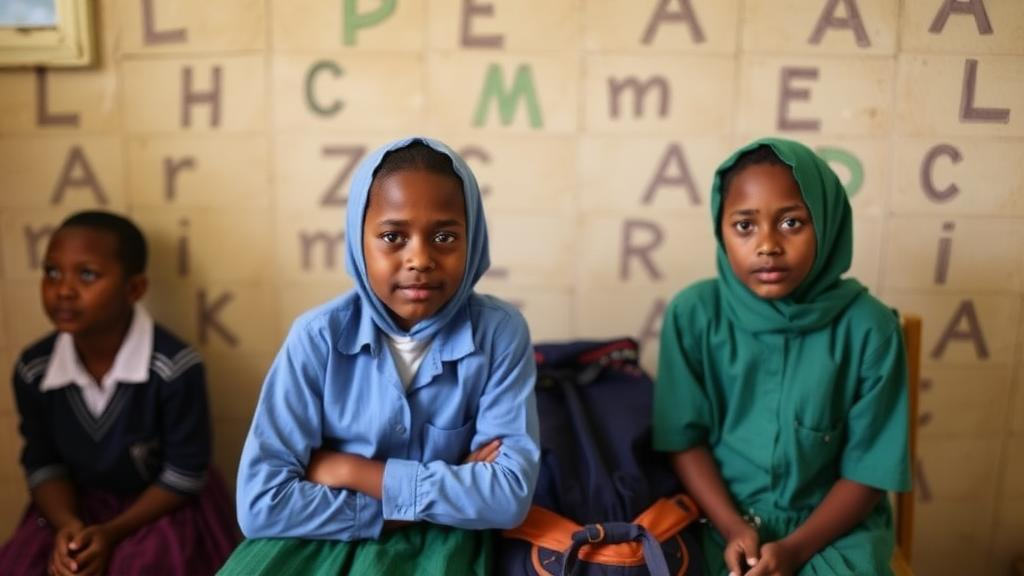
At the University of Gondar in northern Ethiopia, undergraduate students with visual impairment are pursuing degrees in an environment that was never designed for them. A new qualitative study published in Discover Education has documented, in unprecedented detail for this institution, the layered economic, infrastructural, and social obstacles these students confront daily, alongside the remarkable coping strategies they deploy to survive academically. Drawing on in-depth interviews and focus group discussions with 22 undergraduate students, the research offers one of the most granular portraits to date of what inclusive higher education actually looks like on the ground in a low-resource setting, and it arrives with a pointed message: policy commitments to inclusion mean little without accessible Braille materials, working screen readers, safe campus infrastructure, and a fundamental shift in institutional attitudes.
The study, led by Jenberu Mekurianew Kelkay of Debark University with colleagues from Debre Tabor University and the University of Gondar, focused on the university’s Maraki Campus, one of five campuses of one of Ethiopia’s oldest and largest public universities. The researchers employed a qualitative case study design, conducting ten individual in-depth interviews and two focus group discussions with six participants each. The participants, 17 males and 5 females, were drawn from Social Work, Sociology, Psychology, and Law programs spanning all four years of undergraduate study. Interviews and discussions were conducted in Amharic, audio-recorded with permission, transcribed verbatim, translated into English, and analyzed thematically through manual coding and categorization. The research team continued collecting data until saturation was reached, meaning no new themes emerged from subsequent conversations.
The scale of the underlying problem is considerable. According to the World Health Organization, approximately 2.2 billion people worldwide live with some form of vision impairment or blindness, and at least one billion of those cases could have been prevented or remain unaddressed due to inadequate access to eye care. In the Amhara region specifically, a study of 784 clients at the University of Gondar teaching hospital found prevalence rates of visual impairment and blindness of 15.3 percent and 14.4 percent respectively. Against this backdrop, the number of visually impaired students reaching higher education in Ethiopia remains small, and the support systems available to those who do are stretched thin.
The study’s first major theme was economic. Participants described financial hardship as a defining feature of their academic lives, not merely because of general poverty but because visual impairment generates additional costs that sighted students never face. Many students depend on paid sighted readers to access printed materials, review documents, and complete practical assignments that require visual ability. One male participant explained that he could not independently review documents or finish certain assignments, so he had to hire readers who demanded payment. Existing financial support mechanisms, including the Mastercard Foundation Scholarship, were perceived as helpful but insufficient and not fully inclusive of disability-related expenses such as accessible learning materials, academic assistance, and personal support needs. The result, the researchers found, is a system in which students’ independence is compromised and their academic participation is constrained by costs their peers do not bear.
Access to assistive learning resources emerged as a second critical gap. Participants reported inadequate availability of Braille books, computers equipped with screen-reading software, and other assistive technologies. Although computers existed in some university settings, many lacked the accessibility features required for independent use by blind or low-vision students. One participant noted that undergraduate education demands individual effort and that students are expected to work with computers and Braille books, yet these resources were simply not accessible to them. The shortage of materials in accessible formats, whether Braille, audio, or compatible digital files, forced students into dependence on others for basic academic tasks such as reading lecture materials and completing coursework, undermining the self-directed learning that university study presupposes.
The third cluster of findings concerned social and psychosocial barriers, and these proved among the most troubling. Participants described stigma and negative attitudes from some instructors, including doubts about whether visually impaired students could learn as effectively as their sighted peers. Some teachers refused to permit audio recording of lectures, eliminating a crucial accessible learning channel and leaving students unable to review course content independently after class. Participants also reported difficulty securing reliable volunteer assistance, particularly during examinations when informal peer support networks proved least dependable. Most seriously, some female participants described deception and unwanted sexual advances from sighted students who initially presented themselves as academic supporters, revealing how dependence on unregulated informal support networks can expose vulnerable students to exploitation and harm.
Yet the study deliberately moves beyond a deficit narrative, guided by the Strengths Perspective, a framework in disability research that emphasizes individuals’ capacities, resilience, and adaptive strategies rather than their limitations. The students in this study were not passive recipients of hardship. They described hope and determination as sustaining forces, with one participant declaring that although he faced many challenges, he believed he could overcome everything. Others cultivated deliberate social connectedness, building relationships across the university community to secure assistance when needed. Emotional coping strategies ranged from listening to music to spiritual practices, and participants drew on these personal, social, and emotional resources to persist in their studies despite barriers that would defeat many. The researchers interpret this resilience as evidence that students with visual impairment are active agents in their own education, not merely subjects of charity or accommodation.
The contrast with better-resourced contexts is instructive. The study notes that South African universities have, in many cases, provided accessible learning materials, examination readers, dedicated examination rooms, and structured academic support services for visually impaired students. Ethiopian institutions, by comparison, continue to grapple with limited resources, inadequate accessibility arrangements, and gaps between inclusive education policy and its practical implementation. Previous research at Addis Ababa University similarly documented failures to implement building accessibility accommodations for blind students, suggesting the problems identified at Gondar reflect systemic national challenges rather than the failings of a single institution.
From their lived experience, the participants themselves proposed concrete interventions, and their recommendations form perhaps the most actionable component of the research. They called for expanded access to assistive technologies, including Braille books, screen readers such as JAWS, and adapted computers, but crucially they emphasized that access alone is insufficient without training in how to use these tools effectively. They demanded improvements in campus infrastructure, including accessible examination rooms, water facilities, cafeterias, roads, and toilets, designed according to universal design principles that support safe and independent mobility. They urged awareness campaigns and staff training to dismantle stigma and foster positive attitudes among teachers and students. And they called for strengthened counseling and psychosocial support services, alongside inclusive financial support mechanisms that account for the genuine additional costs of studying with a visual impairment.
The study’s broader significance lies in its reframing of disability inclusion as a comprehensive institutional responsibility rather than a matter of individual accommodation. The authors argue that equitable participation requires supportive policies, accessible learning environments, and institutional systems spanning university administration, disability support offices, academic departments, libraries, information technology units, and student affairs. Internationally, the findings resonate with obligations under the United Nations Convention on the Rights of Persons with Disabilities and Sustainable Development Goal 4, which commits governments to inclusive and equitable quality education for all. The persistent gap between such commitments and the daily reality of students at Gondar underscores a global truth: inclusion is not achieved by admitting students with disabilities through the door, but by rebuilding the institution so that the door, the corridor beyond it, the lecture hall, the examination room, and the cafeteria all work for everyone. For the resilient students of Maraki Campus, that transformation cannot come soon enough.
Subject of Research: Barriers and support mechanisms for undergraduate students with visual impairment in Ethiopian higher education
Article Title: Challenges and intervention mechanisms for students with visual impairment at the University of Gondar Ethiopia
Article References: Kelkay, J. M., Mihret, B. G., Tegegne, K. T., Asgai, A. S., Kidie, D. M., & Anteneh, D. S. (2026). Challenges and intervention mechanisms for students with visual impairment at the University of Gondar Ethiopia. Discover Education, 5(1), Article 1072. https://doi.org/10.1007/s44217-026-02165-7
Image Credits: AI Generated
DOI: 10.1007/s44217-026-02165-7
Keywords: visual impairment, inclusive education, higher education, Ethiopia, University of Gondar, assistive technology, disability studies, Braille, screen readers, resilience, stigma, qualitative research
Cite Scienmag News
Courtney Benton. (October 2, 2026). Blind and Low-Vision Students in Ethiopia Face Steep Barriers but Show Remarkable Resilience. Scienmag. https://scienmag.com/blind-and-low-vision-students-in-ethiopia-face-steep-barriers-but-show-remarkable-resilience/
Courtney Benton. "Blind and Low-Vision Students in Ethiopia Face Steep Barriers but Show Remarkable Resilience." Scienmag, 2 October 2026, https://scienmag.com/blind-and-low-vision-students-in-ethiopia-face-steep-barriers-but-show-remarkable-resilience/. Accessed 2 October 2026.
Courtney Benton. "Blind and Low-Vision Students in Ethiopia Face Steep Barriers but Show Remarkable Resilience." Scienmag. October 2, 2026. https://scienmag.com/blind-and-low-vision-students-in-ethiopia-face-steep-barriers-but-show-remarkable-resilience/


