


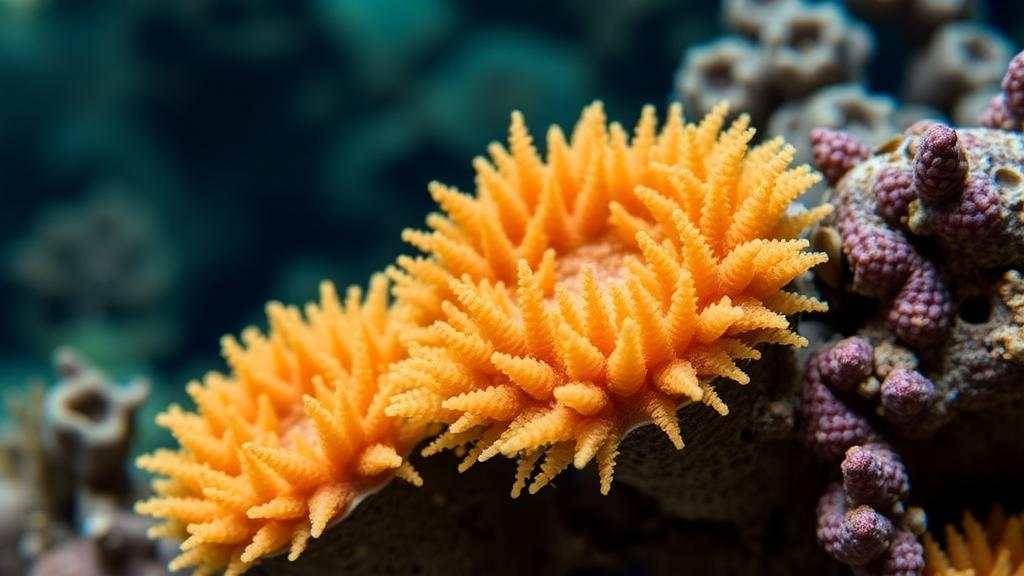
On the sea floor of India’s Gulf of Mannar Marine Biosphere Reserve, a quiet architectural revolution has been taking place at a depth of five metres. Researchers from the Zoological Survey of India submerged roof-shaped panels bearing plates of wood, metal, ceramic and terracotta at four island sites, then waited a full year to see who would move in. The tenants that arrived were not corals, sponges or the charismatic fish that draw divers to tropical reefs, but bryozoans: colonial invertebrates so small that each individual, or zooid, is barely visible to the naked eye. Yet these unassuming creatures proved to be among the most consequential settlers in the entire community, encrusting surfaces with mineralised skeletons that opened the door for a cascade of other marine life.
The study, published in Discover Oceans, represents the first experimental investigation of bryozoans as biofoulers in the Gulf of Mannar and Palk Bay region. Between June 2020 and June 2021, the team deployed eight static immersion panels, two at each of four locations: Pamban Island, Vedalai, Manouli Island and Ervadi. Each panel carried twelve-inch square plates of four different materials, positioned equidistant from one another to prevent interference. One panel at each site was retrieved after six months, and the experiment was repeated with fresh plates in a second six-month window, while a parallel long-term panel remained submerged for the entire year. This design allowed the researchers to track both seasonal patterns of settlement and the slower dynamics of ecological succession.
The results were strikingly selective. Ten species of encrusting bryozoans were identified over the course of the study, but two dominated almost everywhere: Parasmittina projecta and Celleporaria aperta. These pioneer species appeared on ceramic and terracotta plates at every stage of the experiment, regardless of location or season. Rarer species, including Parasmittina tubula, Parasmittina egyptiaca, Hippopodina feegeensis and Pleurocodonellina signata, showed up only as small colonies or patches. Electra pilosa, a species known for its preference for rough surfaces, colonised the coarse reverse side of a terracotta plate at Pamban Island, while the long-term panels revealed two latecomers, Parasmittina triangularis and Rhynchozoon compactum, that never appeared on the shorter deployments.
Just as telling was what the bryozoans refused to colonise. Metal plates, left unpainted and exposed to seawater, corroded heavily over the study period, rusting and in some cases crumbling apart. Not a single bryozoan colony established itself on metal during the first six-month study, and the researchers attribute this to corrosion-induced surface instability and the release of iron oxides, both known to interfere with larval settlement in sessile invertebrates. Wood fared little better: it degraded rapidly, became infested with serpulid worms and bivalves, and hosted bryozoans only in the crevices of rotten timber during the long-term deployment. Ceramic and terracotta, by contrast, offered the stable, wettable surfaces that bryozoan larvae clearly favour, with post-hoc statistical comparisons confirming significantly greater cover on these two substrates than on wood or metal.
Texture and orientation mattered as much as material. The researchers analysed each retrieved plate using a quadrat method, dividing the surface into a four-by-four grid, and complemented colony counts with photographic point-count analysis in ImageJ to estimate total percentage cover. Across the board, the reverse sides of the plates, which faced away from the prevailing swell and sat in shadow, carried more bryozoan cover than the front-facing surfaces, a difference confirmed by a Mann-Whitney U test. Many encrusting bryozoans are sciaphilic, meaning their larvae preferentially settle in shaded, sheltered microhabitats where algal competition and physical disturbance are reduced. The forty-five-degree inclination of the panels also created a gradient of water movement, with the upper portions experiencing greater flow that delivered larvae and food particles without burying the feeding apparatus, or lophophore, in sediment.
Seasonality left its own fingerprint. The first six-month study, spanning the monsoon months when rainfall was highest and temperatures remained within the optimal range for reef-building organisms, yielded seven bryozoan species. The second window, covering the drier, hotter months when water temperatures in 2020 climbed to between 32 and 35.1 degrees Celsius and salinity rose through evaporation and upwelling, produced only four. The researchers suggest that the favourable calcium concentrations and moderate conditions of the monsoon period supported the calcification that bryozoans, like corals, depend upon, while the hotter, saltier conditions of the second period favoured corrosion over colonisation. Notably, P. delicatula appeared only in the second window, consistent with its known salt tolerance.
Perhaps the most vivid finding came from the year-long panels, which transformed into miniature ecosystems. By the time they were retrieved, they harboured hydroids, serpulid worms, barnacles, thickets of seaweed and even juvenile crabs and other crustaceans sheltering among the growth. Scanning electron micrographs captured Celleporaria aperta overgrowing less competitive species, illustrating the competitive displacement that unfolds as succession progresses. The bryozoans, by secreting an adhesive polysaccharide that rapidly mineralises into a solid crust, had created the foundational substrate on which the entire assemblage depended. In ecological terms, they acted as pioneer species initiating facilitative succession, paving the way for a climax community of the kind long described in port fouling studies but never before documented experimentally in this biosphere reserve.
The study’s authors are careful about its limits. Each site hosted a single short-term and single long-term panel, so the deployments served as parallel observations rather than true statistical replicates, and the analyses were deliberately descriptive and comparative. Several plates and panels were lost to monsoonal currents, corrosion and occasional human disturbance, and environmental parameters such as temperature, salinity and chlorophyll-a were not measured in situ. These constraints, common to open-water colonisation experiments in protected reserves, mean the findings should be read as robust baseline evidence rather than definitive inference. Even so, the consistency of the substrate-driven pattern, reinforced by principal component analysis that cleanly separated high-colonisation ceramic and terracotta samples from wood and metal, gives the conclusions considerable weight.
Why does any of this matter beyond the taxonomy of small colonial animals? Bryozoans have long been cast as villains in the biofouling story, blamed for dragging down ship hulls, clogging cooling pipes and ferrying invasive species across oceans. This study reframes them as ecological engineers whose crusts stabilise reef structures, facilitate the settlement of macro-foulers and sustain biodiversity. Artificial substrates colonised in this way can support fisheries, diving tourism and ecotourism without touching endangered natural reefs, and dense fouling communities may even help engineered structures absorb wave energy during storms and tsunamis. The discovery that Paralicornia obtecta, previously recorded from India’s southwest coast, Sri Lanka and the wider Indian Ocean, now appears in the Gulf of Mannar, adds a biogeographical data point to a region whose fouling fauna had been studied almost exclusively in harbours.
The broader lesson is one of hidden complexity in plain sight. A square metre of submerged ceramic, left alone for a year, becomes a stage on which larvae discriminate between textures, pioneers build skeletons, competitors wage slow-motion overgrowth battles and juvenile crustaceans find refuge. Understanding these dynamics matters for anyone designing artificial reefs, managing port infrastructure or predicting how tropical reef communities will respond as seas warm and salinities shift. The Gulf of Mannar’s bryozoans, once dismissed as ecologically insignificant, have now been shown to be among the quiet architects of their underwater world, and the researchers hope their baseline data will guide future studies that pair replicated deployments with continuous environmental sensing to unravel the mechanisms behind the patterns they have revealed.
Subject of Research: Biofouling bryozoan settlement and succession on artificial substrates in the Gulf of Mannar
Article Title: Experimental investigation on biofouling marine bryozoans in reefs
Article References: Sanjay, M. S., Venkatraman, C., Sen, A., & Yogesh Kumar, J. S. (2026). Experimental investigation on biofouling marine bryozoans in reefs. Discover Oceans, 3(1), Article 27. https://doi.org/10.1007/s44289-026-00138-0
Image Credits: AI Generated
DOI: 10.1007/s44289-026-00138-0
Keywords: bryozoa, marine biofouling, Gulf of Mannar, Parasmittina projecta, reef formation, larval settlement, substrate preference, ecological succession, artificial reefs, marine biodiversity, coral reefs, India
Cite Scienmag News
Margaret Porter. (October 2, 2026). Tiny Reef-Builders: Bryozoans Turn Artificial Panels into Thriving Microhabitats. Scienmag. https://scienmag.com/tiny-reef-builders-bryozoans-turn-artificial-panels-into-thriving-microhabitats/
Margaret Porter. "Tiny Reef-Builders: Bryozoans Turn Artificial Panels into Thriving Microhabitats." Scienmag, 2 October 2026, https://scienmag.com/tiny-reef-builders-bryozoans-turn-artificial-panels-into-thriving-microhabitats/. Accessed 2 October 2026.
Margaret Porter. "Tiny Reef-Builders: Bryozoans Turn Artificial Panels into Thriving Microhabitats." Scienmag. October 2, 2026. https://scienmag.com/tiny-reef-builders-bryozoans-turn-artificial-panels-into-thriving-microhabitats/


