


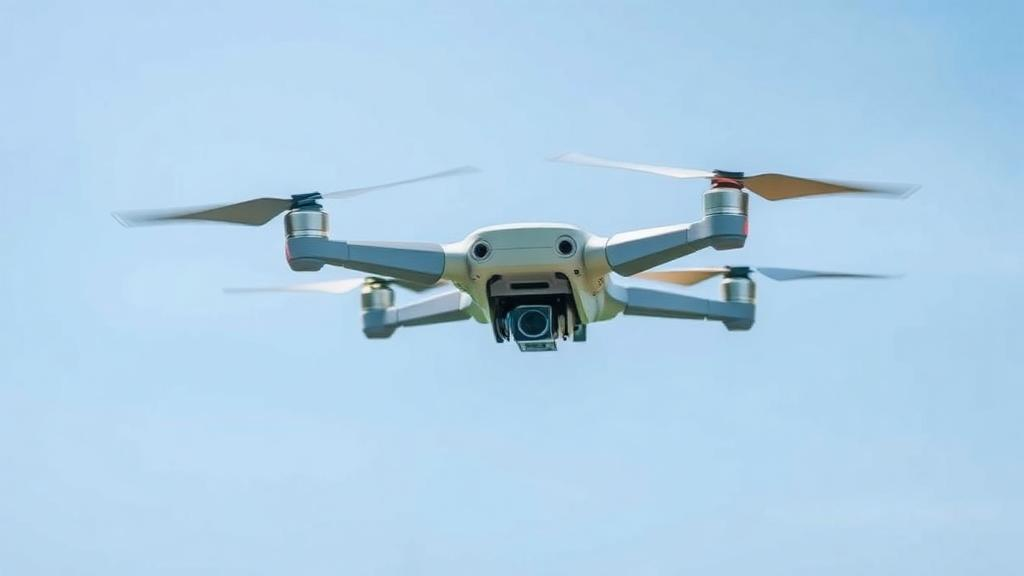
Small autonomous aircraft are proliferating at a remarkable pace, from delivery drones and agricultural sprayers to survey platforms and future air taxis. Yet one problem has stubbornly stood between this boom and routine access to shared airspace: how does an unmanned aircraft, with no pilot on board to look out the window, reliably spot and dodge other traffic? A research team led by Hyunjin Choi of the Korea Aerospace Research Institute, working with colleagues at DBRAIN, Chungnam National University, and Vessel Aerospace, has now presented a detailed answer. In a study published in the International Journal of Aeronautical and Space Sciences, the team describes the design, hardware implementation, and validation of an airborne Detect-and-Avoid, or DAA, system tailored specifically for small autonomous aircraft, along with a computationally lean collision avoidance method that could make such systems practical on lightweight onboard computers.
The stakes are easy to underestimate. In conventional aviation, the final barrier against midair collision is the human pilot, guided by regulations such as the Federal Aviation Administration’s Title 14 CFR Part 91 and advisory guidance on the pilot’s role in collision avoidance, and by the International Civil Aviation Organization’s rules of the air. A remote pilot, however, suffers from limited situational awareness, communication latency, and degraded visual conditions. Decades of research into sense-and-avoid technologies, from early flight trials by Korn and Edinger in 2008 through comprehensive reviews by Yu and Zhang and by Fasano and colleagues, have produced a rich toolbox of radar, electro-optical, and acoustic sensors and a zoo of tracking and avoidance algorithms. What has been missing, the Korean team argues, is a complete, standards-compliant system design that ties those pieces together on hardware small enough to fly on a small unmanned platform.
That is where international standards come in. The team anchored their design to RTCA DO-365B, the Minimum Operational Performance Standards for Detect and Avoid Systems, and to ASTM F3442/F3442M, which specifies performance requirements for DAA equipment. These documents define a reference architecture built around three core functions: Track Processing, Track Alerting, and Guidance Processing. Track Processing fuses raw sensor detections into stable, continuously updated tracks of surrounding aircraft. Track Alerting monitors those tracks against well-clear criteria and issues alerts when another aircraft threatens to come too close. Guidance Processing then computes and guides an appropriate maneuver to restore safe separation. Rather than inventing a parallel architecture, the researchers took this standardized skeleton and filled in every functional detail, specifying inputs, outputs, algorithms, and interfaces so that the design could be implemented directly in flight hardware.
The engineering behind Track Processing is where much of the difficulty lies. Sensors such as radar, lidar, and ADS-B receivers, which listen to the cooperative transponder broadcasts that Garmin’s GDL 90 data interface specification standardizes, rarely agree perfectly on where an intruder is or what it is doing. The team therefore had to solve the classic multitarget tracking problems documented by Bar-Shalom and Li, Fortmann and colleagues’ joint probabilistic data association, and Blackman’s multiple hypothesis tracking: deciding which sensor returns belong to which aircraft, filtering noisy measurements into smooth state estimates, and rejecting spurious detections. Their implementation maintains track quality metrics so that uncertain or fading tracks do not trigger false alarms, drawing on track-quality-based association methods such as those of Sinha and colleagues. The result is a stream of reliable track states, including position, velocity, and confidence, handed to the alerting stage.
Track Alerting then applies the well-clear concept that regulators use to define when another aircraft is dangerously close, a notion central to NASA’s DAIDALUS detect-and-avoid alerting logic developed by Munoz, Narkawicz, and Hagen. The alerting function must be tuned carefully: alert too late and the aircraft cannot maneuver in time; alert too early and the system cries wolf, eroding trust and triggering unnecessary deviations. The researchers implemented alerting thresholds consistent with the standards’ guidance, so that the system signals a threat with enough lead time for the guidance function to act, mirroring the philosophy behind TCAS II resolution advisories that have protected crewed airliners for decades.
The heart of the paper’s technical contribution, however, sits in Guidance Processing. Once an alert fires, the aircraft must choose a maneuver, typically a vertical or horizontal deviation, that maximizes the closest point of approach with the intruder while remaining flyable and predictable. Collision cone approaches, such as the classic method of Chakravarthy and Ghose, and reactive avoidance algorithms for multiple unmanned aircraft, like the one Choi and colleagues published in 2013, offer geometric ways to reason about which directions of flight lead toward danger and which lead away. The team designed a collision avoidance method in this family and then benchmarked it quantitatively against an existing method used in DAA systems, including comparisons informed by NASA’s ICAROUS integrated configurable algorithms for reliable operations of unmanned systems. The outcome was striking: the proposed method achieved competitive collision avoidance performance while demanding substantially less computation, a decisive advantage when the processor must also run tracking, alerting, flight control, and communications on a small aircraft’s power and weight budget.
Computational efficiency is not a cosmetic metric in this field. The ACAS XU program, which applies advanced decision-making and even deep neural network compression, as explored by Julian, Kochenderfer, and Owen, to aircraft collision avoidance, has shown how expensive it can be to certify and run sophisticated avoidance logic. Studies by Wu and Lee on the impact of airborne radar uncertainties, and by Abramson and colleagues on sensor uncertainty mitigation, underline that real-world DAA performance depends as much on robust, fast processing as on raw algorithmic elegance. By demonstrating that their guidance method delivers comparable safety margins at lower computational cost, the Korean team has addressed precisely the bottleneck that keeps full DAA capability off most small platforms. Their work also complements flight-test efforts such as Kotegawa’s proof-of-concept ACAS XU airborne system and NASA’s AiRanger program, which evaluated small form-factor lidar and radar sensors for DAA applications.
Equally important is how the system was proven. The researchers validated their design through hierarchical test procedures, a layered approach in which individual functions are tested in isolation, then integrated subsystems are exercised together, and finally the complete hardware is evaluated end to end against simulated encounters. This mirrors the certification mindset of aerospace engineering, where a function that works in simulation means little until it survives hardware-in-the-loop testing with realistic sensor noise, timing jitter, and message latencies. The quantitative evaluation of the collision avoidance method was embedded in this hierarchy, allowing the team to compare miss distances, alerting behavior, and processing load against the baseline method under identical encounter conditions. Such structured validation is exactly what regulators will demand before small autonomous aircraft are allowed to operate beyond visual line of sight in civil airspace.
The broader significance extends well beyond one laboratory prototype. Airspace integration for unmanned aircraft is widely recognized as a prerequisite for the drone economy’s next phase, and DAA is the enabling technology for that integration. By showing a complete path from standardized architecture to implemented hardware to validated performance, the study offers a template that other developers can follow and that standards bodies can reference. The work was supported by a grant funded by the Korea AeroSpace Administration, reflecting national investment in autonomous aviation capability. If small aircraft are to share the sky safely with airliners, helicopters, and each other, they will need exactly this kind of disciplined engineering: sensors that see, trackers that understand, alerters that warn, and guidance that acts, all fast enough to fit on a flying computer the size of a shoebox. This study moves that vision measurably closer to reality.
Subject of Research: Airborne detect-and-avoid and collision avoidance systems for small autonomous unmanned aircraft
Article Title: Development of An Airborne Detect-and-Avoid System for Small Autonomous Aircraft
Article References: Choi, H., Kim, J., Bae, J., Kim, T. S., Kim, D., Koo, B., Lee, J., Suk, J., Yang, S.-K., & Choi, H. K. (2026). Development of An Airborne Detect-and-Avoid System for Small Autonomous Aircraft. International Journal of Aeronautical and Space Sciences. https://doi.org/10.1007/s42405-026-01262-z
Image Credits: AI Generated
DOI: 10.1007/s42405-026-01262-z
Keywords: detect-and-avoid, collision avoidance, unmanned aircraft systems, drones, airspace integration, track processing, well clear, RTCA DO-365B, guidance processing, sensor fusion, autonomous flight, aviation safety
Cite Scienmag News
Grant Pearson. (October 2, 2026). New Detect-and-Avoid System Could Let Small Drones Fly Safely in Shared Airspace. Scienmag. https://scienmag.com/new-detect-and-avoid-system-could-let-small-drones-fly-safely-in-shared-airspace/
Grant Pearson. "New Detect-and-Avoid System Could Let Small Drones Fly Safely in Shared Airspace." Scienmag, 2 October 2026, https://scienmag.com/new-detect-and-avoid-system-could-let-small-drones-fly-safely-in-shared-airspace/. Accessed 2 October 2026.
Grant Pearson. "New Detect-and-Avoid System Could Let Small Drones Fly Safely in Shared Airspace." Scienmag. October 2, 2026. https://scienmag.com/new-detect-and-avoid-system-could-let-small-drones-fly-safely-in-shared-airspace/


