


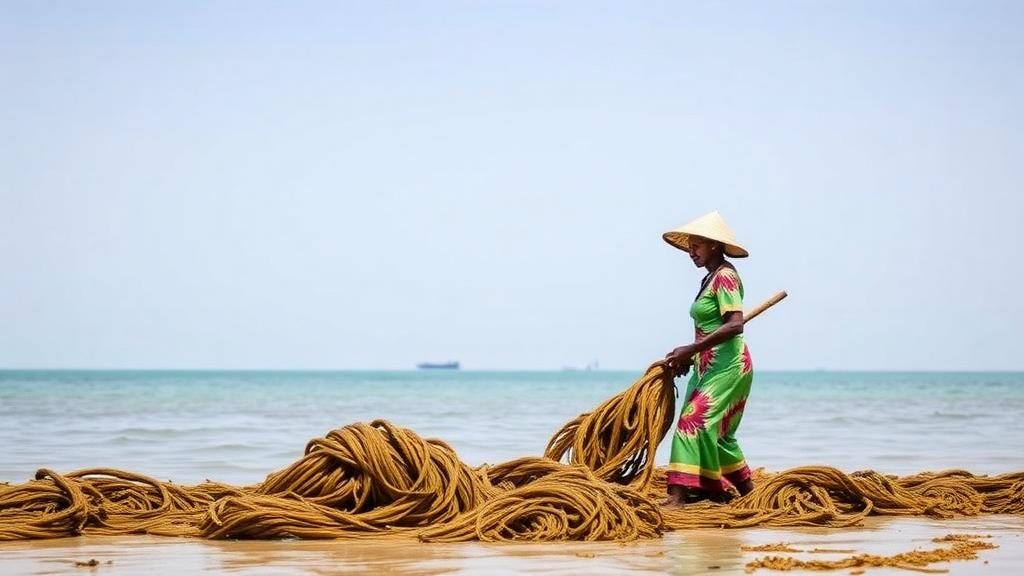
Along the palm-fringed shores of mainland Tanzania, thousands of women wade into the shallow Indian Ocean each morning to tend lines of Kappaphycus alvarezii and Eucheuma denticulatum, the red algae that supply the world’s carrageenan industry. Their labor feeds a global market worth roughly 22 billion US dollars in 2024, yet a new study reveals that most of these farmers see almost none of that value. Research by Robert Eliakim Katikiro of the University of Dar es Salaam and Angelina Michael of the University of Dodoma, published in Discover Oceans, offers the most detailed picture yet of a supply chain that is expanding in output while failing, structurally, to deliver prosperity to the people who make it possible.
The timing of the study is significant. Tanzania is riding a remarkable rebound. After wild seaweed stocks were depleted in the late 1970s, the country transitioned to commercial cultivation in 1989 with seedlings introduced from the Philippines, and production climbed from 7,000 tons of dry weight in 2005 to a peak of 17,600 tons in 2015. A crash followed after 2016, driven by climate-related stress, disease outbreaks including the notorious ice-ice syndrome, and epiphyte infestations, dragging output down to about 11,000 tons by 2018 to 2020. But recent policy reforms, including reduced export permit fees, helped production surge to 25,426 metric tons in 2023, with quarterly monitoring showing a 52 percent year-over-year increase in the third quarter of that year.
Despite that recovery, Tanzania still contributes only about 0.4 percent of global seaweed output, in a market where Asia dominates with 97 percent of the roughly 35.8 million tons cultivated worldwide in 2023. Africa produces an estimated 120,000 metric tons of red eucheumatoid seaweeds annually, and more than 90 percent of that comes from Tanzania. The gap between what the country produces and what it could produce, given its rich native biodiversity in nutrient-poor but sun-drenched coastal waters, is what the researchers describe as untapped potential. The question their study poses is why that potential remains locked, and their answer points not to the farms themselves but to everything that happens after harvest.
The research team worked across six sites in five coastal regions: Pangani in Tanga, Kigamboni in Dar es Salaam, Bagamoyo and Juani in Pwani, Somanga in Lindi, and Naumbu in Mtwara. These locations were chosen because each supports an average of around 800 people involved in the seaweed industry. Using a mixed-methods design, the team surveyed 208 stakeholders, from farmers and traders to suppliers, fishers, processors, transporters, and cooperative leaders, selected through proportional stratified sampling to ensure representation. They supplemented the surveys with 55 semi-structured interviews with key informants, including district fisheries officers and marine aquaculture experts, focus group discussions of roughly ten participants at each site, and direct participant observation of village life and farming operations.
The demographic picture that emerged is strikingly gendered. Women made up 74 percent of survey respondents, and 94 percent of respondents identified women as the primary actors in production. Yet only about 30 percent of these women reported owning the plots they farm; the remaining 70 percent work as laborers on land they do not control. Most respondents were of working age, with nearly 90 percent between 26 and 50 years old, and 85 percent had participated in seaweed farming for less than five years, suggesting a recent influx of newcomers drawn by economic necessity. Incomes were low across the board, with 88.5 percent earning below 300,000 Tanzanian shillings per month, and households were large, with 61.5 percent reporting six to ten members.
Income generation was the dominant motivation for farming, cited by about 40 percent of respondents, far ahead of social influence, training exposure, or village initiatives. Notably, ecological awareness played almost no role: roughly 86 percent of respondents could not clearly explain how seaweed farming contributes to marine environmental protection, even though the practice is widely regarded as one of the most sustainable forms of aquaculture, requiring no fertilizers, pesticides, land, or freshwater. Farmers participate because the work is flexible enough to combine with domestic responsibilities and because declining capture fisheries have left few alternatives, not because they see themselves as stewards of a climate-friendly industry.
The technical picture is one of stagnation. More than 96 percent of respondents rely on traditional shallow-water, off-bottom cultivation using peg-and-rope methods, with minimal adoption of floating lines or tubular nets that could buffer crops from warming waters. Around 70 percent said their current scale of operations does not yield sufficient economic returns, and only 12 percent reported any involvement in value addition over the past five years. Access to inputs such as ropes, floats, and boats was lacking for 76 percent of respondents, and fewer than 30 percent received extension services, which were described as irregular, project-based, and often occurring less than twice a year. Perceptions of the policy framework scored a mean of just 2.73 on a six-point satisfaction scale.
The market structure may be the most damning finding. Approximately 80 percent of harvested seaweed is sold dried to intermediaries or exporting firms, and 92 percent of respondents did not know where their product ultimately went. A small group of firms, including Tanga Seaweed, ZANEA, King David, and Ledo Biashara, dominates buying and exporting, with a spatially uneven presence that leaves some communities with no buyer at all or forced to accept reduced prices. Local demand is nearly absent, with 70 percent of respondents reporting no household consumption of seaweed products, and exposure to seaweed goods largely confined to occasional events such as Nanenane Farmers’ Day and the Dar es Salaam International Trade Fair. With so few buyers, farmers have almost no bargaining power, and the sector remains locked in exporting low-value raw dried biomass.
The study’s central argument is that Tanzania’s problem is not production capacity but structural fragmentation. Production is growing without corresponding improvements in aggregation, processing, market transparency, or coordination, so expansion translates into more labor rather than more value. The researchers point to experiences in Indonesia, the Philippines, and Europe, where supply chain upgrading has depended on coordinated investment in processing capacity, quality standards, and institutional support. They also highlight a governance gap: the farmers who produce the crop, most of them women, have limited representation in market negotiations and policy processes, and Tanzania lacks a dedicated seaweed policy. Inclusion without access to assets, credit, and decision-making, the authors warn, does not translate into empowerment.
Yet the study is not only a diagnosis of failure. Respondents identified concrete opportunities: strengthening producer groups and collection systems for bulk handling, investing in basic storage and handling infrastructure to improve quality, supporting emerging local enterprises in collection and small-scale processing, and deepening ties with research institutions such as the Institute of Marine Sciences, the University of Dar es Salaam, and Sokoine University of Agriculture. Embedding seaweed farming within broader coastal development and ocean sustainability strategies, the authors argue, could improve livelihoods while building more resilient marine economies. The future of the sector, they conclude, depends less on growing more seaweed and more on reorganizing how value is created and distributed along the chain, a structural transition that would determine whether Tanzania’s seaweed boom finally pays off for the women who make it happen.
Subject of Research: The seaweed supply chain, market constraints, and livelihood opportunities for coastal farming communities in mainland Tanzania
Article Title: Challenges and opportunities of seaweed supply chain in mainland Tanzania
Article References: Katikiro, R. E., & Michael, A. (2026). Challenges and opportunities of seaweed supply chain in mainland Tanzania. Discover Oceans, 3(1), Article 29. https://doi.org/10.1007/s44289-026-00142-4
Image Credits: AI Generated
DOI: 10.1007/s44289-026-00142-4
Keywords: seaweed farming, Tanzania, supply chain, carrageenan, coastal livelihoods, women farmers, value addition, blue economy, aquaculture, market access, Kappaphycus alvarezii, Eucheuma denticulatum
Cite Scienmag News
Violet Maxwell. (October 2, 2026). Tanzania’s Seaweed Boom Leaves Women Farmers Trapped in a Broken Supply Chain. Scienmag. https://scienmag.com/tanzanias-seaweed-boom-leaves-women-farmers-trapped-in-a-broken-supply-chain/
Violet Maxwell. "Tanzania’s Seaweed Boom Leaves Women Farmers Trapped in a Broken Supply Chain." Scienmag, 2 October 2026, https://scienmag.com/tanzanias-seaweed-boom-leaves-women-farmers-trapped-in-a-broken-supply-chain/. Accessed 2 October 2026.
Violet Maxwell. "Tanzania’s Seaweed Boom Leaves Women Farmers Trapped in a Broken Supply Chain." Scienmag. October 2, 2026. https://scienmag.com/tanzanias-seaweed-boom-leaves-women-farmers-trapped-in-a-broken-supply-chain/


