


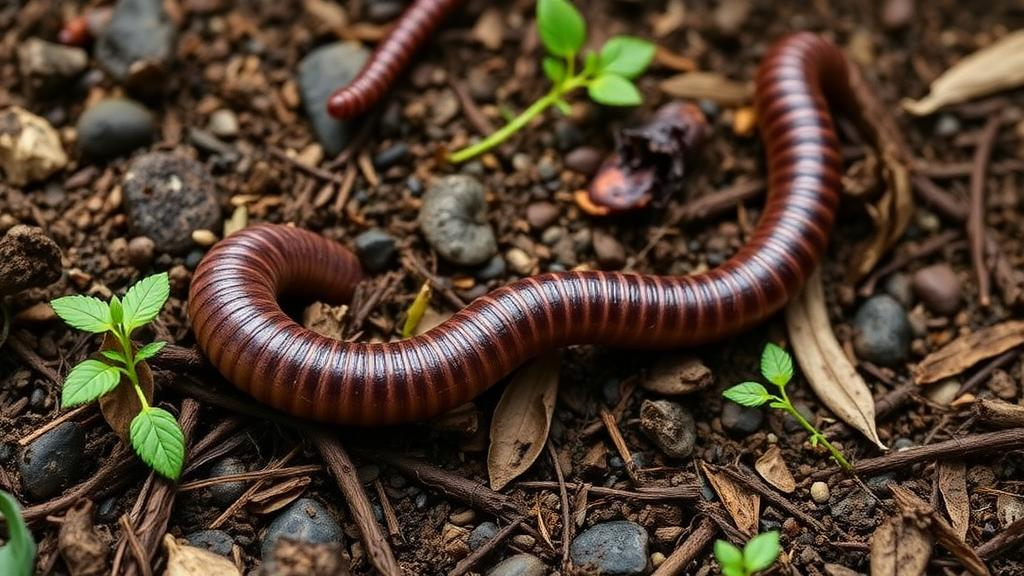
Deep in the hilly state of Manipur, within one of the planet’s most biologically rich regions, an unassuming invader is rewriting the rules of forest ecology. Pontoscolex corethrurus, an earthworm native to South America, has established thriving populations in two protected subtropical forests that have experienced remarkably little human disturbance. The finding, published in the journal Discover Ecology, challenges a long-standing assumption in invasion biology: that exotic species need disturbed, degraded habitats to gain a foothold. Instead, this worm appears to be colonizing some of the most intact forest ecosystems in Northeast India, raising urgent questions about the future of native soil biodiversity in the Indo-Burma biodiversity hotspot.
The research team, led by Rojen Singh Thounaojam of Manipur University, spent the entirety of 2018 sampling earthworms and soils at two contrasting forest sites in the Imphal region. Site I was a reserved mixed forest in Imphal West district, while Site II was a community-protected mixed forest in Imphal East. Both sit within a subtropical monsoon climate that delivers an average annual rainfall of 1325.7 millimeters, with a wet season from June to October, a hot summer from March to May, and a cool, dry winter from November to February. The soils at both sites were sandy loam, and the vegetation included familiar subtropical trees such as Lithocarpus dealbatus, Gmelina arborea, Pinus kesiya, and Schima wallichii.
The sampling protocol was deliberately rigorous. Each month, the researchers demarcated six random plots of one square meter at each site, and within each plot they excavated four soil monoliths measuring 25 by 25 by 30 centimeters. Over the year, this yielded 72 quadrats per site, with earthworms extracted by digging and hand-sorting following the standard Tropical Soil Biology and Fertility method. Specimens were preserved in formalin and identified under stereo zoom microscopes using established taxonomic keys. Alongside the biological sampling, the team recorded soil temperature in situ each month, measured pH in soil-water suspensions, and determined moisture content gravimetrically.
What emerged from this year-long effort was a community profile that surprised the researchers. Site I harbored seven earthworm species belonging to six genera and four families, while Site II supported five species in four families. The Megascolecidae family dominated the species lists at both sites. Shannon diversity indices of 1.29 at Site I and 1.17 at Site II indicated modestly higher diversity at the reserved forest. But the headline result concerned the exotic component of the community: at Site I, exotic species made up more than 74 percent of the earthworm community, with P. corethrurus alone accounting for 62.37 percent. At Site II, the single exotic species present, P. corethrurus, constituted 38.65 percent of the community, second only to the native Drawida nepalensis at 45.89 percent.
The ecology of P. corethrurus helps explain its success. First described in 1857 by the German naturalist Fritz Müller from Santa Catarina State in Brazil, and believed to have originated in the Guiana Shield region of South America, the species is now one of the most widely distributed tropical earthworms on Earth. According to the Drilobase database, as of July 2025 it had been recorded in tropical, subtropical, and Mediterranean zones across dozens of countries on four continents. In India, it was first reported from Kerala in 1910, likely introduced through human activity associated with cassava or rubber plantations. It has since spread to nine of India’s fifteen agro-climatic zones and to eight states in Northeast India alone.
Several biological traits make this worm a formidable invader. It tolerates an exceptionally broad range of soil conditions and climates, reproduces continuously with high fecundity and hatching success, develops quickly, and can even reproduce by parthenogenesis, meaning a single individual can found a population without a mate. In the Manipur forests, the species showed remarkable spatial and temporal versatility: it was found throughout the year, in every season, and at soil depths of up to 30 centimeters, whereas most other species were confined to the upper 10 centimeters of soil and many appeared only during the rainy season. Notably, the researchers recorded P. corethrurus active at soil temperatures as low as 15 degrees Celsius, below the previously reported minimum of 17 degrees for other parts of Northeast India.
The statistical analysis reinforced the importance of climate in structuring these communities. Soil moisture and soil temperature showed significant positive correlations with every recorded species at both sites, with correlation coefficients generally ranging from about 0.69 to 0.86, while soil pH was negatively correlated with earthworm abundance. Earthworm populations peaked during the rainy season, when elevated moisture and moderate temperatures create ideal conditions for activity and reproduction. Earthworms breathe through their skin, so moisture is a critical constraint on their distribution, and the optimal soil temperature for the species recorded in this study fell between 20.21 and 24.26 degrees Celsius, within the broader 20 to 30 degree range reported for tropical and subtropical earthworms.
Why does the dominance of an exotic worm in an undisturbed forest matter? Earthworms are ecosystem engineers, and established populations of P. corethrurus have been shown elsewhere to alter soil physical structure, modify biogeochemical processes, and reshape plant and microbial communities. By accelerating leaf litter decomposition and mixing soil in the upper layers, invasive earthworms can strip away the litter layer, increase soil bulk density, and reduce soil carbon content, carbon-to-nitrogen ratios, and cation exchange capacity, ultimately degrading forest soil fertility. The density of P. corethrurus is often inversely correlated with the density of other earthworm species, and previous studies have documented the displacement of native earthworms following the establishment of exotic populations. The Manipur findings suggest a real risk that native species at these sites could decline over time.
Yet the story is not one of inevitable defeat for the natives. The native Drawida nepalensis maintained high population densities even in communities dominated by exotics, and it was the most abundant species at Site II, where natives predominated. A parallel pattern has been reported in pineapple plantations in West Tripura, where the native Drawida assamensis outcompeted P. corethrurus, apparently thanks to superior survival and competitive ability. Endogeic earthworms, which live within the soil rather than on its surface, are also known to be the most resistant ecological group to disturbance. These observations hint that some native lineages may possess the competitive arsenal to coexist with, or even resist, the invader, although the researchers caution that long-term coexistence may ultimately depend on how much habitat modification the exotic species causes.
How the worm reached these protected forests remains a question of pathways rather than capability. Earthworms disperse on their own less than 10 to 15 meters per year, so human-mediated transport is almost certainly responsible. Cocoons and worms can hitchhike in soil on vehicle tires, in potted plants, in streams and surface water, or on birds and mammals. In Manipur specifically, the authors point to a worrying and largely unregulated trend: the booming use of exotic earthworms, particularly Eisenia andrei and Eisenia fetida, for vermicomposting, with little ecological oversight or public awareness of the risks of escape and establishment. The team calls for immediate policy formulation, monitoring protocols, and public education to protect native soil biodiversity. As the invasion of P. corethrurus proceeds even in undisturbed forests, the study stands as a warning that no ecosystem, however pristine, is automatically safe from a determined, parthenogenetic, climate-tolerant invader moving quietly beneath our feet.
Subject of Research: Invasion of protected subtropical forests in Northeast India by the exotic earthworm Pontoscolex corethrurus
Article Title: Assessment of Pontoscolex corethrurus, an exotic earthworm, in contrasting protected subtropical forest habitats in North-East India
Article References: Thounaojam, R. S., Singh, K. B., Singh, T. B., Keisham, S., & Singh, T. B. (2025). Assessment of Pontoscolex corethrurus, an exotic earthworm, in contrasting protected subtropical forest habitats in North-East India. Discover Ecology, 1(1), Article 10. https://doi.org/10.1007/s44396-025-00010-z
Image Credits: AI Generated
DOI: 10.1007/s44396-025-00010-z
Keywords: Pontoscolex corethrurus, invasive species, earthworms, soil biodiversity, Manipur, Northeast India, Indo-Burma biodiversity hotspot, subtropical forest, soil ecology, ecosystem engineers, vermicomposting, species invasion
Cite Scienmag News
Patricia Pace. (October 1, 2026). Invasive South American Earthworm Quietly Takes Over Protected Forests in Northeast India. Scienmag. https://scienmag.com/invasive-south-american-earthworm-quietly-takes-over-protected-forests-in-northeast-india/
Patricia Pace. "Invasive South American Earthworm Quietly Takes Over Protected Forests in Northeast India." Scienmag, 1 October 2026, https://scienmag.com/invasive-south-american-earthworm-quietly-takes-over-protected-forests-in-northeast-india/. Accessed 1 October 2026.
Patricia Pace. "Invasive South American Earthworm Quietly Takes Over Protected Forests in Northeast India." Scienmag. October 1, 2026. https://scienmag.com/invasive-south-american-earthworm-quietly-takes-over-protected-forests-in-northeast-india/


