


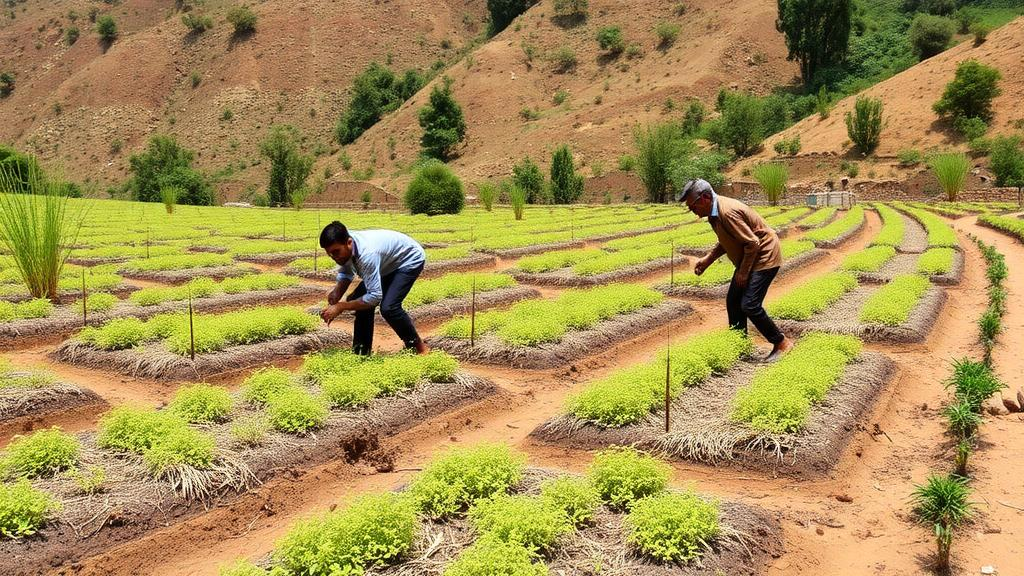
A sweeping survey of 360 farming households across six districts of Himachal Pradesh has delivered some of the strongest economic evidence yet that chemical-free agriculture can outperform conventional, input-intensive farming in mountain environments. The study, published in the journal Environmental Challenges, compared natural farming systems built on homemade biological preparations with chemical farming across the summer Kharif and winter Rabi seasons, and found that in most crop combinations the natural approach cut cultivation costs while delivering equal or dramatically higher net returns per hectare.
The research comes at a pivotal moment for Indian agriculture. The Green Revolution transformed the country’s food security, lifting wheat production from roughly 10 million tonnes in 1960 to more than 100 million tonnes by 2020, but it did so through synthetic fertilizers, pesticides, and high-yielding varieties that carried hidden ecological costs. According to the UN Convention to Combat Desertification, more than 30 percent of India’s land area is now degraded, driven by extensive pesticide use, water and wind erosion, and vegetation decline. The Food and Agriculture Organization has warned that if current trends continue, as much as 90 percent of the world’s topsoil could be at risk of erosion by 2050, a threat that lands with particular force on the fragile slopes of the Himalayas.
Himachal Pradesh offers an ideal testing ground for alternatives. Nearly 90 percent of the state’s population is rural, 87 percent of its farmers are small or marginal, and agriculture employs over 65 percent of the workforce while contributing about 13 percent of the Gross State Domestic Product. The apple industry alone generates roughly 456 million US dollars annually, and off-season vegetable cultivation adds another 522 million dollars. Yet concerns over pesticide exposure have grown acute: a 2023 meeting of 100 cancer specialists in Shimla called for strict regulations on pesticide use, citing elevated cancer rates in the region. In response, the state government has championed Subhash Palekar Natural Farming, an agroecological approach that eliminates synthetic inputs entirely and relies on farm-derived resources such as Jeevamrit, a fermented microbial culture, Beejamrit for seed treatment, Ghanjeevamrit, and botanical sprays known as Agniaster and Neemaster.
The research team, led by Rohit Kumar Vashishat and colleagues, purposively selected six districts—Solan, Sirmaur, Kangra, Hamirpur, Mandi, and Una—spanning diverse agro-ecological zones. From district lists of trained natural farmers, they drew 60 households per district through simple random sampling, yielding 360 farms surveyed during the 2023–24 agricultural year. Crucially, because natural farming adoption in the state is gradual, most sampled farmers were simultaneously practicing both systems on different plots. This enabled a within-household comparison: each farmer’s natural farming economics were contrasted with their own chemical farming experience on adjacent land, controlling for the confounding effects of management skill, soil, and market access that plague between-farm comparisons.
The structural differences between the systems were striking. Every natural farming household practiced intercropping, and every cropping system included at least one leguminous crop to boost biological nitrogen fixation and soil fertility. Dominant summer combinations included maize with black gram (27 percent of households), maize with French bean (26 percent), and tomato–capsicum–French bean mixtures (16.7 percent). Winter systems centered on wheat with pea (30 percent) and wheat with chickpea (23 percent). Mulching with crop residues conserved soil moisture, while a technique called Whapasa—managing soil moisture and aeration through reduced irrigation frequency—replaced conventional watering schedules. Natural farming plots achieved a cropping intensity of 197 percent, meaning nearly two crops were harvested per unit of sown land each year, compared with 184 percent under chemical farming.
To compare the productivity of diverse intercrop mixtures against single crops, the researchers converted multi-crop yields into a crop equivalent yield using prevailing market prices. The results were emphatic. In the Kharif season, natural farming combinations outyielded their chemical counterparts by 6 to 154 percent in most cases. The maize–French bean system reached an equivalent yield of 11.7 tonnes per hectare against 5.2 tonnes for chemically grown French bean alone, while the sugarcane–French bean–turmeric combination posted an extraordinary 133.5 tonnes per hectare versus 80.8 tonnes for chemical sugarcane. In the Rabi season, every natural farming combination outperformed its chemical counterpart except wheat–pea, which fell short of chemically grown sole-crop pea. The exceptions clustered in vegetable–pulse mixes, where capsicum and pea performed slightly better as chemically grown monocrops.
The economics told an even more compelling story. Cultivation costs under natural farming were lower in nearly every comparison: the tomato–capsicum–French bean system cost 858 dollars per hectare against 1,300 dollars under chemical management, a 51 percent reduction, while maize–French bean costs fell 29 percent and wheat–pea–mustard costs dropped 37 percent in winter. The single exception was capsicum–French bean, where natural farming ran 4 percent more expensive, likely due to higher labour demands in vegetable intercropping. Net returns followed suit. Maize–French bean returned 1,919 dollars per hectare under natural farming, a 197 percent increase over chemical French bean, and the sugarcane–French bean–turmeric system earned 5,307 dollars per hectare, 140 percent above chemical sugarcane. The most dramatic gain came in winter, where wheat–pea–cauliflower returned 1,648 dollars per hectare—a 490 percent increase over chemically grown wheat’s 279 dollars. Only wheat–pea–mustard lost money relative to chemical mustard, returning 29 percent less.
What drives this performance? The team deployed a Cobb-Douglas production function alongside machine learning tools—LASSO regression and Random Forest modelling—to disentangle the contribution of each natural farming input. Three inputs emerged as statistically significant productivity engines: Ghanjeevamrit, Agniaster, and seed, with production elasticities of 0.340, 0.323, and 0.315 respectively. Random Forest analysis independently ranked seed and Agniaster as the most influential predictors of output, corroborating the econometric result. Conversely, labour showed a significant negative elasticity of −0.294, and Beejamrit was also negative, suggesting these resources were being over-applied relative to their marginal returns. Efficiency ratios based on marginal value products confirmed the pattern: Agniaster scored highest at 0.538, followed by Ghanjeevamrit at 0.486 and seed at 0.425, while labour, Beejamrit, and Jeevamrit registered negative ratios. The authors note this points to a clear opportunity—natural farming’s profitability depends less on applying every traditional preparation uniformly and more on allocating the right inputs efficiently.
Why do farmers switch? Garrett ranking of adoption factors placed low cost of production first, followed by locally available resources requiring no purchased external inputs, enhanced soil health, increased yields, and reduced irrigation requirements. Chemical-free produce quality, lower crop failure risk, freedom from farm credit debt, and the revival of traditional knowledge rounded out the top motivations. The findings arrive as Himachal Pradesh scales its CETARA-NF farmer self-certification system and targets 20,000 hectares under natural farming. The authors caution that their evidence is specific to Himalayan agroecological systems and should not be generalized without validation elsewhere, and they call for long-term research on soil health, water use, and greenhouse gas emissions. But for the smallholders who dominate mountain agriculture, the message is concrete: diversifying crops, brewing local biological inputs, and cutting purchased chemicals can simultaneously lower financial risk and raise household income—a combination few agricultural technologies have achieved.
Subject of Research: Comparative economic and resource-use efficiency analysis of natural farming versus chemical farming systems in the Western Himalayas
Article Title: Resource-efficient sustainable farming systems: A comparative study of natural and chemical farming practices in Western Himalayas
Article References: Vashishat, R. K., Divyanshu, Sharma, S., Dev, I., Chandel, R. S., Chandel, A., Shraddha, Yang, X.-M., András, K., & Khargotra, R. (2026). Resource-efficient sustainable farming systems: A comparative study of natural and chemical farming practices in Western Himalayas. Environmental Challenges, 25, Article 101668. https://doi.org/10.1016/j.envc.2026.101668
Image Credits: AI Generated
DOI: 10.1016/j.envc.2026.101668
Keywords: natural farming, Himachal Pradesh, sustainable agriculture, intercropping, Subhash Palekar Natural Farming, resource-use efficiency, Cobb-Douglas production function, net returns, soil health, Western Himalayas, pesticides, smallholder farmers
Cite Scienmag News
Alan Morgan. (October 1, 2026). Natural Farming Outearns Chemical Agriculture in the Western Himalayas, Landmark Survey Finds. Scienmag. https://scienmag.com/natural-farming-outearns-chemical-agriculture-in-the-western-himalayas-landmark-survey-finds/
Alan Morgan. "Natural Farming Outearns Chemical Agriculture in the Western Himalayas, Landmark Survey Finds." Scienmag, 1 October 2026, https://scienmag.com/natural-farming-outearns-chemical-agriculture-in-the-western-himalayas-landmark-survey-finds/. Accessed 4 October 2026.
Alan Morgan. "Natural Farming Outearns Chemical Agriculture in the Western Himalayas, Landmark Survey Finds." Scienmag. October 1, 2026. https://scienmag.com/natural-farming-outearns-chemical-agriculture-in-the-western-himalayas-landmark-survey-finds/


