


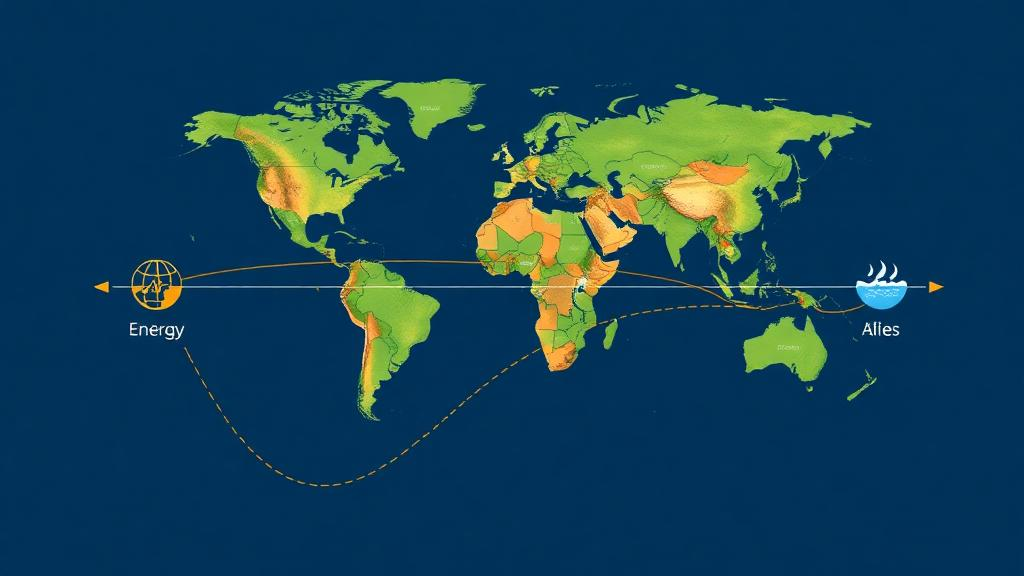
Every major decision about the future of energy ripples outward into water tables, farmland, mines and human health, yet most computer models used to plan that future treat these domains as separate worlds. A new study published in the Journal of Industrial Ecology by Koji Tokimatsu, Rieko Yasuoka and Shinjiro Kanae of Institute of Science Tokyo proposes a way to end that fragmentation. The researchers have built an interlinked global model that couples a life cycle impact assessment framework, known as LIME3, with an integrated assessment model covering water, energy, minerals, land and food simultaneously. They then ran the coupled system from the present day to the year 2100 under a scenario in which global warming is held below two degrees Celsius, producing one of the most comprehensive long-range pictures yet of how a decarbonizing world would strain and reshuffle the planet’s resources.
The intellectual foundation of the work is the resource nexus, a concept that has evolved over four decades. Its origins trace to the United Nations University’s Food–Energy Nexus Program in the early 1980s, and it was broadened at the 2002 World Summit on Sustainable Development in Johannesburg to include water, energy, health, agriculture and biodiversity. The water–energy–food nexus was formally conceptualized at the Bonn2011 conference, the same year the World Economic Forum published a report on water security across the food, energy and climate nexus. By 2018, the Routledge Handbook of the Resource Nexus had consolidated the idea into what its editors called the five-node nexus of energy, minerals, food, land and water. Yet as the new study’s authors note, systematic reviews of the field have found the concept ambiguous and its models partial: nearly every existing analysis covers only a subset of the five nodes, or only a specific region, or only a short time horizon.
The technical novelty of the Tokyo team’s framework lies in its hybrid architecture. Four bottom-up resource balance models, covering energy, minerals, land and now water, are nested inside a top-down macroeconomic structure that maximizes social welfare. The bottom-up models describe the actual technologies that convert primary resources into final goods: power plants, mines, farms, water treatment facilities. The macroeconomic layer then feeds back, so that the costs of supplying resources and the environmental damages they cause subtract from gross domestic product, which in turn drives future demand. This feedback mechanism distinguishes the model from prominent integrated assessment models such as ReMIND and WITCH, which lack such loops. The researchers adapted the water module from the TIAM-FR water model, incorporating supply channels that include pumped water, desalination, treated wastewater, saline and brackish water and rainwater, each constrained by annual precipitation volumes drawn from the FAO’s AQUASTAT database.
The most distinctive feature is the full integration of LIME3, a life cycle impact assessment method whose damage factors translate physical inventories, such as tonnes of sulfur dioxide emitted or hectares of land converted, into endpoint damages to human health, natural resources, biodiversity and net primary productivity. These damages are then monetized using marginal willingness-to-pay values derived from large-scale surveys of roughly 10,000 respondents across G20 countries and Asia, and extrapolated forward with income elasticity parameters in the manner of cost–benefit models like DICE and FUND. Because the monetized damages are internalized into total system costs, the model can price environmental harm into its economic optimization, something earlier LCA-linked modeling efforts, which reported damages only as non-monetary endpoints, could not do.
Water enters the human-health accounting through two carefully specified causal chains. The first links domestic water scarcity to infectious disease: insufficient supply erodes access to safe water, which raises the incidence of diarrhea, ascariasis, trichuriasis and hookworm disease, with risks modulated by temperature, sanitation connections, nutrition and health expenditure. The second chain connects agricultural water shortage to malnutrition, as crop losses are only partially offset by food stocks, global trade and economic adaptation. Characterization factors for these damages were regressed globally as a function of per capita agricultural water withdrawal. Notably, the model treats water demands from the energy sector, for power generation, fuel production and hydrogen, as fully satisfied, and excludes industrial water from the health impact chains, a simplification the authors acknowledge as a limitation.
Running the model under a business-as-usual baseline calibrated to the SSP-2 socioeconomic pathway, the researchers then imposed a two-degree carbon constraint. Under the baseline, greenhouse gas emissions rise until about 2040, peak, and stabilize after 2060. Under the climate target, net carbon dioxide emissions must peak by 2030 and decline steadily to 2080. The model finds that the largest contribution to negative emissions comes from forest carbon sequestration, followed by carbon capture and storage applied to fossil fuels producing hydrogen and power, and bioenergy with carbon capture and storage in the non-power sector. The energy system shifts dramatically: fossil fuels without capture are slashed in both power and non-power sectors, while renewables such as geothermal, tidal and wind, along with nuclear, expand sharply in electricity generation.
The resource consequences of that transition are striking. Meeting the two-degree target requires expanding forest land for carbon sequestration, which reshapes grasslands in major livestock-producing regions and alters agricultural water use: rainfed agriculture grows because it demands less energy, while irrigated agriculture shrinks because pumping freshwater is energy-intensive. Meanwhile, the renewable build-out drives significant increases in cumulative mining of bauxite, copper and iron by 2100, with copper demand driven largely by vehicles and power transmission, zinc by wind power, and iron by nuclear construction. Lead demand from batteries falls as electric and fuel cell vehicles displace conventional ones. The mineral balance model also reflects an industrial ecology insight: as ore grades degrade, the energy required per tonne of metal rises, feeding back into the energy system.
Perhaps the study’s most consequential finding concerns what the five-node nexus diagram leaves out. The carbon budget, the finite quantity of carbon dioxide the atmosphere can absorb before warming thresholds are breached, does not appear anywhere in the classic nexus illustrations, yet the model shows it functioning as a genuinely scarce resource. Causal chains radiate from the carbon budget to land and energy, and from there reach water not only through food but also through bio-resources and biodiversity and through minerals. The chain running from food to water causes the largest changes in water use, while chains from energy and minerals are comparatively minor. The monetized results add a second hidden resource: human health. The largest external costs flow through land-use change and climate change, followed by local air pollution, whose damages fall substantially as coal combustion declines, partly because carbon capture systems must remove particulate contaminants anyway.
The team also tested the political realism of their scenario by delaying global cooperation. In variants where emissions follow the baseline until 2030 or 2040 before pivoting to the target, the required emissions trajectories become steeper, yet most outcomes, water demand, environmental costs, energy supply and cumulative mining, remain broadly similar to the original pathway, with drastic changes appearing only under a delay to 2050. This resilience offers a measure of reassurance, though the authors caution that their water impact assessment captures only health effects of diarrhea and malnutrition, excluding economic damages from industrial shortages and other chains. They frame the work as a first step toward bridging the long-standing gap between the integrated assessment modeling and industrial ecology communities, a divide that researchers such as Stefan Pauliuk and colleagues have repeatedly highlighted.
The implications reach beyond academia. The latest assessment of the Intergovernmental Science-Policy Platform on Biodiversity and Ecosystem Services has emphasized the interconnections among biodiversity, water, food, climate and health, and the Tokyo model maps many of those same linkages in quantitative, monetized form. From a material-scarcity perspective, the study suggests that climate policy is not merely an energy problem: it is simultaneously a land problem, a mining problem, a water problem and a public health problem, and the trade-offs among them can now be traced through explicit causal chains to the end of the century. The authors note that a water-focused view of the same system, grounded in general circulation models and detailed hydrology, could yield substantially different conclusions, and they propose linking such models to their framework in future work, potentially incorporating advanced desalination technologies. For now, the model stands as an argument that the nexus is not a buzzword but a measurable structure, one in which the atmosphere’s carbon budget quietly governs the fate of forests, fields, mines and the people who depend on them.
Subject of Research: An interlinked global life cycle impact assessment and integrated assessment model of the water–energy–mineral–land–food resource nexus under a 2°C climate scenario to 2100
Article Title: Proposal for an interlinked global model of LCIA and IAM for the water–energy–mineral–land nexus: global case study until 2100 for meeting the 2-degree Celsius scenario
Article References: Tokimatsu, K., Yasuoka, R., & Kanae, S. (2026). Proposal for an interlinked global model of LCIA and IAM for the water–energy–mineral–land nexus: global case study until 2100 for meeting the 2-degree Celsius scenario. Journal of Industrial Ecology. https://doi.org/10.1007/s44498-026-00106-z
Image Credits: AI Generated
DOI: 10.1007/s44498-026-00106-z
Keywords: resource nexus, integrated assessment model, life cycle impact assessment, LIME3, water-energy-food nexus, 2-degree scenario, carbon budget, critical minerals, land use, human health, decarbonization, industrial ecology
Cite Scienmag News
Sloane Callahan. (October 1, 2026). Global Model Links Water, Energy, Minerals and Land to Chart the Path to 2 Degrees. Scienmag. https://scienmag.com/global-model-links-water-energy-minerals-and-land-to-chart-the-path-to-2-degrees/
Sloane Callahan. "Global Model Links Water, Energy, Minerals and Land to Chart the Path to 2 Degrees." Scienmag, 1 October 2026, https://scienmag.com/global-model-links-water-energy-minerals-and-land-to-chart-the-path-to-2-degrees/. Accessed 4 October 2026.
Sloane Callahan. "Global Model Links Water, Energy, Minerals and Land to Chart the Path to 2 Degrees." Scienmag. October 1, 2026. https://scienmag.com/global-model-links-water-energy-minerals-and-land-to-chart-the-path-to-2-degrees/


