


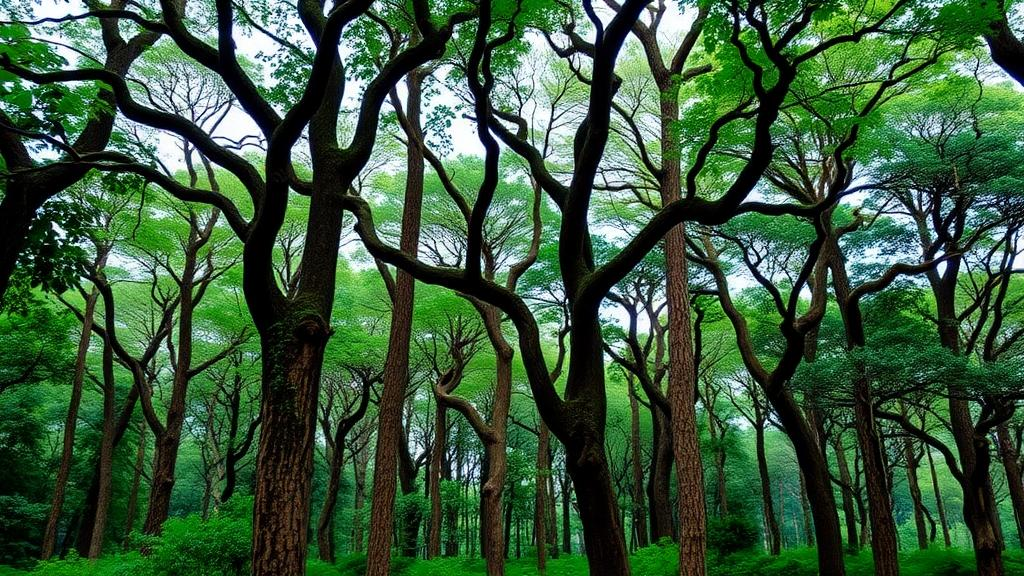
In the tropical dry forests of central India, a quiet demographic contest has been unfolding for three decades, and a new study has finally put numbers on it. Researchers tracked tree regeneration across eight long-term Preservation Plots in Madhya Pradesh and Chhattisgarh, comparing the size structure of 101 tree species in 1991 and again in 2021. Their findings, published in Regional Environmental Change, show that the forests’ future composition is being shaped less by dramatic die-offs and more by subtle, species-by-species shifts in how successfully young trees recruit into adult populations. The results carry a warning for forest managers: some of the region’s most ecologically valuable late-successional species are showing the weakest regeneration signals, while fast-growing, light-demanding pioneers are holding their ground or improving.
The methodological heart of the study is a metric called the size class distribution slope, or SCD slope. In a healthy, regenerating tree population, the number of individuals declines smoothly and predictably as size increases: many seedlings and saplings, fewer poles, and a handful of large canopy trees. When this relationship is plotted on a log scale, it produces a characteristic downward-sloping line. A steep negative slope indicates abundant young recruits but few adults, often a sign of vigorous regeneration or high adult mortality. A flattened or positive slope suggests the opposite: a population dominated by large, old individuals with too few youngsters coming up behind them, a demographic profile that portends eventual local decline.
By calculating these slopes for every species in both census years and then computing the change between them, a quantity the authors call delta SCD, the team created a thirty-year regeneration scorecard for each of the 101 species. This approach, long used in tropical forest dynamics plots from Barro Colorado Island to Mudumalai, turns static inventory data into a dynamic picture of forest trajectory. Crucially, it requires no felling, no growth rings, and no repeated measurement of individual trees, making it an unusually cost-effective monitoring tool for tropical forests where resources for long-term ecological research are scarce.
The trait-based analysis is where the story becomes genuinely revealing. The researchers sorted species into functional groups based on well-established ecological classifications, distinguishing light-demanding from shade-tolerant species and early-successional from late-successional ones. The pattern that emerged was consistent with theory: light-demanding, early-successional species, which thrive in canopy gaps and disturbed sites, generally showed positive or less negative changes in their SCD slopes, indicating maintained or improving regeneration. Shade-tolerant and several late-successional species, by contrast, tended to hold relatively more negative values, suggesting that their recruitment pipelines are thinning even as adult trees persist. In a forest experiencing rising temperatures and increasingly erratic monsoon rainfall, the shade-tolerant specialists that define mature forest structure may be slowly losing their foothold.
Yet the study’s most scientifically honest finding is a negative one. When the researchers built regression models and mixed-effects models to predict delta SCD from functional traits, the models explained only a small fraction of the variation. Functional traits, in other words, are a useful lens but a weak crystal ball. Knowing whether a species demands light or tolerates shade tells you something about the direction of its regeneration trend, but not enough to predict the trajectory of any individual species with confidence. This limitation matters for the growing field of trait-based ecology, which often promises to scale from measured traits to ecosystem-level forecasts. The central Indian data suggest that unmeasured factors, from seed dispersal dynamics and soil heterogeneity to disturbance legacies and biotic interactions, carry as much or more weight than the traits ecologists routinely measure.
The climatic context the researchers documented is sobering in its own right. Across the preservation plots, analyses revealed significant decadal variation in temperature, rainfall, and relative humidity over the study period. Notably, temporal effects, meaning changes through time, proved stronger than site effects, meaning differences between locations. This is an important result for a region where the monsoon system is known to be shifting: studies have documented a threefold rise in widespread extreme rain events over central India, alongside changes in the frequency of dry spells during the summer monsoon. Central Indian forests, which sit in the transition zone between moist and dry tropical forest types, are considered particularly sensitive to such hydroclimatic swings, and the new decadal climate data provide exactly the environmental backdrop against which the regeneration signals should be read.
The authors are careful, appropriately, about how far to push the climate connection. Their analyses show that climate has changed and that regeneration patterns have changed, but demonstrating direct trait-by-climate causation would require a different experimental and statistical apparatus. Tree regeneration is a slow, multi-stage process, filtered by seed production, germination, seedling survival, and sapling growth, each stage responsive to different combinations of light, moisture, and temperature. Vapor pressure deficit, which has risen globally and is known to stress tropical trees, interacts with soil moisture in ways that vary enormously across microsites. The study therefore positions its climatic findings as essential context and a call for cautious interpretation rather than a definitive attribution, a stance that reflects the genuine complexity of disentangling climate signals from demographic noise in long-lived organisms.
What the study does offer, and offers convincingly, is a practical framework for forest management under uncertainty. By combining SCD-based monitoring with functional trait information, forest departments can triage their species: identify which groups are regenerating robustly and which are drifting toward demographic deficit, and then concentrate site-specific interventions where they matter most. For species showing persistently negative delta SCD values, options might include assisted regeneration through enrichment planting, protection of seedlings from grazing and fire, or targeted canopy manipulation to create recruitment opportunities for shade-intolerant champions. The preservation plot network in Madhya Pradesh, established in the early 1990s by the Tropical Forest Research Institute, proves its worth here: without three decades of standardized inventory, none of these signals would be detectable at all.
The broader implications stretch well beyond central India. Tropical dry forests cover vast areas of the tropics, are among the most heavily used and least protected forest types on Earth, and are projected to face some of the sharpest climate-driven changes in the coming decades. Global syntheses have already documented rising tropical tree mortality under increasing atmospheric water stress, and climate-driven risks now threaten the carbon mitigation potential of forests worldwide. Whether dry tropical forests can shift their composition toward more drought-tolerant, regenerative species assemblages, and do so fast enough to keep pace with climate change, is one of the defining ecological questions of the century. This study contributes a rare empirical data point: a thirty-year, species-level record showing that the composition of a tropical forest’s next generation is already diverging from its current one.
For the forests of central India, the message is one of watchful urgency. The canopy may look intact, and the large trees of today’s forest will stand for decades yet, but the seedling and sapling layers tell a different story about tomorrow. Light-demanding pioneers appear positioned to persist, while the shade-tolerant, late-successional species that give mature forests their structure and much of their biodiversity are quietly failing to replace themselves at the needed rates. Combined with documented decadal shifts in temperature, rainfall, and humidity, the demographic evidence suggests these forests are not waiting for some future climate to arrive before they begin reorganizing. They are reorganizing now, one seedling at a time, and only sustained, trait-informed monitoring will reveal whether the forests of 2060 resemble the forests of 1991, or something new entirely.
Subject of Research: Trait-mediated tree regeneration dynamics and climate influences on forest size class structure in central Indian tropical forests
Article Title: Trait-mediated regeneration dynamics and climatic influence on tree size class distribution in central Indian tropical forests
Article References: Kewat, A. K., Singh, S., Kumar, P., Khanduri, A., Kumar, A., Kumar, R., & Chand, H. B. (2026). Trait-mediated regeneration dynamics and climatic influence on tree size class distribution in central Indian tropical forests. Regional Environmental Change, 26(3), Article 177. https://doi.org/10.1007/s10113-026-02660-5
Image Credits: AI Generated
DOI: 10.1007/s10113-026-02660-5
Keywords: tropical dry forests, tree regeneration, size class distribution, functional traits, climate variability, central India, forest monitoring, early-successional species, shade tolerance, monsoon rainfall, forest management, long-term ecological research
Cite Scienmag News
Sloane Callahan. (October 1, 2026). Thirty Years of Forest Data Reveal Which Indian Trees Are Winning the Race to Regenerate. Scienmag. https://scienmag.com/thirty-years-of-forest-data-reveal-which-indian-trees-are-winning-the-race-to-regenerate/
Sloane Callahan. "Thirty Years of Forest Data Reveal Which Indian Trees Are Winning the Race to Regenerate." Scienmag, 1 October 2026, https://scienmag.com/thirty-years-of-forest-data-reveal-which-indian-trees-are-winning-the-race-to-regenerate/. Accessed 4 October 2026.
Sloane Callahan. "Thirty Years of Forest Data Reveal Which Indian Trees Are Winning the Race to Regenerate." Scienmag. October 1, 2026. https://scienmag.com/thirty-years-of-forest-data-reveal-which-indian-trees-are-winning-the-race-to-regenerate/


