


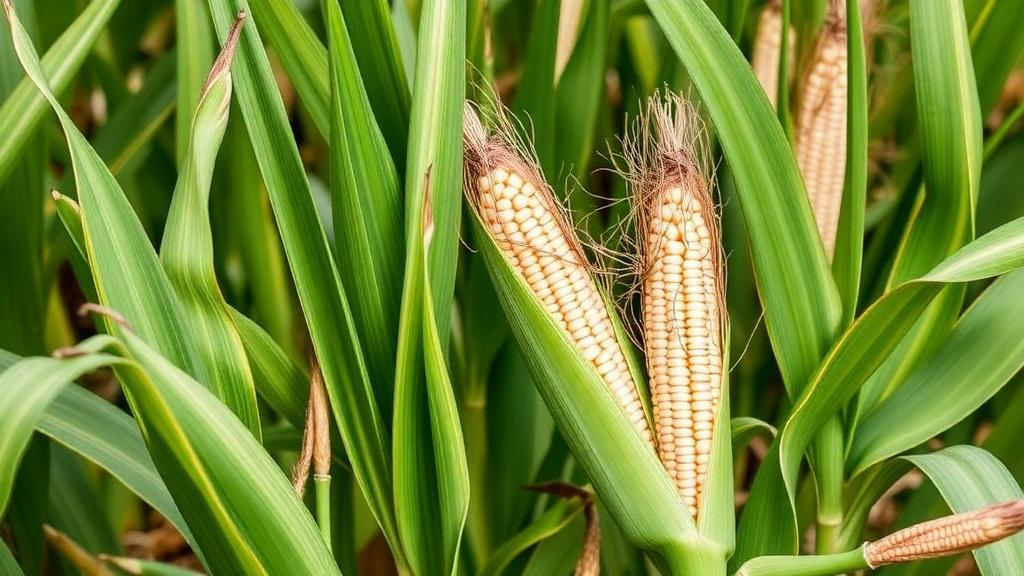
When humans first domesticated maize from its wild ancestor teosinte roughly nine thousand years ago, they were selecting for bigger kernels, less branching, and easier harvests. But according to a new study published in Nature Plants, something far less visible was also being shaped by that ancient process: the ability of the plant to survive in salty soil. A team of researchers led by Caifu Jiang at China Agricultural University has discovered that modern maize is markedly more tolerant of salt than teosinte, and they have traced that difference to a single genetic module that was positively selected during domestication. The finding not only rewrites part of the evolutionary story of one of the world’s most important crops, but also hands breeders a precise molecular target for developing salt-resilient cultivars at a time when soil salinity is steadily eroding global farmland.
The research began with a deceptively simple observation. When the team compared modern maize, represented by the W22 inbred line, with its wild progenitor teosinte, represented by the T8759 accession, the differences under salt stress were striking. Modern maize seedlings maintained their growth far better when sodium chloride was added to their growing medium, while teosinte seedlings suffered severe growth inhibition. Because the damage inflicted by salt stress is driven largely by the accumulation of sodium ions in the shoot, the researchers measured shoot sodium content in both species and found that teosinte accumulated substantially more sodium in its aboveground tissues. This pointed to a defect in what plant physiologists call shoot sodium exclusion, the process by which a plant keeps toxic sodium ions out of its leaves and stems, where they would otherwise interfere with photosynthesis and enzyme function.
To find the gene responsible, the team turned to a powerful genetic resource: a recombinant inbred line population derived from a cross between W22 maize and T8759 teosinte. By crossing and repeatedly self-fertilizing these hybrids, researchers generate lines in which small random chunks of the two parental genomes are shuffled together like a mosaic. When these lines are grown under salt stress, statistical associations between particular genomic regions and the observed salt tolerance reveal the locations of the underlying genes, a technique known as quantitative trait locus mapping. This analysis converged on a region harboring a gene called MYB28, which encodes a transcription factor, a type of protein that binds to DNA and controls the activity of other genes. The mapping data identified MYB28 as a major genetic determinant of the divergence in shoot sodium content and salt tolerance between the two species.
The mechanistic story that emerged is more intricate than a simple gain or loss of function. MYB28, it turns out, is a transcriptional repressor: it acts as a brake on salt tolerance by impairing the plant’s ability to exclude sodium from its shoots. In teosinte, this brake is locked firmly on. In modern maize, however, salt stress triggers a second player, a protein kinase called CIPK20. Protein kinases are enzymes that attach phosphate groups to other proteins, a common cellular strategy for switching protein activity on or off. The researchers showed that salt stress activates CIPK20, which then phosphorylates MYB28, and this phosphorylation relieves the repressor’s grip, allowing the salt tolerance machinery to operate. In other words, modern maize has evolved a regulatory release valve: the repressor is still present, but salt stress neutralizes it exactly when it matters.
The critical difference between the two species boils down to a single letter of the genetic code. A non-synonymous single nucleotide polymorphism, designated SNP1409T, changes one amino acid in the MYB28 protein, specifically a tryptophan residue at position 341 that becomes glycine in the teosinte version. This single substitution, the team demonstrated, disrupts the regulation of MYB28 by CIPK20. In teosinte, even when salt stress activates CIPK20, the phosphorylation fails to relieve the repression, leaving the sodium exclusion machinery throttled and the plant salt-sensitive. Structural modeling using the AlphaFold protein prediction system supported the functional importance of this region of the protein. The elegance of the finding lies in its economy: a single amino acid change converts a rigid repressor into a regulatable one, and that conversion underlies a whole-plant trait of enormous agricultural consequence.
What does MYB28 actually repress? The researchers identified the downstream target as HAK4, a transporter belonging to the HAK family of potassium transporters, which earlier work had already implicated in natural variation of salt tolerance in maize. HAK4 mediates shoot sodium exclusion and salt adaptation, and it sits directly under the control of the CIPK20–MYB28 pathway. When CIPK20 phosphorylates MYB28 and lifts the repression, HAK4 is expressed, sodium is kept out of the shoots, and the plant thrives under saline conditions. When the pathway is broken, as in teosinte, HAK4 remains suppressed, sodium floods the shoots, and the plant suffers. This chain of command, from a salt-activated kinase through a phosphorylated transcriptional repressor to a membrane transporter, constitutes a complete signaling module, and the authors describe it as the CIPK20–MYB28–HAK4 module.
The evolutionary twist came from population genomic analysis. By surveying genetic variation across large panels of maize and teosinte, and by comparing related species, the team found that the salt-tolerant SNP1409T allele of MYB28 did not arise during domestication. It originated in ancestral teosinte populations long before humans entered the picture. During domestication, however, this allele was positively selected, meaning that early farmers, likely without knowing it, favored plants carrying the version of MYB28 that responds to salt stress with relief of repression rather than continued repression. Selective sweeps, the genetic signatures left behind when an advantageous allele spreads rapidly through a population, were detectable at this locus. The result is that modern maize carries a salt-tolerance module that was essentially a lucky draw from the wild ancestor’s gene pool, amplified by thousands of years of cultivation.
The practical payoff of that ancient selection was confirmed in the field. The researchers constructed near-isogenic lines, plants that are genetically identical except at the MYB28 locus, carrying either the maize or the teosinte version of the gene. When these lines were grown in salt-affected fields, where soil analysis confirmed abundant sodium in the topsoil, the plants carrying the maize allele maintained lower shoot sodium content, higher photosynthetic rates, and, crucially, greater yield than their teosinte-allele counterparts. This demonstrates that the molecular module identified in seedling experiments translates into real agronomic performance under realistic field conditions, a step that many laboratory studies of stress tolerance never achieve.
The broader significance of the work extends beyond maize. Soil salinity threatens crop productivity worldwide, and previous studies have shown that domestication has sometimes stripped crops of salt tolerance, as in tomato, where variation in a sodium and potassium transporter caused a loss of tolerance during domestication. The maize story shows the opposite trajectory: domestication captured and amplified an ancestral salt-tolerance allele. Together with earlier discoveries of teosinte-derived HKT1 transporter alleles and SnRK2–HAK regulatory modules that improve maize salt tolerance, the new study reveals that the wild relatives of crops remain a deep reservoir of stress-resilience genes, and that understanding the evolutionary logic of domestication can guide their deployment. For breeders, the CIPK20–MYB28–HAK4 module offers a validated, mechanistically understood target: marker-assisted selection or genome editing could, in principle, tune this pathway to produce maize cultivars that yield well on the increasingly saline soils of a changing world.
Subject of Research: A domestication-selected CIPK20–MYB28–HAK4 genetic module controlling salt tolerance divergence between modern maize and teosinte
Article Title: A domestication-selected CIPK–MYB–HAK module improves salt tolerance in modern maize
Article References: Liang, X., Yin, P., Guo, C., Zhao, Z., Liu, R., Li, Y., Zhang, C., Tian, F., Fu, X., & Jiang, C. (2026). A domestication-selected CIPK–MYB–HAK module improves salt tolerance in modern maize. Nature Plants. https://doi.org/10.1038/s41477-026-02384-8
Image Credits: AI Generated
DOI: 10.1038/s41477-026-02384-8
Keywords: maize, teosinte, salt tolerance, domestication, MYB28, CIPK20, HAK4, sodium exclusion, phosphorylation, selective sweep, plant genetics, soil salinity
Cite Scienmag News
Juliet Wilcox. (October 1, 2026). How a Single Genetic Switch Made Modern Maize Salt-Tolerant. Scienmag. https://scienmag.com/how-a-single-genetic-switch-made-modern-maize-salt-tolerant/
Juliet Wilcox. "How a Single Genetic Switch Made Modern Maize Salt-Tolerant." Scienmag, 1 October 2026, https://scienmag.com/how-a-single-genetic-switch-made-modern-maize-salt-tolerant/. Accessed 1 October 2026.
Juliet Wilcox. "How a Single Genetic Switch Made Modern Maize Salt-Tolerant." Scienmag. October 1, 2026. https://scienmag.com/how-a-single-genetic-switch-made-modern-maize-salt-tolerant/


